Key takeaways
- Compare the best salt spreaders by hopper size, spread width and material fit, from handheld units for steps to tow-behind models for long lanes.
Spreading salt or ice melt by hand with a scoop is slow, uneven and wasteful. Piles sit in one spot while the rest of the walk stays slick, and the excess ends up in the lawn. A purpose-built salt spreader meters material out at a steady rate, throws it in a controlled pattern and lets you treat a driveway in a few passes instead of a long shuffle with a bucket.
The catch is that salt is harder on equipment than fertilizer. It is heavy, often coarse, absorbs moisture from the air and corrodes bare metal. The five spreaders below are all rated by their makers for salt or ice melt work, and they cover the full range of winter jobs: a battery handheld for steps and short walks, two walk-behind hoppers for driveways and pads, a high-capacity push model, and a tow-behind unit for long lanes cleared from a tractor seat.
As an Amazon Associate, we earn from qualifying purchases.
Quick Picks
| Product | Best for | Key point |
|---|---|---|
| Chapin 81008A Salt and Ice Melt Spreader | Home driveways and walks | 80 lb hopper built only for winter material, with baffles and a spiked auger |
| Buyers Products Grounds Keeper 3039632R | Large pads and light commercial routes | 100 lb hopper, enclosed gearbox and a throw of up to 24 feet |
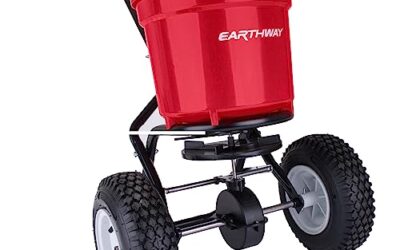
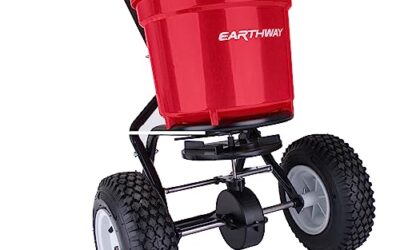
| Agri-Fab 45-0614 Push Broadcast Spreader | Big areas covered on foot | 130 lb hopper with a simple rod flow control lever |
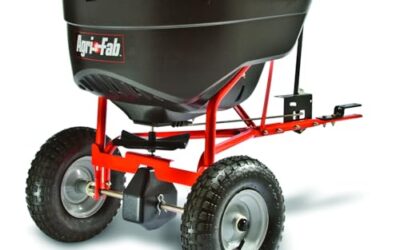
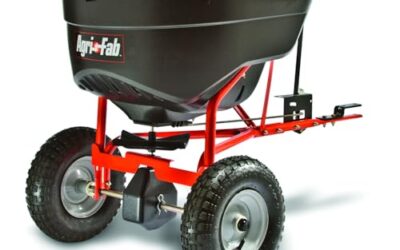
| Agri-Fab 45-0463 Tow-Behind Spreader | Long lanes and rural driveways | 130 lb hopper towed by a lawn tractor, flow set from the seat |
| Scotts Wizz Handheld Spreader | Steps, porches and short sidewalks | Battery powered handheld with EdgeGuard for tight, tidy passes |
How to Choose
Match the hopper to the area, not the other way round. Capacity drives everything else. Steps and a short walk need only a handheld that holds a few pounds at a time. A two-car driveway is comfortable work for an 80 to 100 lb walk-behind. Once you are treating a long lane, a shared parking pad or several properties, a 130 lb hopper or a tow-behind unit saves repeated trips back to the bag.
Confirm the maker rates it for salt. Many lawn spreaders are built for dry, free-flowing fertilizer and seed. Salt and ice melt are denser, sharper and often slightly damp, so look for a model whose listing names salt or ice melt as an intended material, ideally with an auger or agitator to keep it moving and a grate to catch clumps. A spreader that is not rated for salt may jam, and its gearbox may not be sealed against the grit.
Check the material you actually buy. Bagged ice melt and halite flow well through most winter spreaders. Coarse rock salt is the troublemaker: some makers, including Chapin and Scotts on the models below, specifically advise against rock salt in their units. Read the spreader manual and the bag together before the first storm, not during it.
Spread pattern control matters near lawns and beds. Salt that lands on grass and planting beds causes real damage in spring. Front and side baffles, deflectors or an edge guard let you cut off the throw on one side and keep material on the pavement. On open pads, a wider broadcast of 10 to 24 feet simply means fewer passes.
Plan for corrosion from day one. Poly hoppers shrug off salt; steel frames need a powder coat and a rinse after use. Enclosed gearboxes keep salt spray away from the gears. Whatever you buy, empty it, rinse it and let it dry before storage, because a hopper left full of damp salt will cake solid and attack every metal part it touches.
Best Options
Chapin 81008A Salt and Ice Melt Spreader

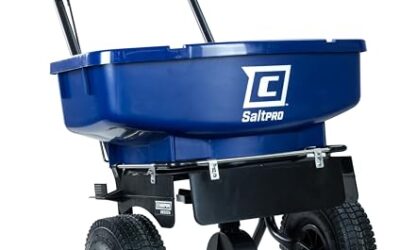
The 81008A is one of the few home-grade spreaders designed for winter work first rather than adapted from a lawn tool. Its 80 lb poly hopper sits on a powder-coated steel frame, and the flow system is built around the material: a spiked auger breaks up clumps as you walk, a salt grate sits over the hopper opening, and a snow and rain cover is included so a passing shower does not turn your load into a block.
Front and side baffles let you shape the pattern along edges, and the bail-style gate control works with either hand, which is welcome in thick gloves. The 10-inch pneumatic tires roll over packed snow and uneven pavement far better than small solid wheels. For a typical suburban driveway and front walk, this is the most winter-focused pick in the group.
Specs
- Hopper capacity 80 lb, poly hopper; powder-coated steel frame; 10-inch pneumatic wheels; spiked auger plus conical auger; front and side baffle system; enclosed gear system; salt grate and snow/rain cover included
- Best for: Homeowners treating a driveway and walks who want a spreader made specifically for salt and ice melt
- Watch out for: Chapin states this model is not recommended for rock salt; run bagged ice melt or halite instead. It can spread fertilizer, but the maker notes it lacks fertilizer calibration, so winter is its real job
- ASIN: B071ZBBJNQ
Buyers Products Grounds Keeper 3039632R

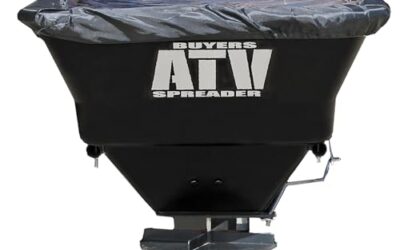
Buyers Products builds equipment for the snow and ice trade, and the Grounds Keeper brings that commercial approach to a walk-behind frame. The 100 lb poly hopper feeds an enclosed gearbox with commercial-grade alloy gears, driven by axle motion, and the fully welded carbon steel frame is powder-coated against corrosion. A hopper grate and nylon cover are included in the box.
The headline number is reach: the Grounds Keeper throws material up to 24 feet, roughly double a typical lawn spreader, and adjustable deflectors rein that width in when you work along beds or parked cars. That combination suits big residential pads, church and shop lots, and anyone who salts the same route after every storm and wants the job done in fewer passes.
Specs
- Hopper capacity 100 lb, poly hopper; spread width up to 24 ft; enclosed gearbox with commercial-grade alloy gears; fully welded powder-coated carbon steel frame; adjustable deflectors; hopper grate and nylon cover included; product dimensions 40 x 26.5 x 32 inches
- Best for: Large driveways, parking pads and light commercial routes where a wide throw cuts down passes
- Watch out for: The wide pattern is wasted and messy on narrow walks unless you close the deflectors down; it is also a big unit to store for a small property
- ASIN: B081XHFKR8
Agri-Fab 45-0614 Push Broadcast Spreader

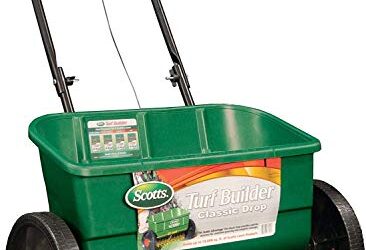
The 45-0614 is Agri-Fab’s high-capacity push spreader, and its Amazon listing names seed, fertilizer, salt and ice melt as intended materials. The 130 lb polypropylene hopper is the largest walk-behind capacity here, enough to cover up to half an acre on a fill, and the flow control is a direct rod lever that is easy to set and easy to read with gloves on.
Because it began life as a lawn and garden spreader, the design is simple and open rather than winter-sealed, so it rewards owners who rinse it after salt duty. In return you get one machine that handles spring feeding, autumn seeding and winter salting, with a 10 to 12 foot spread width that suits open ground better than tight paths.
Specs
- Hopper capacity 130 lb, polypropylene hopper; walk-behind push broadcast; spread width 10 to 12 ft; coverage up to half an acre per fill; direct rod flow control lever
- Best for: Owners of large properties who want one big spreader for lawn work in summer and salt in winter
- Watch out for: A full 130 lb load of salt is heavy to push on slopes or through snow; fill partway for winter passes. Rinse and dry it after salting, since the design is not sealed like the dedicated winter models
- ASIN: B0C1KKNDMK
Agri-Fab 45-0463 Tow-Behind Broadcast Spreader

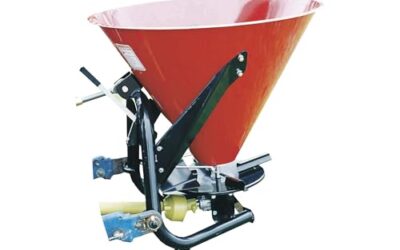
If your winter route is a long gravel lane or a rural driveway, walking it with a push spreader gets old quickly. The 45-0463 tows behind a riding mower or lawn tractor on a universal hitch and carries the same 130 lb hopper as its push sibling, good for an estimated 25,000 square feet per fill. The steel rod flow control is reachable from the tractor seat, so you open and close the gate without dismounting at the road.
Two 13 by 4 inch pneumatic tires and an enclosed gear housing suit it to rougher ground than a walk-behind would enjoy. The listing names salt and ice melt among its intended materials alongside seed and fertilizer. It assembles to 46 x 27.1 x 31.5 inches, so plan storage space beside the tractor rather than on a shelf.
Specs
- Hopper capacity 130 lb; tow-behind with universal hitch for riding mowers and lawn tractors; spread width up to 12 ft; coverage an estimated 25,000 sq ft per fill; two 13 x 4 inch pneumatic tires; enclosed gear housing; steel rod flow control from the seat; assembled size 46 x 27.1 x 31.5 inches
- Best for: Long driveways and lanes where the owner already runs a lawn tractor through the seasons
- Watch out for: Useless without a tractor or mower to pull it, and the tow setup needs room to turn at the end of a lane; keep passes straight and steady for an even pattern
- ASIN: B002U0KDHI
Scotts Wizz Handheld Spreader
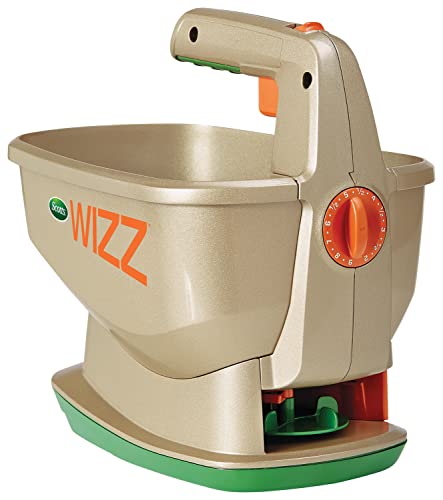
The Wizz is the small-job answer. It is a battery-powered handheld broadcast spreader: fill the hopper, dial in the setting, squeeze the trigger and walk. Scotts describes it as a year-round tool for seed, fertilizer, salt and ice melt, and one fill covers up to 2,500 square feet of product, which translates to a lot of front steps and short sidewalks.
EdgeGuard technology blocks the throw on one side so material stays off flower beds and lawn edges, and the roughly 5 foot broadcast is a sensible width for a path. It runs on four AA batteries, so there is no crank to work with cold hands. Keep a bag of fine ice melt by the door and this is the fastest way to make steps safe before guests arrive.
Specs
- Handheld battery-powered broadcast spreader; runs on 4 AA batteries; holds enough product to cover up to 2,500 sq ft; broadcast width about 5 ft; EdgeGuard technology; adjustable settings dial
- Best for: Steps, porches, short sidewalks and spot-treating icy patches
- Watch out for: Scotts does not recommend it for rock salt, which is too coarse and heavy for the small motor; use finer ice melt. Capacity is small by design, so it is the wrong tool for a full driveway
- ASIN: B011HY5Q1K
Which One Fits
- Steps and a short walk only: Scotts Wizz. Nothing to assemble, nothing to store on the floor, and it lives by the door with the ice melt bag.
- A standard driveway and front walk: Chapin 81008A. The baffles, spiked auger and cover are all aimed at exactly this job.
- A big pad or a small commercial route: Buyers Grounds Keeper. The 100 lb hopper and 24 foot throw finish wide areas quickly.
- Large grounds, no tractor: Agri-Fab 45-0614. The 130 lb hopper covers serious area on foot and earns its keep in summer too.
- A long lane and a lawn tractor in the shed: Agri-Fab 45-0463. Towing beats pushing when the route is measured in hundreds of feet.
Common Mistakes
Loading rock salt into a spreader that is not rated for it. Coarse rock salt jams small gates and stalls handheld motors. Two of the makers here advise against it outright. Match the material to the manual.
Leaving salt sitting in the hopper. Salt pulls moisture from the air, cakes into a solid mass and corrodes frames and gears while it sits. Empty the hopper after every use, even if you expect more snow tomorrow.
Filling the hopper on the driveway. Spills happen during loading, and a pile of spilled salt burns a dead spot into nearby lawn and can pit concrete. Fill over a tarp or on a gravel area, and sweep up what escapes.
Spreading without edge control. Broadcasting at full width along a walk throws half the load onto grass and beds. Close down the baffles or deflectors on edge passes, and make the final pass with the guard toward the planting.
Applying far too much. More salt does not melt ice proportionally faster; it mostly wastes material and increases runoff damage. Use the setting on the ice melt bag as your guide and make a second light pass only where ice persists.
Skipping the rinse. A two-minute rinse and a dry-off after the last storm of the season is the difference between a spreader that lasts a decade and one whose gearbox seizes by the third winter.
FAQ
Can I use my fertilizer spreader for salt?
Only if the maker rates that model for salt or ice melt. Salt is heavier and more corrosive than fertilizer, and it often arrives slightly damp. Models with an enclosed gearbox, a grate and an auger handle it well; a basic lawn spreader with exposed gears may jam and rust. Every model in this guide is named for salt or ice melt use by its maker.
Is a broadcast or drop spreader better for sidewalks?
Broadcast spreaders cover ground faster and handle coarse material better, and with baffles or deflectors they can be kept tidy on a walk. Drop spreaders place material in a precise band with almost no scatter, which suits narrow paths beside delicate planting, but they are slower and clog more easily with damp salt. For most homes, a broadcast unit with edge control is the more forgiving choice.
How big a hopper do I really need?
Work backwards from the area. A handheld covers steps and short walks. An 80 to 100 lb walk-behind treats a typical driveway and its walks on one fill. A 130 lb hopper, push or tow-behind, makes sense once you are covering a long lane, a shared pad or several neighbouring drives in one outing.
How do I stop a salt spreader from rusting?
Empty it after every use, rinse the hopper, auger and spinner with clean water, and let it dry fully before storing it under cover. A poly hopper will not rust, but frames, axles and gearboxes are metal on most models. The rinse matters most at the end of the season, before months of storage.
Final Verdict
For most households, the Chapin 81008A is the salt spreader to buy: it is the one model here designed from the hopper down for ice melt, with the baffles, auger and cover that winter work demands. Step up to the Buyers Grounds Keeper when the area grows or the route turns semi-commercial, and let the Agri-Fab pair handle the extremes of scale, the 45-0614 on foot and the 45-0463 behind a tractor. Keep a Scotts Wizz by the door regardless; steps ice over faster than any driveway, and the smallest spreader in the group is the one you will reach for most often.