Key takeaways
- The best commercial grade push broadcast spreaders, compared on hopper capacity, gearbox, tires, and pattern control, for crews and large properties.
As an Amazon Associate we earn from qualifying purchases.
A homeowner spreader and a commercial grade push broadcast spreader look similar from across the yard: a hopper, two wheels, a handle. The difference shows up in the second season, or the second month of daily use. Commercial machines carry bigger loads without flexing, meter material evenly at walking speed all day, roll over rough ground on real pneumatic tires, and seal their gearboxes against the fertilizer dust that quietly destroys exposed gears. For lawn care crews, groundskeepers, estate owners, and anyone treating large turf areas week after week, those details decide whether a spreader is a tool or a recurring problem.
This guide covers walk-behind broadcast spreaders only: the kind you push, where a spinning impeller throws granular material in a wide fan as you walk. It does not cover handheld spreaders, which suit patch repairs, or tow-behind models, which need a tractor or ATV. Every model below is a push spreader built to a commercial standard, with the build features stated on its product page: enclosed gearboxes, heavy frames, pneumatic tires, and pattern control systems. The guide explains what separates commercial grade from consumer grade, then walks through three machines at two capacity points, 50 pounds and 100 pounds of hopper volume.
Disclosure: This article contains affiliate links. If you buy through these links, we may earn a commission at no additional cost to you.
How to Choose a Commercial Grade Push Broadcast Spreader
Hopper capacity and refill rhythm
Capacity is quoted in pounds of material. A 50 lb hopper suits a single large property or a crew working smaller lawns, where refills happen at the truck between jobs anyway. A 100 lb hopper halves the refill stops on big, open turf: sports fields, campuses, cemeteries, and multi-acre estates. Remember that a full 100 lb hopper plus the machine’s own weight is a real load to push, so match capacity to the ground you cover. Slopes and soft turf argue for the smaller hopper even when the area is large.
Frame and gearbox: the commercial difference
The frame carries the load and takes the knocks of daily loading and transport. Stainless steel and heavy powder-coated steel frames are the commercial standard; thin stamped frames flex under a full hopper and eventually crack at the mounts. The gearbox matters even more. Fertilizer and ice melt are corrosive and abrasive, and an enclosed gearbox keeps that dust away from the gears that drive the impeller. A grease fitting on the gearbox housing is a sign the maker expects the machine to be maintained and kept in service for years, not replaced.
Tires and ground handling
Commercial spreaders roll on pneumatic tires, typically 13 or 14 inches, with a tread that grips wet turf and rolls over ruts, sprinkler heads, and uneven ground without bouncing the hopper. Bounce is not a comfort issue; it is an accuracy issue, because a bouncing spreader throws an uneven pattern. Stud or turf tread patterns give traction without tearing grass. Solid plastic wheels belong on consumer machines and are a reliable sign a spreader is not built for daily work.
Pattern control and even spreading
A broadcast spreader earns its keep on pattern quality. The drop system decides how material reaches the impeller: multi-hole drop systems feed the plate at several points so the fan of material stays even across its width instead of bunching to one side. Side-spread or edge control, which shuts off one side of the pattern, is close to essential for professional work, because it keeps granules off sidewalks, driveways, and planting beds, where fertilizer wastes money and can stain or burn. Look also for a rate setting dial that locks positively, an agitator that keeps material flowing, and a hopper screen that catches clumps before they jam the drop holes.
Material compatibility
Most commercial push spreaders are built for fertilizer, seed, and granular pest control products. Ice melt and salt are harder on machines and not every model is rated for them; some makers state plainly that a model should not be used for salt, sand, or lime. Check the product page for the materials you actually spread, and rinse the hopper and impeller after use, because fertilizer residue left in the machine is the main cause of corrosion and seized parts.
The Best Commercial Grade Push Broadcast Spreaders
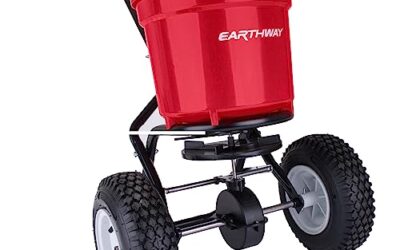
1. EarthWay 2150 Commercial Broadcast Spreader — the 50 lb crew standard

The EarthWay 2150 is the smaller of EarthWay’s commercial walk-behind models and one of the most widely used push spreaders in professional lawn care. Its 50 lb hopper is sized for a single property or a route of modest lawns, and everything about the machine is built to be used daily and maintained in the field.
- View on Amazon: https://www.amazon.com/dp/B00002N66D
The 2150 rides on 13-inch pneumatic stud tires that grip turf and roll over rough patches without jarring the hopper, keeping the pattern steady at a working pace. Material metering is handled by EarthWay’s EVEN-SPRED 3-hole drop system, which feeds the impeller at three points to produce an even fan across the full spread width, avoiding the heavy-center pattern that leaves stripes in a lawn. Side-spread control lets the operator shut down the pattern on one side for clean edges along walks and beds. The gearbox is enclosed, protecting the drive from fertilizer dust, and the hopper includes the practical details crews ask for: a rate control that holds its setting and a design that can be partially disassembled for cleaning and service.
Choose the 2150 if you treat small to mid-size properties all day, if you want commercial build without pushing a full 100 lb load, or if you maintain one large home property and are tired of replacing consumer spreaders. It is the balanced pick in this guide: genuinely commercial in construction, manageable in weight, and proven in route work.
2. Chapin 8400C SureSpread Professional Spreader — the 100 lb stainless option
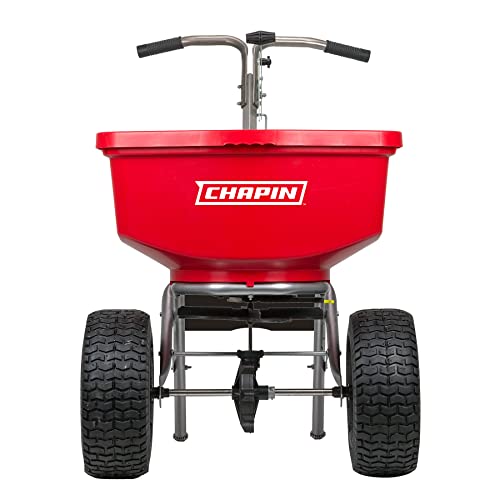
The Chapin 8400C is a professional 100 lb push spreader built around a stainless steel frame, and it is made in the USA. For crews whose work is dominated by large, open turf, it doubles the hopper capacity of the 50 lb class while keeping the pattern control that professional results depend on.
- View on Amazon: https://www.amazon.com/dp/B072FK465J
The stainless frame is the headline: it shrugs off the fertilizer exposure that rusts painted frames, and it carries a full 100 lb load without the flex that throws a pattern off. The enclosed gearbox includes a grease fitting, so the drive can be serviced on a schedule rather than run to failure, and it is supported by 14-inch pneumatic tires, the largest in this guide, which roll a loaded machine over uneven ground with less bounce and less effort. Chapin’s SureSpread system manages the drop and pattern, with edge control for working along pavement and beds. One limit is stated by the maker and worth respecting: this model is not recommended for salt, sand, or lime, so winter ice-melt work should go to a machine rated for it.
Choose the 8400C if your days are spent on big turf areas, if refill stops cost you real time, and if you want a stainless frame and a serviceable gearbox in one machine. It is the heavy-duty pick for fertilizer and seed programs on large properties.
3. EarthWay 2170 Commercial Broadcast Spreader — the 100 lb high-capacity workhorse
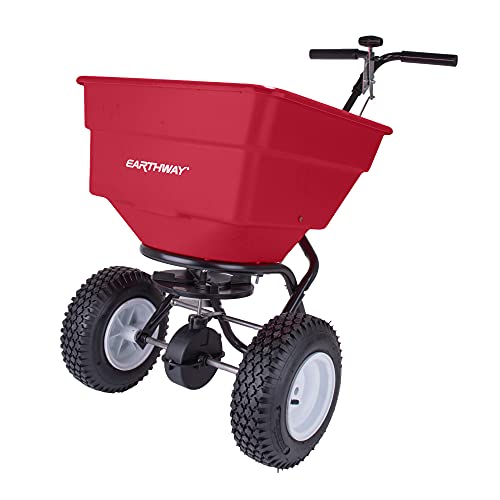
The EarthWay 2170 is the company’s 100 lb commercial walk-behind, built for the same daily-duty brief as the 2150 but scaled for acreage: a high-capacity hopper, heavy-duty frame, and the same pattern system, aimed at grounds crews and large estates where a route is measured in acres rather than lawns.
- View on Amazon: https://www.amazon.com/dp/B00004RB0E
The 2170 uses EarthWay’s EV-N-SPRED 3-hole drop system, feeding the impeller evenly across the pattern so a full-width pass lays material consistently from edge to edge, which matters most at this capacity because pattern errors repeat over very large areas before anyone notices them. The enclosed gearbox keeps fertilizer dust off the drive gears, the pneumatic tires are sized for loaded work on turf and rougher ground, and the hopper design includes a debris screen and a rate control built to hold calibration between refills. The frame and handle are built for transport abuse: this is a machine meant to ride in a truck or trailer between sites, be loaded fast, and go straight to work.
Choose the 2170 if you cover large areas on foot, want EarthWay’s drop system at maximum capacity, or run a mixed fleet and prefer one maker’s parts and settings across machines. Paired with the 2150 for smaller lawns, it gives a crew a matched set for properties of every size.
Comparison Table
| Model | Hopper capacity | Frame | Gearbox | Tires | Pattern system |
|---|---|---|---|---|---|
| EarthWay 2150 | 50 lb | Heavy-duty commercial frame | Enclosed | 13 in pneumatic stud | EVEN-SPRED 3-hole drop, side-spread control |
| Chapin 8400C | 100 lb | Stainless steel | Enclosed, with grease fitting | 14 in pneumatic | SureSpread, edge control |
| EarthWay 2170 | 100 lb | Heavy-duty commercial frame | Enclosed | Pneumatic, sized for loaded work | EV-N-SPRED 3-hole drop |
Frequently Asked Questions
What makes a spreader commercial grade?
Four things: a frame that carries a full hopper without flexing, an enclosed gearbox protected from fertilizer dust, pneumatic tires that keep the pattern steady on real ground, and a drop system that meters material evenly across the spread width. Consumer spreaders cut corners on most of these, which is why they often last a season or two in weekly use while commercial machines run for years with basic maintenance.
Should I choose a 50 lb or 100 lb hopper?
Match it to your largest regular job. If most properties are under half an acre, a 50 lb machine refills at natural stopping points and is kinder to push on slopes and soft ground. If you regularly treat an acre or more in one pass, the 100 lb hopper removes refill trips across open turf, which is where the time goes. Many crews run one of each.
How do I keep the spread pattern even?
Calibrate the rate setting for each material, since granule size changes the flow; walk at a steady pace, because the impeller speed follows your walking speed; overlap passes slightly and consistently; and use the edge control near pavement instead of trying to steer the pattern. A hopper screen and dry material prevent the clumps that cause skips.
Can I spread ice melt or salt with these machines?
Only if the model is rated for it. Salt is highly corrosive and its granules behave differently in the drop system. Note that the Chapin 8400C in this guide is specifically not recommended for salt, sand, or lime. Whichever machine you use for winter material, empty and rinse it after every use.
What maintenance does a commercial spreader need?
Rinse the hopper, impeller, and drop area after use and let the machine dry before storage. Check tire pressure, since soft tires change the machine’s height and your walking effort. Grease the gearbox where a fitting is provided, following the maker’s schedule, and store the spreader empty, indoors, with the rate control closed. That routine is most of what separates a ten-year machine from a two-year one.
Conclusion
For most professional work, the EarthWay 2150 is the right starting point: commercial construction, an even three-hole drop pattern, side-spread control, and a 50 lb hopper that stays manageable all day. When the work is large open turf, step up to a 100 lb machine: the Chapin 8400C for its stainless frame and serviceable gearbox, or the EarthWay 2170 for maximum capacity in EarthWay’s pattern system. Buy the frame, gearbox, and tires first and the hopper size second; those are the parts that decide how long a commercial spreader stays on the route.