Key takeaways
- Compare four commercial broadcast spreaders for pro turf work: compare hopper size, frame build, tires and gate control before you choose a crew machine.
Buying a commercial spreader is really a decision about downtime. A frame that flexes under a full load, a gate that drifts mid-pass, or gears that pack with fertilizer dust will cost a crew more in rework and repeat trips than the machine itself ever did. The right question is not which unit looks toughest in a photo, but which one keeps its pattern honest after months of daily loading, hosing down, and bouncing across rough turf.
This guide is for lawn care operators, grounds crews, and estate managers who spread fertilizer, seed, and ice melt as paid work rather than weekend chores. Every model below is a walk-behind broadcast spreader positioned by its maker for commercial, contractor, or professional use, and each was chosen from the capacity, frame, tire, and gate details stated on its Amazon product page.
Quick Picks
As an Amazon Associate we earn from qualifying purchases
| Product | Best for | Key spec |
|---|---|---|
| EarthWay 2150 Commercial | Smaller crews wanting a compact commercial unit | 50 lb rustproof poly hopper |
| EarthWay 2170 Commercial | Large open turf where refill stops waste crew time | 100 lb hopper, 3350 cubic inches |
| Chapin 8301C Contractor Turf | Contractors who spread in wet, messy conditions | 80 lb hopper, enclosed acetal gears |
| Spyker Ergo-Pro SPY80-1S | Operators who run one machine all day, every day | 80 lb capacity, stainless steel frame |
How to Choose
Hopper Capacity Matched to the Route
Capacity decides how a route actually flows. A 50 lb hopper suits tight residential rounds where the truck is never far away and a lighter push matters across dozens of small lawns. Step up to 80 or 100 lb and the maths changes on estates, sports fields, and commercial campuses, where every refill means walking back across ground you have already covered. Remember that capacity figures describe material weight, and dense products such as ice melt fill a hopper very differently from fluffy seed blends. Match the hopper to the material you spread most often, not the largest number on the box, and check the stated cubic capacity alongside the weight figure before deciding.
Frame Material and Corrosion Resistance
Fertilizer is corrosive, and commercial machines live outdoors, get rinsed irregularly, and ride in damp truck beds. That is why frame construction separates pro units from homeowner tools. Stainless steel frames, like the all-welded frame on the Spyker below, shrug off the rust that eventually eats powder-coated steel at welds and scratches. Powder coating still earns its place on contractor models because it protects well while keeping the machine manageable to lift, but it needs chips touched up before they spread. Rustproof poly hoppers remove one worry entirely, since the bin itself cannot corrode even when material sits in it overnight between jobs.
Gate Control, Agitators, and Pattern Accuracy
A commercial spreader earns its keep through repeatability: the setting dialled in on Monday must deliver the same rate on Friday. Look for solid steel gate linkage rather than cable arrangements that stretch, an adjustable rotary gate that handles both fine seed and coarse granules, and an agitator that breaks up clumps before they block the ports. Pattern control features matter just as much on real sites. Side-spread control and directional baffles keep product off pavements, planting beds, and water features, which protects both the client’s property and your margin, because wasted granules on concrete are product you bought and cannot bill for twice.
Tires, Gearboxes, and Daily Handling
Pneumatic tires are near-universal in this class because they roll over ruts, kerbs, and frost-heaved turf without jolting the hopper or bouncing the pattern sideways. Larger 13-inch wheels handle rough ground and long grass better, while 12-inch wide-tread designs trade a little clearance for stability on slopes. Enclosed gearboxes deserve close attention: sealing the gears away from fertilizer dust and grit is what keeps the drive smooth season after season. Finally, weigh the machine itself. Item weights here range from 25 to 43 pounds before material, and a heavier unit that a tired operator pushes badly will spread worse than a lighter one handled well.
The 4 Best Options
EarthWay 2150 Commercial Broadcast Spreader

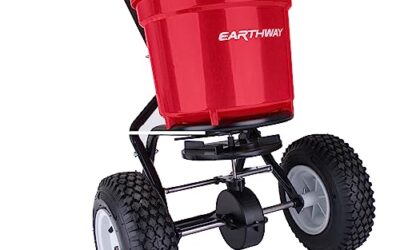
The 2150 is the entry point into EarthWay’s commercial line, built around a 50 lb rustproof poly hopper that suits crews working smaller properties back to back. Its EV-N-SPRED 3-hole drop system with side-spread control aims for an even pattern with feathered edging, which helps along borders and paths. At 25 pounds empty, it loads in and out of a truck bed easily between stops, and the enclosed gearbox with solid linkage should keep the rate consistent without constant adjustment during a round.
Specs
- Brand: EarthWay
- Item model number: 2150
- Hopper capacity: 50 lb, rustproof poly hopper
- Tires: 13-inch pneumatic stud tires with rustproof poly rims
- Drop system: EV-N-SPRED 3-hole drop with side-spread control
- Gearbox: enclosed gearbox with solid linkage
- Item weight: 25 pounds
- Warranty: 5-year limited warranty
Best for: Small crews and solo operators covering residential rounds who want commercial construction without a heavy machine.
Watch out for: The 50 lb hopper means frequent refills on large sites, so measure your biggest regular property before committing.
ASIN: B00002N66D
EarthWay 2170 Commercial Broadcast Spreader
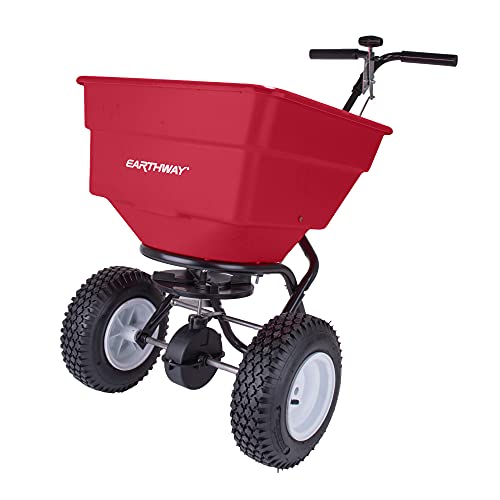
Where the 2150 trims size, the 2170 doubles down on volume. Its 100 lb, 3350-cubic-inch hopper is built for long, uninterrupted passes across campuses, sports turf, and big commercial grounds where walking back to refill is pure lost time. The super-duty gearbox runs enclosed gears, the coated frame is made to take daily knocks, and an adjustable handle accommodates taller operators on long shifts. Despite the capacity, the unit itself is listed at 25 pounds, though a full hopper changes the pushing effort considerably on slopes or soft ground.
Specs
- Brand: EarthWay
- Item model number: 2170
- Hopper capacity: 100 lb, 3350 cubic inches
- Tires: 13-inch pneumatic stud tires
- Gearbox: super-duty gearbox with enclosed gears
- Frame: durable coated frame with adjustable handle
- Product dimensions: 37 x 30 x 40 inches
- Item weight: 25 pounds
Best for: Grounds teams maintaining large open turf who want the fewest possible refill stops per session.
Watch out for: A full 100 lb load is a serious push on hills and wet turf, so plan routes that work with the slope rather than against it.
ASIN: B00004RB0E
Chapin 8301C Contractor Turf Broadcast Spreader

Chapin positions the 8301C squarely at contractors, and the details back that up. An 80 lb weather-proof poly hopper sits on a powder-coated steel frame, the enclosed acetal gear system is sealed against the elements, and a cast zinc-plated agitator works to break up clumps as material feeds through the adjustable rotary gate. Solid steel gate linkage and directional spread pattern control help keep placement precise, while the included rain cover and hopper grate suit crews who keep working when the weather turns rather than packing up.
Specs
- Brand: Chapin
- Item model number: 8301C
- Hopper capacity: 80 lb, weather-proof poly hopper
- Frame: powder-coated steel frame
- Gear system: enclosed acetal gears
- Gate: solid steel linkage with adjustable rotary gate and zinc-plated agitator
- Handle: T-shaped handle with rubber grips
- Tires: 12-inch pneumatic wide-tread tires
- Included: rain cover and hopper grate
- Product dimensions: 18.2 x 23.2 x 17.3 inches
- Item weight: 33.6 pounds
- Warranty: 5-year limited warranty
Best for: Contractors spreading fertilizer and seed through changeable weather who value pattern control and included weather accessories.
Watch out for: The listing states this model is not recommended for sand and sand mixes, lime, pelletized lime, or lime mixes, so check your material list first.
ASIN: B01MUODGQ2
Spyker Ergo-Pro Walk-Behind Broadcast Spreader SPY80-1S

Spyker builds the Ergo-Pro around an all-welded stainless steel frame, a direct answer to the corrosion that shortens the life of lesser machines in fertilizer service. The 80 lb hopper uses a bridge-free design intended to let material flow to empty without shaking or bouncing the unit, and the ergonomic handle adjusts to better match the operator, which matters when one person spreads for hours. At 43 pounds it is the heaviest machine here, a trade-off that buys rigidity and stability in exchange for more effort at the truck tailgate.
Specs
- Manufacturer: Spyker
- Item model number: SPY80-1S
- Hopper capacity: 80 lb
- Frame: all-welded stainless steel frame
- Hopper design: bridge-free design, material flows to empty
- Handle: ergonomic, adjustable handle
- Product dimensions: 47 x 25 x 36.5 inches
- Item weight: 43 pounds
- Country of origin: United States
Best for: Professional operators who keep one spreader for years and want stainless construction plus an operator-matched handle.
Watch out for: Confirm the frame variant on the listing before ordering, because this Ergo-Pro line is sold in both stainless and powder-coated frame versions.
ASIN: B084D26FNR
Which One Fits Your Situation
You Run Tight Residential Rounds All Day
Choose the EarthWay 2150. Its 50 lb hopper matches the bag sizes and lawn sizes typical of residential routes, the 25-pound machine weight keeps tailgate handling easy across many stops, and side-spread control helps near the beds, drives, and paths that dominate suburban work. Bigger hoppers would mostly add push weight you never use on this kind of round.
You Maintain Campuses, Fields, or Large Estates
Pick the EarthWay 2170 and build your route around its capacity. A 100 lb hopper lets one operator cover long stretches without returning to the truck, and the 13-inch pneumatic stud tires cope with the ruts and uneven ground common on big sites. Just schedule slopes thoughtfully, because a full load demands respect on inclines and soft, wet turf.
Your Crew Spreads in All Weather
The Chapin 8301C fits operations that cannot wait for perfect conditions. Enclosed acetal gears, a weather-proof hopper, and the included rain cover and grate all point the same way, and the T-handle with rubber grips is designed to stay manageable with gloves on. Keep lime and sand products on a different machine, following the listing’s own material guidance.
You Want One Machine to Keep for Years
Go with the Spyker Ergo-Pro SPY80-1S. Stainless steel removes the frame-rust failure mode that ends many spreaders’ lives, the bridge-free hopper reduces the shaking and bouncing that wear components out, and the adjustable ergonomic handle suits a regular operator doing long sessions. Accept the extra machine weight as the price of that long-service build.
Common Mistakes
- Buying the largest hopper by default, then fighting a fully loaded machine across slopes and soft ground where a mid-size unit would spread more accurately.
- Leaving fertilizer sitting in the hopper overnight, which cakes material, corrodes metal parts, and ruins the next morning’s calibration.
- Skipping a calibration check when switching products, even though seed, fertilizer, and ice melt all flow at different rates through the same gate setting.
- Ignoring the listing’s material limits, such as running sand or lime mixes through a spreader whose maker specifically advises against them.
- Spreading right up to pavements and beds without using side control or baffles, wasting product and leaving clients with stained hard surfaces.
Frequently Asked Questions
How big a hopper does a commercial crew actually need?
It depends on the distance between refill points. Crews working near the truck on residential rounds do well with 50 lb, while campus and field work rewards 80 to 100 lb because each refill costs a long walk. Choose by route layout and material density rather than chasing the biggest number available.
Can one commercial spreader handle seed, fertilizer, and ice melt?
Generally yes, because all four machines here are broadcast designs with adjustable gates intended for granular products. The exception is material-specific guidance: the Chapin 8301C listing advises against sand and lime mixes. Always rinse the hopper between products, especially after ice melt, and recalibrate the gate for each new material you run.
Why do commercial spreaders use pneumatic tires instead of solid wheels?
Air-filled tires absorb ruts, kerb edges, and rough turf instead of transmitting every jolt to the hopper, which keeps the spread pattern steadier and the push less tiring. They also grip better on wet grass and slopes. The trade-off is basic upkeep: check pressure regularly, because a soft tire changes rolling resistance and walking pace.
How should a crew maintain a spreader through the season?
Empty the hopper after every job, rinse off fertilizer residue, and let the machine dry before storage. Check tire pressure, work the gate linkage to confirm it moves freely, and inspect the agitator and ports for caked material. A few minutes of cleaning after each use protects calibration and keeps enclosed gears and frames working as intended.