Key takeaways
- Our guide to the best broadcast lawn spreaders covers hopper size, spread width, edge control, and calibration, with one verified walk-behind pick inside.
A lawn that looks even from the curb usually comes down to even spreading, and the best broadcast lawn spreaders are the tools that make that job faster than scattering granules by hand. A broadcast spreader, also called a rotary spreader, throws seed, fertilizer, or ice melt outward in a wide arc as you walk, so each pass covers a broad band of ground. Used with a steady pace and the right setting, it lays down a far more uniform layer than a hand scoop ever could.
This guide explains how to choose one, names one walk-behind model whose Amazon listing was confirmed by name, model number, and ASIN through more than one independent source, and describes the wider options you may come across so you can match the tool to the size of your lawn. Every product named here is a broadcast spreader made for lawn care, and the single linked pick below is the only model that cleared every verification check applied during this guide.
What to Look For
Choosing a broadcast spreader begins with your lawn, not with the tool. A small front yard, a half-acre lot, and a property that needs a tow-behind unit behind a riding mower are three different jobs, and the spreader that suits one can be a poor fit for another. The points below cover the features that matter most.
Broadcast or Drop
A broadcast spreader uses a spinning disc to throw granules outward in an arc, covering a wide band on each pass. A drop spreader releases granules straight down through slots, in a narrow band directly beneath the hopper. Broadcast models cover ground faster and suit large, open lawns, while drop models give tighter control along narrow strips. For most homeowners, a broadcast model is the quicker choice, because fewer passes are needed to cover the same area. The trade-off is that wind can carry light granules off course, and the edges of the pattern need care near beds and pavement.
Hopper Capacity and Lawn Size
Hopper capacity decides how often you stop to refill. A spreader that holds enough product for up to 5,000 square feet per load suits a small to mid-size lawn, letting you finish in one or two fills. Larger lawns call for a bigger hopper, since repeated refills slow the job and make it harder to keep a steady rhythm. A 50-pound hopper suits frequent users who fertilize often and want a sturdy commercial-style frame, while a 130-pound hopper belongs to large properties where a single load should cover half an acre. Match the hopper to your lawn rather than buying the largest model on the shelf, because a heavy full hopper is harder to push, especially on slopes or soft ground after rain.
Spread Width and Overlap
Spread width is the width of the band each pass covers. Wider bands mean fewer passes, but they also demand more attention to overlap. If passes are spaced too far apart, thin stripes appear between them. If passes overlap too much, some areas receive a double dose. A practical approach is to overlap each pass slightly with the edge of the previous one, so the lighter edge of one pattern fills the lighter edge of the next. Walking at a steady pace matters as much as width, because slowing down or speeding up changes how much material lands on each patch of ground.
Edge Control
Edge control keeps granules off driveways, sidewalks, patios, and planting beds. Some spreaders use a side shield or a shut-off gate that blocks flow on one side of the pattern, so you can run along a border without scattering product where it does not belong. Others use a three-hole drop system with side-spread control that feathers the edge of the pattern instead of cutting it off hard. Either approach helps along the boundary between lawn and hardscape. If your lawn has long edges against concrete or flower beds, treat edge control as a core feature rather than an extra.
Wheels and Frame
Wheels decide how easily a spreader rolls over real lawns. Small plastic wheels work well on flat, smooth turf but can struggle on rough or uneven ground. Larger pneumatic tires with rustproof rims roll more easily over bumps, ruts, and damp soil, and they carry a heavy load with less effort. The frame matters too. A powder-coated steel frame resists corrosion from fertilizer better than bare metal, while a fully plastic body keeps weight down but may wear sooner under heavy use. An enclosed gearbox protects the drive mechanism from corrosive granules and moisture, which is one reason commercial-style models often pair a sealed gearbox with a steel frame.
Calibration and Flow Control
Every granular product has a recommended spreader setting, usually printed on the bag. A spreader with a clear, adjustable rate dial lets you match that setting instead of guessing. Some models arrive pre-calibrated for one brand of products, which removes guesswork on the first use, though you should still confirm the setting against the bag of whatever product you are spreading. Flow control should respond promptly when you open and close it, so material stops flowing when you stop walking or turn around. A gate that sticks or lags leaves heavy patches at the ends of each pass.
Storage and Cleaning
Fertilizer and ice melt are corrosive, so cleaning decides how long a spreader lasts. After each use, empty the hopper, brush out residue, and wipe down the frame and wheels. A fold-down handle makes storage far easier, letting the spreader hang on a garage wall or fit into a tight corner. A hopper cover or rain shield helps when a shower arrives mid-job, and a grate over the hopper keeps clumps from reaching the spinning disc. These details sound minor in a store aisle, but they decide whether the spreader still works smoothly next season.
Walk-Behind or Tow-Behind
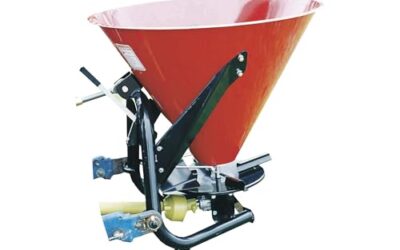
Walk-behind spreaders suit lawns you can cover on foot in a reasonable time. Tow-behind spreaders hitch to a riding mower or garden tractor and suit large properties, where walking the whole area would take too long. A tow-behind unit usually carries a larger hopper and covers a wider band, but it needs turning room and a mower to pull it. If your lawn is mostly open ground above half an acre, a tow-behind model is worth considering. If it has tight corners, narrow gates, and many beds, a walk-behind model will be easier to steer.
Top Picks
Only one spreader cleared every check applied during this guide: confirmation of the exact product name, the exact model number, and the exact ASIN through more than one independent source, with the listing showing the model as still available. Other well-known broadcast spreaders are described further below for context, but they are not linked picks here, because their Amazon listings could not be confirmed to the same standard during this pass. That limit is stated plainly so you can confirm any other listing yourself before buying.
Scotts Turf Builder EdgeGuard Mini Broadcast Spreader

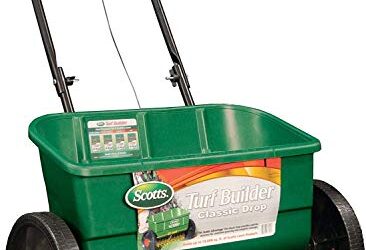
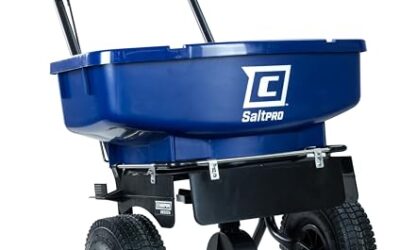
The Scotts Turf Builder EdgeGuard Mini Broadcast Spreader is the smallest walk-behind spreader in the Scotts line, built for small to mid-size lawns. Its hopper holds enough product to cover up to 5,000 square feet per load, so a typical suburban front and back lawn can often be finished with one or two fills. It arrives fully assembled and pre-calibrated for Scotts granular products, which means there is no assembly to work through before the first use. You set the rate dial to the number printed on the product bag, pour in the granules, and begin walking.
EdgeGuard technology is the defining feature. A side shield blocks granules from leaving the right side of the spread pattern when engaged, keeping fertilizer, seed, and ice melt off driveways, sidewalks, and planting beds. That matters most along the long edges of a lawn, where an uncontrolled arc would waste product on concrete and leave a pale strip where granules landed too thinly. The shield flips out of the way when you want the full pattern on open ground.
The spreader measures 21.5 x 16 x 18 inches, with a fold-down handle that makes it easy to hang on a garage wall or tuck into a corner between uses. Its model number is 76121. It handles seed, fertilizer, granular weed control, salt, and ice melt, so the same tool serves the lawn through the growing season and the driveway through winter. That year-round use is a genuine advantage for a homeowner who wants one tool for several jobs.
There are limits worth knowing. The hopper capacity suits lawns up to about 5,000 square feet per load, so a larger property will need several refills. The plastic body and small wheels keep the unit light and easy to push on flat turf, but rough or uneven ground can make it harder to steer, and heavy commercial use will wear plastic parts sooner than a steel-framed model. The factory calibration matches Scotts products, so spreading another brand calls for care in choosing the setting, and checking the result on a small area first is wise. None of these limits makes it a poor tool. They mark it as a spreader for the lawn it was designed for: a small to mid-size home lawn, used through the year, stored in a garage, and pushed by someone who wants a simple, ready-to-use machine.
Comparison at a Glance
| Spreader | Type | Coverage per Load | Edge Control | Best For |
|---|---|---|---|---|
| Scotts Turf Builder EdgeGuard Mini Broadcast Spreader | Walk-behind broadcast | Up to 5,000 sq. ft. | EdgeGuard side shield | Small to mid-size lawns |
Wider Options Worth Knowing About
Several other broadcast spreaders appear often in lawn care guides, and knowing how they differ helps you decide whether the Mini is enough or whether a larger machine fits your lawn better. These models are described here for context only, without Amazon links, because their listings were not confirmed to the same standard during this pass.
The Scotts Turf Builder EdgeGuard DLX Broadcast Spreader is the larger sibling of the Mini, holding enough product for up to 15,000 square feet per load. It suits a bigger lawn where the Mini would need several refills, while keeping the same EdgeGuard side shield for work along driveways and beds.
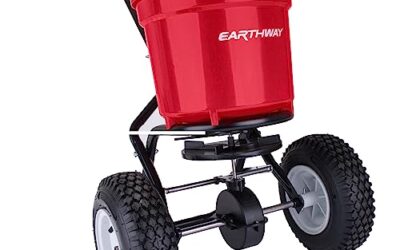
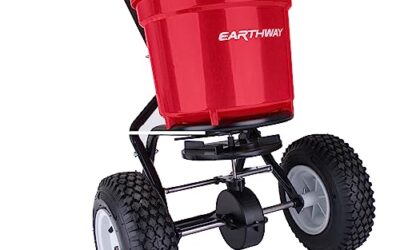
The EarthWay 2150 Commercial Broadcast Spreader is a commercial-style walk-behind model with a 50-pound rustproof poly hopper and 13-inch pneumatic stud tires on rustproof rims. Its enclosed gearbox and EVEN-SPREAD three-hole drop system with side-spread control are built for rough, uneven ground and frequent use. It is a heavier, sturdier machine than a homeowner model, and it fits a user who fertilizes often or maintains a larger lawn.
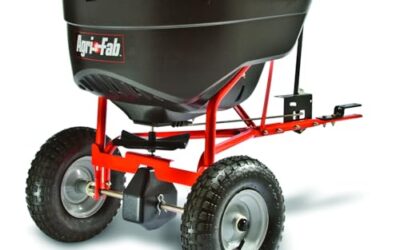
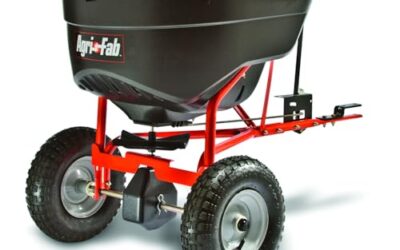
The Agri-Fab 45-0614 Push Broadcast Spreader carries a 130-pound hopper and spreads in a band 10 to 12 feet wide, covering up to half an acre per load. Agri-Fab notes that the 45-0614 has replaced the earlier 45-0462 model, so a listing for the older model number deserves a close look before buying. A tow-behind version, the Agri-Fab 45-0463, carries the same 130-pound hopper behind a riding mower for larger properties.
If your lawn is small to mid-size, the verified pick above is the straightforward choice. If it is larger, rougher, or fertilized often, one of these bigger machines may suit it better, once you have confirmed its current listing yourself.
Frequently Asked Questions
What is the difference between a broadcast spreader and a drop spreader?
A broadcast spreader throws granules outward in a wide arc with a spinning disc, covering a broad band on each pass. A drop spreader releases granules straight down in a narrow band beneath the hopper. Broadcast models cover open lawns faster, while drop models give tighter control in narrow areas. For most home lawns, a broadcast model finishes the job with fewer passes.
How much lawn can a broadcast spreader cover per load?
It depends on the hopper. A compact walk-behind model such as the Scotts EdgeGuard Mini holds enough product for up to 5,000 square feet per load. Larger walk-behind models hold enough for 15,000 square feet, and large push or tow-behind models with a 130-pound hopper can cover up to half an acre per load. The amount also depends on the product and the setting, since a heavy application rate empties the hopper sooner than a light one.
Can I use a broadcast spreader for grass seed and fertilizer?
Yes. Most broadcast spreaders handle grass seed, fertilizer, granular weed control, salt, and ice melt. The setting matters, because seed and fertilizer flow at different rates. Always use the setting printed on the product bag, and check the spread pattern on a small area first when you switch to a product you have not spread before. Clean the hopper between different products so residue from one does not mix with the next.
How do I keep a broadcast spreader working well between seasons?
Empty the hopper after every use and brush out any residue, since fertilizer and ice melt corrode metal parts and clog the gate. Wipe the frame and wheels, and let the spreader dry before storing it. Keep it under cover, with the handle folded down if it folds, so it stays out of rain and damp air. Before the first use of a new season, move the rate dial through its full range and confirm the gate opens and closes smoothly.
Conclusion
The best broadcast lawn spreaders share the same strengths: a hopper matched to the lawn, a wide and even pattern, reliable edge control, wheels that roll over real ground, and a rate dial you can set with confidence. For a small to mid-size lawn, the Scotts Turf Builder EdgeGuard Mini Broadcast Spreader covers those points in a simple, ready-to-use package, with enough capacity for up to 5,000 square feet per load and a side shield that protects beds and pavement. Larger or rougher lawns may call for a bigger machine, such as a commercial walk-behind model or a high-capacity push spreader, and those are worth considering once their listings are confirmed. Whichever model you choose, match it to your lawn, set it from the product bag, walk at a steady pace, and clean it after each use, and the spreader will serve the lawn well for many seasons.
Disclosure: As an Amazon Associate, angkaprediksi.cc earns from qualifying purchases.