Key takeaways
- Compare four drop spreaders for precise seed and fertilizer placement, from a push model for medium lawns to tow-behind units for larger properties.
A drop spreader drops granules straight down in a narrow band, so the real decision is how much control you need over where each granule lands. A broadcast spreader throws material wide and finishes a big lawn fast, but it also dusts flower beds, paths, and driveways unless you shut the gate at every edge. A drop spreader moves slower and covers a narrower strip per pass, yet it keeps seed and fertilizer inside the lines you walk. That trade suits lawns with defined borders, striping from past overlap, or a neighbouring garden.
This guide suits homeowners who overseed or feed a defined lawn, owners of larger properties who already run a lawn tractor, and anyone whose last application left pale stripes or scorched edges. Each spreader below was picked from the name and specifications on its Amazon listing, using the spread width, hopper capacity, and coverage figure shown there. Read the spread width first, then match the hopper to your lawn.
Quick Picks
As an Amazon Associate we earn from qualifying purchases.
| Product | Best for | Key spec from title |
|---|---|---|
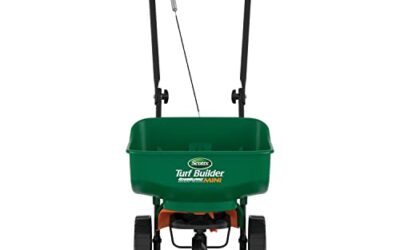
| Scotts Turf Builder Classic Drop Spreader | Medium lawns with beds, paths, and edges to protect | 22-inch spread pattern; holds product for up to 10,000 sq. ft. |
| Agri-Fab 45-0288 175-Pound Max Tow Behind Drop Spreader | Large properties worked behind a lawn tractor | 175-pound capacity; 42-inch spread width |
| Agri-Fab 45-0543 100 lb. Tow Spiker/Seeder/Spreader | Smaller areas that also need light aeration | 100-pound capacity; 32-inch spread width |
| Brinly AS-40BH Tow Behind Combination Aerator Spreader | Thick, established lawns needing seed and aeration in one pass | 120-pound capacity; 40-inch spread width |
How to Choose
Push model or tow-behind unit
The first choice is how the spreader moves, because that decides which lawns it suits at all. A push drop spreader fits a medium lawn with turns, gates, and narrow side strips, since you steer it by hand and stop exactly where a bed begins. A tow-behind unit needs a lawn tractor and open runs, and it struggles in tight corners or on a lawn broken up by trees and planting. Tow models also need more storage space and a hitch you already own, so measure the shed before you order. If you mow with a walk-behind mower and have no tractor, a push model is the only sensible pick, however large its tow-behind rival looks.
Spread width and hopper capacity
Spread width and hopper capacity together decide how many passes and refills a job takes. A 22-inch push model lays a narrow band, so a wide lawn means many careful passes, while a 42-inch tow model covers the same ground in roughly half the rows. A bigger hopper means fewer stops to refill, yet it also means pushing or towing more weight, which matters on slopes and soft ground. Check the coverage figure on the listing as well, and remember it describes the amount of product the hopper holds rather than a promise about your lawn. Match the width to the shape of your lawn, not just its size, because a long narrow lawn wastes a wide spreader.
Rate control and calibration
Rate control is what turns a hopper of granules into an even application instead of a feast-and-famine lawn. Look for a clearly marked setting dial and a lever you can open and close without bending down mid-pass, since shutting the flow at the end of each row stops piles forming where you turn. Some models arrive pre-calibrated, which saves setup time but still deserves a check against the setting printed on your seed or fertilizer bag. Others need calibrating from scratch, so expect a first run on a driveway or test strip before you touch the lawn. A spreader with vague markings will frustrate you every single season, whatever else it offers.
Build, wheels, and cleaning
A drop spreader lives outdoors in damp conditions, so its materials decide how many seasons it survives. A rustproof poly hopper resists fertilizer corrosion better than bare steel, while a galvanized steel agitator keeps granules flowing without crumbling. Pneumatic tires roll smoothly over rough ground and help the drive mechanism turn evenly, but flat-free wheels never go soft in storage. After each use, empty the hopper completely, rinse off residue, and let the moving parts dry, because fertilizer left inside draws moisture, clumps, and corrodes the mechanism. Check the handle grip and the gate linkage too, since a sticky gate is the usual cause of uneven lines.
The 4 Best Options
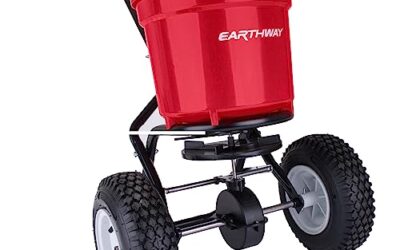
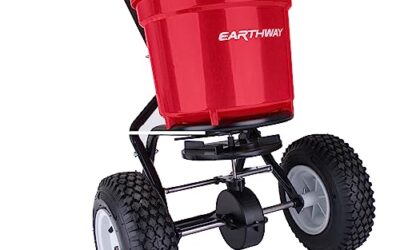
Scotts Turf Builder Classic Drop Spreader

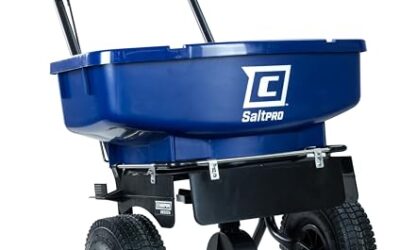
The Scotts Classic is the straightforward push option for a medium lawn where accuracy matters more than covering ground quickly. Its 22-inch spread pattern is narrow enough to run along a flower bed or driveway edge without throwing granules where they do not belong, and the lever sits under the handle so you can start and stop the flow without breaking stride. It arrives fully assembled and pre-calibrated, so there is no build session before the first use, and the heavy-duty frame keeps it steady on flat ground. Listings quote slightly different coverage figures, so treat 10,000 sq. ft. as the working number.
Specs
- Spread width: 22 inches
- Coverage: up to 10,000 sq. ft. of Scotts lawn product
- Hopper holds grass seed and fertilizer
- Heavy-duty frame for stability during use
- Arrives fully assembled and pre-calibrated
Best for: Homeowners with a medium lawn, defined edges, and beds or paths that must stay clear of granules.
Watch out for: The plastic wheels grip poorly on wet grass, the foam handle grip can wear with heavy use, and low ground clearance can clog the outlet in tall, damp grass, so mow first and spread on a dry day.
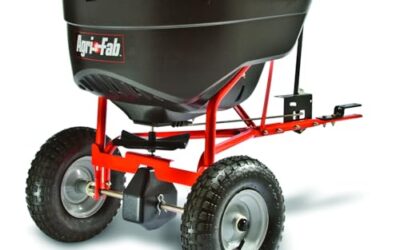
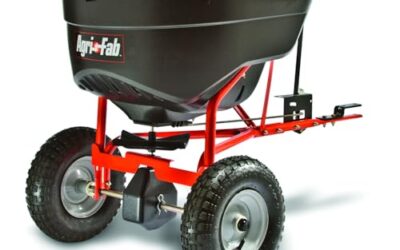
Agri-Fab 45-0288 175-Pound Max Tow Behind Drop Spreader
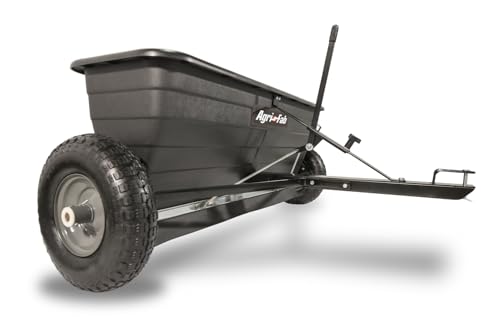
The Agri-Fab 45-0288 is the tow-behind pick for a large property where a push spreader would mean an afternoon of refills. Its 175-pound hopper and 42-inch spread width lay a wide, precise band behind a lawn tractor, covering around one acre per fill according to the listing, and the rustproof poly hopper stands up to fertilizer and salt. The galvanized steel agitator keeps granules moving, the 15-inch pneumatic tires give a steady drive over uneven ground, and the universal hitch and seat-mounted on-off control keep the job moving. It is not pre-calibrated and assembly takes longer than suggested, so set aside time before the first run.
Specs
- Hopper capacity: 175 pounds
- Spread width: 42 inches
- Coverage: around 1 acre (40,000 sq. ft.) per fill
- Rustproof poly hopper with galvanized steel agitator
- 15-inch pneumatic tires and universal hitch
- On-off control workable from the tractor seat
Best for: Owners of large properties who already have a lawn tractor and want wide, accurate passes with few refills.
Watch out for: It needs a tractor and open runs, it is not pre-calibrated, and assembly is fiddly, so check the calibration on a test strip and confirm the hitch fits your tractor before ordering.
Agri-Fab 45-0543 100 lb. Tow Spiker/Seeder/Spreader

The Agri-Fab 45-0543 suits a smaller property where the lawn is compacted and needs seed pressed into the soil rather than scattered on top. Its spiked galvanized steel spike disks open the surface, then drop seed or fertilizer into the holes across a 32-inch spread width, combining two jobs in one tow behind a tractor. The 100-pound hopper covers around one third of an acre per fill, the rustproof hopper resists corrosion, and the 10-inch flat wheels never need air. It is narrower and lighter than the 175-pound models, so it turns more easily and stores in less space, though it still needs assembly and a tractor to pull it.
Specs
- Hopper capacity: 100 pounds
- Spread width: 32 inches
- Coverage: around one third of an acre (17,500 sq. ft.) per fill
- Galvanized steel spike disks for aerating while spreading
- Rustproof hopper
- 10-inch flat wheels
Best for: Smaller properties with compacted lawns where overseeding should follow aeration in the same pass.
Watch out for: The spike disks do not aerate wet grass well, the unit needs assembly, and the narrower width means more passes than the 42-inch tow models on a bigger lawn.
Brinly AS-40BH Tow Behind Combination Aerator Spreader

The Brinly AS-40BH is the pick for a thick, established lawn where seed struggles to reach the soil through dense turf. Its 8-inch galvanized tine spikes punch into the lawn as the unit rolls, and the 40-inch drop opening then places seed or fertilizer directly into the opened ground instead of leaving it sitting on top. The heavy-duty steel hopper carries 120 pounds, the unit arrives pre-calibrated, and the flow control settings let you adjust the application rate for different materials. That combination saves a separate aerating pass entirely. The steel hopper is not stainless, so rinsing and drying after use matters more here.
Specs
- Hopper capacity: 120 pounds
- Spread width: 40 inches
- 8-inch galvanized tine spikes for aerating while spreading
- Heavy-duty steel hopper
- Arrives pre-calibrated with adjustable flow control settings
Best for: Thick, established lawns where seed needs soil contact and the owner wants aeration and spreading done together.
Watch out for: The steel hopper is not stainless, so clean and dry it after every use, and confirm your tractor can tow a loaded 120-pound unit across your ground before ordering.
Which One Fits Your Situation
A medium lawn with beds, paths, and a driveway to protect
Choose the Scotts Turf Builder Classic Drop Spreader. Its narrow 22-inch band and handle-mounted lever let you run tight to an edge and stop the flow exactly where a bed begins, which is the whole point of a drop spreader on a defined lawn. The assembled, pre-calibrated design also means you can start work the day it arrives instead of spending an afternoon building it.
A large property you already mow with a tractor
Choose the Agri-Fab 45-0288. The 175-pound hopper and 42-inch width cover around an acre per fill with few stops, and the seat-mounted control keeps you moving through long runs. A push spreader would turn the same job into many slow passes and several refills, so the tow model earns its storage space here.
A smaller lawn that feels compacted underfoot
Choose the Agri-Fab 45-0543. Its spike disks open the surface while it drops seed, giving overseeding a better chance on ground that has been walked on and compacted all summer. The 100-pound hopper and 32-inch width fit a smaller property, and the flat wheels need no attention between seasons, so the unit is ready whenever overseeding season arrives.
A thick lawn where seed sits on top and dries out
Choose the Brinly AS-40BH. The 8-inch tine spikes cut through dense turf so the drop opening can place seed into the soil rather than onto it, and the 40-inch width keeps the job moving. Arriving pre-calibrated with adjustable flow control, it handles different granular materials without a separate aerating pass.
Safety Notes
Fertilizer, seed treatments, and ice melt are garden chemicals, not harmless dust, so read the label on every bag before you spread it and follow its stated application rate, protective clothing, and re-entry guidance. Wear gloves and eye protection while filling the hopper, keep children and pets off the lawn until the label says it is safe to return, and wash your hands after handling granules. Sweep any granules off paths and driveways back onto the lawn so rain cannot wash them into drains, and never spread before heavy rain near a waterway. Store unused product sealed, dry, and out of reach of children, and clean the spreader after use so corrosive residue does not damage the mechanism.
Common Mistakes
- Overlapping passes by a full width, which double-doses the overlap strip and leaves visible stripes or scorched lines.
- Spreading on tall or wet grass, which clogs the drop outlet and leaves bare patches where the flow stopped.
- Guessing the rate setting instead of matching it to the figure printed on the seed or fertilizer bag.
- Leaving granules in the hopper between jobs, where moisture turns them into a clump that jams the agitator and corrodes the mechanism.
- Forgetting to close the gate at the end of a row or before crossing a path, which drops a pile exactly where you turn.
Frequently Asked Questions
What is the difference between a drop spreader and a broadcast spreader?
A drop spreader releases granules straight down in a narrow band the width of the hopper, so material lands only where the spreader passes. A broadcast spreader spins granules outward in a wide arc, covering ground faster but throwing material onto beds, paths, and driveways. Choose a drop spreader when edges and accuracy matter, and a broadcast model when you need to cover a large open lawn quickly.
Can a drop spreader spread grass seed, fertilizer, and ice melt?
Most drop spreaders handle any dry granular material that flows freely, including grass seed, granular fertilizer, and ice melt, but always check the listing and the product bag first. Fine powders, damp granules, and oversized pellets can jam the outlet or flow unevenly. Match the rate setting to each material, since seed and fertilizer need very different application rates.
How do I avoid stripes when using a drop spreader?
Walk at a steady pace, keep the gate open only while moving, and overlap each pass by a small margin rather than a full width so no strip gets a double dose. Many lawn owners apply half the material in one direction and the remaining half at right angles, which evens out any small gaps. Mow before spreading so the outlet clears the grass.
How should I clean and store a drop spreader?
Empty the hopper completely after every use, then rinse the hopper, wheels, and moving parts with a hose and let everything dry fully before storage. Fertilizer residue draws moisture and corrodes steel parts, so never store a spreader with granules inside. Follow the manual for lubricating the gate and drive parts, and store the unit under cover.