Key takeaways
- Compare the best lawn fertilizer spreaders by hopper capacity, broadcast or drop design, edge control and tire type, with verified Amazon listings.
The real decision with a fertilizer spreader is not how fast you can walk the lawn. It is whether the machine puts granules where the grass is and nowhere else, at a rate that stays even from the first pass to the last. A broadcast model throws product in a wide arc and covers ground quickly, while a drop model releases it straight down in a fixed band for tight control near beds and paths. Hopper size then decides how often you stop to refill, and edge control decides how much product ends up wasted on concrete.
This guide is for owners of small suburban plots who refill too often, for people with medium lawns who want one fill per job, and for anyone maintaining a large or uneven property where plastic wheels struggle. Every option below was chosen from its Amazon product title and listing details, including stated coverage capacity, spread pattern and tire type, so the differences you read here come from the listings themselves rather than from guesswork about how a spreader might behave.
Quick Picks
As an Amazon Associate we earn from qualifying purchases.
| Product | Best for | Key spec from title |
|---|---|---|
| Scotts Turf Builder EdgeGuard DLX Broadcast Spreader | Medium lawns needing edge control | Holds up to 15,000 sq. ft. of product |
| Scotts Turf Builder EdgeGuard Mini Broadcast Spreader | Small to medium lawns and tight storage | Holds up to 5,000 sq. ft. of product |
| EarthWay 2150 Commercial Broadcast Spreader | Large or rough ground and heavy loads | 50 lb hopper, 13-inch pneumatic tires |
| Scotts Turf Builder Classic Drop Spreader | Precise work beside beds and paths | 22-inch spread pattern, drop design |
How to Choose
Broadcast or Drop: Match the Pattern to Your Edges
A broadcast spreader spins granules outward, so one pass treats a wide swath and a half-acre lawn takes far fewer laps. The trade-off is overshoot: product can land in flower beds, on a driveway or in a pool border unless the model has an edge guard you can engage along boundaries. A drop spreader avoids that problem entirely because granules fall only within the width of the hopper, which makes it the calmer choice for narrow side yards and lawns edged with planting. The cost is time, since a 22-inch band needs many more passes than a broadcast arc, and any gap between passes shows as a pale stripe later.
Hopper Capacity Versus Refill Trips
Listings state capacity as the area one fill can treat, and that number should be compared with your actual lawn size rather than with the biggest figure on the page. A hopper rated for 5,000 square feet suits a compact plot and keeps the loaded machine light enough to push comfortably. Step up to a rating near 15,000 square feet and a medium lawn becomes a single-fill job, which matters because every refill stop is a chance to spill product or lose your place in the pass pattern. Oversizing has a downside too: a full large hopper is heavy on slopes, and leftover granules stored in it can absorb moisture and clump before the next use.
Rate Settings and Calibration
Fertilizers differ in granule size and density, so a spreader needs an adjustable rate dial that you set from the number printed on each product bag. Models that arrive pre-calibrated and fully assembled remove one source of error, because the dial positions already correspond to the settings charts the fertilizer brands publish. EarthWay takes a different route with its three-hole drop shut-off system, which is designed to deliver a balanced spread pattern on both sides of the machine. Whichever design you pick, confirm the listing names the control type clearly, and plan to sweep stray granules off hard surfaces after each pass so they are not washed into drains.
Wheels, Frame and Ground Conditions
Wheel choice decides how a spreader behaves once the hopper is full. Large pneumatic tires, such as the 13-inch stud tires on the EarthWay 2150, roll over rutted or soft ground and keep the spread pattern steadier because the machine bounces less. Smaller solid wheels are fine on flat, smooth turf and need no inflation, but they can chatter on bumpy lawns and scatter the pattern. Frame construction matters on bigger jobs as well: a heavy-duty frame holds alignment when you push a full load across a slope, while a fold-down handle, offered on the Mini, is the detail that decides whether the spreader stores on a garage shelf or claims floor space all winter.
The 4 Best Options
Scotts Turf Builder EdgeGuard DLX Broadcast Spreader

This is the balanced pick for a medium lawn where most of the border touches something you do not want to feed. The EdgeGuard feature blocks the outward throw on one side, so passes along a driveway or sidewalk keep granules on the grass, and the hopper is sized so a typical suburban treatment finishes without a refill trip to the garage. It also handles grass seed, salt and ice melt according to the listing, which gives it a second job in winter. Owners who already buy Scotts lawn products will find the rate dial language familiar, since the settings follow the same system printed on those bags.
Specs
- Type: Broadcast (rotary) spreader
- Capacity: Holds up to 15,000 sq. ft. of product
- Edge control: EdgeGuard technology
- Uses listed: Seed, fertilizer, salt and ice melt
- Setup: Pre-calibrated, ready to use
Best for: Medium lawns with long driveway and sidewalk edges.
Watch out for: Confirm the dial setting for your exact fertilizer bag before the first pass, because broadcast rates vary by granule size.
ASIN: B001H1EQO2
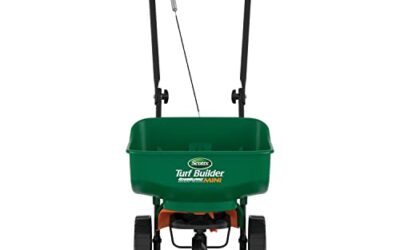
Scotts Turf Builder EdgeGuard Mini Broadcast Spreader

The Mini shrinks the same EdgeGuard idea down for smaller properties and tighter storage. Its hopper covers a modest lawn in one fill, and the fold-down handle lets it hang or shelve in a crowded shed where a full-size frame would not fit. Because the loaded weight stays low, it is easier to push at a steady walking pace, and a steady pace is what keeps a broadcast pattern even. It still spreads seed, salt and ice melt as well as fertilizer, so it can stay in rotation all year. For a first spreader on a small plot, this is the simplest route in.
Specs
- Type: Broadcast (rotary) spreader
- Capacity: Holds up to 5,000 sq. ft. of product
- Model number: 76121
- Edge control: EdgeGuard technology
- Storage: Fold-down handle
- Setup: Pre-calibrated, fully assembled
Best for: Small to medium lawns and limited storage space.
Watch out for: The smaller hopper means a lawn larger than its stated coverage needs a mid-job refill, so check your area against the rating first.
ASIN: B002YPS1KK
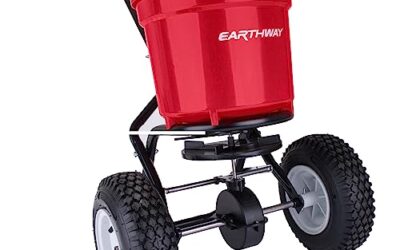
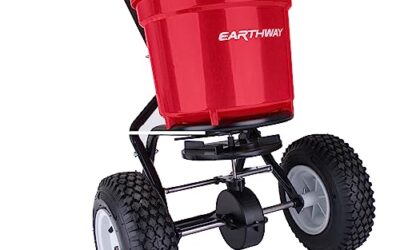
EarthWay 2150 Commercial Broadcast Spreader

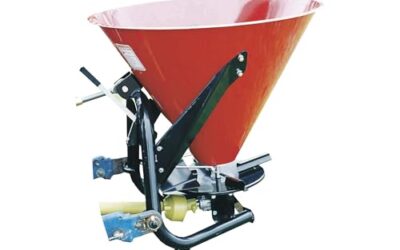
EarthWay builds this model for workload rather than convenience. The 50-pound hopper, a frame rated for far heavier loads, and pneumatic stud tires suit properties where the ground is uneven and a light plastic machine would bounce and drift. Its three-hole shut-off system is designed to keep the pattern balanced, and a debris screen keeps clumps from clogging the shut-off, which is a practical detail when fertilizer has sat in a humid garage. An adjustable drop rate and a driving handle round out a tool aimed at owners who treat large areas several times a year and want the spreader to outlast the lawn tractor seat.
Specs
- Type: Commercial broadcast spreader, walk-behind
- Hopper capacity: 50 lb
- Tires: 13-inch pneumatic stud tires
- Shut-off: EV-N-SPRED 3-hole drop system
- Frame: 175 lb load-bearing capacity
- Extra: Debris screen, adjustable drop rate
Best for: Large, uneven properties and frequent heavy use.
Watch out for: Pneumatic tires need occasional air checks, and some assembly is expected on a commercial frame, so allow setup time before the first job.
ASIN: B00002N66D
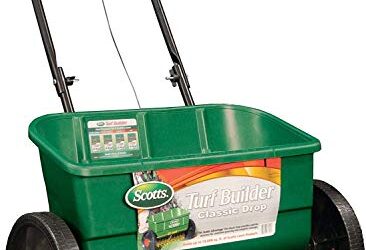
Scotts Turf Builder Classic Drop Spreader

A drop spreader answers a different question: not how wide can I throw, but how exactly can I place. This model releases product in a 22-inch band directly beneath the hopper, so you can run a clean line beside a garden bed, a pool edge or a narrow strip between fences without feeding the plants you are walking past. The hopper holds enough for a medium lawn, and the heavy-duty frame keeps the band tracking straight. It arrives fully assembled and pre-calibrated, which suits buyers who want placement control without a setup project. Striping is the known discipline cost of the design.
Specs
- Type: Drop spreader
- Capacity: Holds up to 10,000 sq. ft. of product
- Spread pattern: 22-inch band
- Frame: Heavy-duty frame
- Model number: 76565
- Setup: Fully assembled, pre-calibrated
Best for: Lawns with many beds, paths and narrow strips needing exact placement.
Watch out for: Drop patterns demand slight overlap between passes; skipped overlaps leave untreated stripes, so plan your walking lines before filling.
ASIN: B002ZTK09U
Which One Fits Your Situation
Your Lawn Is Small but Your Storage Is Smaller
Choose the EdgeGuard Mini. Its hopper matches a compact plot in a single fill, the loaded machine stays light enough to push at an even pace, and the fold-down handle lets it store on a shelf or hook instead of occupying garage floor. You give up the one-fill convenience of the bigger models, but on a small lawn that refill rarely happens anyway, and the EdgeGuard still protects your paths and beds along every border pass you make.
You Border a Driveway, Sidewalk and Street
Take the EdgeGuard DLX. The larger hopper finishes a medium lawn without stopping, and the edge control earns its keep on every boundary run, keeping granules on turf instead of concrete where they would be swept or washed away. It is the better answer when your lawn has more edge than interior, because interior passes use the full broadcast arc while edge passes switch to the guarded throw, and one machine covers both modes without a second tool.
Your Ground Is Rough and the Area Is Big
The EarthWay 2150 fits this ground. Pneumatic stud tires keep rolling where solid wheels stall or bounce, the 50-pound hopper cuts refill trips across a large property, and the debris screen plus three-hole shut-off keep the pattern consistent even when product quality varies between bags. It asks more of you in setup and tire upkeep, but for acreage-style suburban lots and repeated seasonal work, that trade returns steadier coverage on the passes that matter most.
Precision Matters More Than Speed
Pick the Classic Drop Spreader. When the lawn wraps around planting beds, a pond edge or a vegetable patch, the 22-inch drop band places fertilizer only where the wheels have been, and nothing lands on leaves or paths. You will walk more passes than with any broadcast model here, yet each pass is predictable, and the pre-calibrated settings mean the rate you choose is the rate that reaches the ground along those careful lines.
Common Mistakes
- Choosing by hopper size alone and ignoring whether the pattern is broadcast or drop, which decides where granules actually land.
- Leaving the rate dial on a previous product setting even though the new bag lists a different setting for the same spreader.
- Walking at an uneven pace with a broadcast model, which thins the pattern where you hurry and doubles it where you slow.
- Filling the hopper while it sits on the lawn, so a spill burns a concentrated patch of grass in one spot.
- Storing leftover fertilizer inside the hopper, where humidity turns granules into clumps that clog the shut-off next season.
Frequently Asked Questions
Is a broadcast or drop spreader better for a lawn with many flower beds?
A drop spreader is usually the safer fit, because product falls only within the hopper width and nothing is thrown sideways into the beds. A broadcast model with an edge guard can also work if you engage the guard on every border pass. The choice comes down to patience: drop designs need more passes, while broadcast designs need more attention along each edge.
How do I know which rate setting to use for my fertilizer?
Use the setting printed on the fertilizer bag for your spreader model or its setting family, since brands test their granules against common dial charts. If the bag lists several spreader types, match the broadcast or drop column to your machine. Start on a driveway or patio section to watch the flow, then move onto the lawn once the rate looks right.
Can one spreader handle seed, fertilizer and ice melt?
Several listings here name all three uses, including both Scotts broadcast models, which list seed, fertilizer, salt and ice melt. Clean the hopper between products so leftover granules do not mix, and dry it before storage. Very fine or very coarse materials may need a different dial setting than lawn fertilizer, so check the bag guidance for each product type before you load.
Why does my lawn show stripes after spreading?
Stripes usually come from pass spacing rather than from the machine. With a drop spreader, gaps between bands leave untreated lines; with a broadcast model, passes spaced too far apart thin the overlap zone. Mark your lines with the previous wheel track or a simple guide, keep a steady walking speed, and overlap each pass slightly so the pattern blends across the full width of the lawn.