Key takeaways
- Compare five drop spreaders for seed and fertilizer, from compact push models to tow-behind units, by capacity, spread width, and build quality.
A drop spreader drops seed and fertilizer straight down in a narrow band between its wheels, so nothing drifts onto beds, paths, or the driveway. That precision is the whole point of buying one instead of a broadcast unit, and it is also what makes the choice harder than it looks. A spreader that is too small means constant refills on a half-acre lawn, while one that is too wide will not fit through a garden gate or turn around a flower bed.
This guide is for homeowners who seed or feed a lawn themselves, for people with narrow strips and edged beds where overspray is a real problem, and for owners of larger properties who tow equipment behind a riding mower. Every model below was picked from its Amazon listing by hopper capacity, spread width, build, and the type of lawn it suits.
Quick Picks
As an Amazon Associate we earn from qualifying purchases.
| Product | Best for | Key spec from title |
|---|---|---|
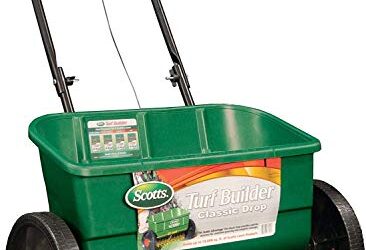
| Scotts Turf Builder Classic Drop Spreader | Medium lawns with beds and paths nearby | 22-inch spread, covers up to 10,000 sq ft |
| Agri-Fab 45-0543 Spiker Seeder Drop Spreader | Overseeding and aerating in one pass | 100 lb hopper, 32-inch spread, 8 spike discs |
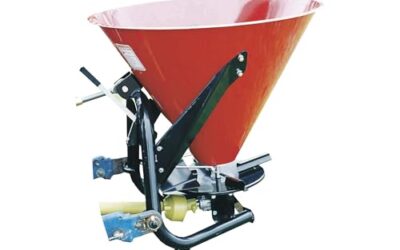
| Agri-Fab 45-0288 Tow Drop Spreader | Acre-size lawns behind a tractor | 175 lb hopper, 42-inch spread width |
| Spyker P70-12010 Commercial Drop Spreader | Heavy, frequent use on big lawns | 120 lb hopper, 36-inch spread width |
| Yard Commander 60 LB Walk-Behind Push Drop Spreader | Corrosion-resistant hopper for fertilizer | 60 lb hopper, covers up to 15,000 sq ft |
How to Choose
Match hopper capacity to lawn size
Hopper capacity decides how often you stop to refill, and refills are where uneven patches start. A 60 lb hopper suits a typical suburban lawn, while tow-behind models with 100 lb, 120 lb, or 175 lb hoppers belong on lawns approaching an acre, where a push unit would need several refills. Read the coverage figure on the listing alongside the weight, because dense fertilizer and light seed fill the same hopper very differently. A spreader that covers 10,000 square feet per fill is a sensible middle ground for most single-family lawns.
Check the spread width against your lawn shape
Spread width decides how many passes a lawn takes and how neatly the spreader fits around obstacles. A 22-inch band is easy to steer along beds, fences, and paths, and it leaves little room for error near planting. A 32-inch or 36-inch band cuts the number of passes on open ground, which matters when the lawn is wide and mostly rectangular. The 42-inch tow-behind band is fastest of all, but it needs open space to turn. Measure your narrowest gate and your tightest bed edge before choosing a wide model.
Push or tow behind
Push spreaders suit lawns where you walk the whole job and where turns are frequent, because you control the pace and can stop the flow at the end of each row. They are also the only sensible choice when there is no riding mower or tractor to pull a tow unit. Tow-behind spreaders suit large, open lawns where walking the full area would take too long, and they pair well with a tractor you already own. A tow unit needs a hitch and turning room, so small or steeply sloped lawns are better served by a push model.
Build, wheels, and calibration
A drop spreader lives outdoors and handles corrosive fertilizer, so the hopper and frame materials matter more than they first appear. Rustproof poly hoppers and powder-coated steel frames hold up better than bare metal, and a galvanized agitator keeps granules flowing instead of clumping in damp weather. Pneumatic or flat-free tires roll more smoothly over rough ground than hard plastic wheels, which can slip on wet grass. A model that arrives pre-calibrated saves a fiddly setup step, while an adjustable flow control lets you match the drop rate to the seed or fertilizer bag instructions.
The 5 Best Options
Scotts Turf Builder Classic Drop Spreader

The Scotts Classic is the straightforward choice for a medium lawn with beds, paths, and edges that need protecting. Its 22-inch spread pattern lays seed and fertilizer in a neat band, so granules stay off the walkway and out of the flower beds. The heavy-duty frame keeps the unit steady while you push, and it arrives fully assembled and pre-calibrated, which means the first job starts as soon as the hopper is filled. Coverage of up to 10,000 square feet per fill suits most suburban lawns without a mid-job refill.
Specs
- Spread width: 22 inches
- Coverage: up to 10,000 sq ft per fill
- Frame: heavy-duty
- Assembly: arrives fully assembled
- Calibration: pre-calibrated
- Made in the USA
Best for: Medium lawns with beds, paths, and edging that need clean lines.
Watch out for: The 22-inch band is narrow, so a large open lawn takes more passes than a wider tow-behind model.
Agri-Fab 45-0543 Tow Behind Spiker Seeder Drop Spreader

The Agri-Fab 45-0543 suits homeowners who want to overseed and aerate in a single pass behind a tractor. Its eight galvanized spike discs work into the soil as the unit moves, opening the ground so seed falls where it can take hold, and the drop mechanism places seed and fertilizer in a controlled 32-inch band. The 100 lb hopper covers approximately 40,000 square feet per fill, and 10-inch flat-free tires roll smoothly over rough and uneven ground. A steel lift handle adjusts the height for precision, and a direct rod lets you switch the unit on and off from the tractor seat.
Specs
- Hopper capacity: 100 lb
- Coverage: approximately 40,000 sq ft per fill
- Spread width: 32 inches
- Spike discs: 8 galvanized
- Tires: 10-inch flat-free
- Lift handle: steel, height adjustable
- Hitch: universal
- Item weight: 37.5 lb
- Control: direct rod from the tractor seat
Best for: Overseeding a tired lawn while aerating, behind a tractor or riding mower.
Watch out for: It does not come fully assembled, and it needs a tow vehicle, so it is not a walk-behind option.
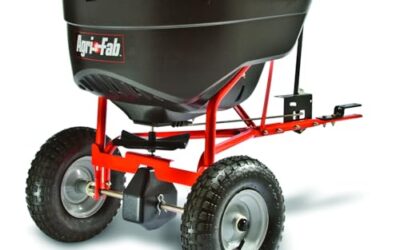
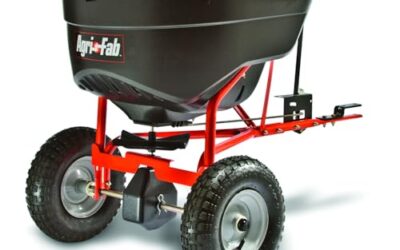
Agri-Fab 45-0288 175 lb. Tow Drop Spreader
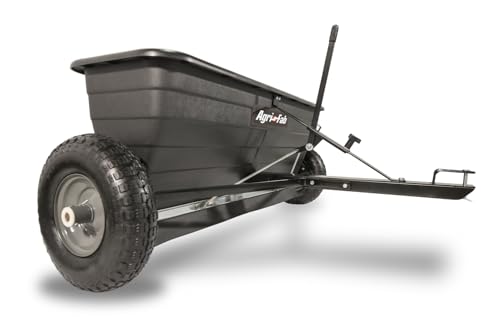
The Agri-Fab 45-0288 is the pick for lawns approaching an acre, where a push spreader would mean many refills and a long afternoon. Its 175 lb poly hopper covers close to 40,000 square feet per fill, and the 42-inch controlled spread width lays a wide, even band behind the tractor. A galvanized steel agitator keeps granules moving, and the rustproof hopper stands up to fertilizer season after season. Pneumatic tires smooth out rough ground, and the unit is backed by a three-year limited warranty.
Specs
- Hopper capacity: 175 lb
- Hopper volume: 17 gallons
- Spread width: 42 inches
- Coverage: up to 40,000 sq ft per fill
- Hopper: rustproof poly
- Agitator: galvanized steel
- Tires: pneumatic
- Warranty: 3-year limited
Best for: Large, open lawns worked with a tractor or riding mower.
Watch out for: It needs a tow vehicle and turning room, so it is not suited to small or tightly planted lawns.
Spyker P70-12010 Commercial Drop Spreader

The Spyker P70-12010 is built for frequent, heavy use on large lawns, and its split hopper is the feature that sets it apart. Two side-by-side hopper sections let you spread a full 36-inch band, or fill one side only for an 18-inch band along narrow strips. The 120 lb capacity covers serious ground per fill, and the powder-coated steel frame handles rough terrain without flexing. Large 13-inch by 5-inch wheels give traction on uneven ground, and variable rate bottoms let you adjust the flow for seed, fertilizer, sand, or top dressing material.
Specs
- Hopper capacity: 120 lb
- Spread width: 36 inches, or 18 inches using one hopper side
- Frame: powder-coated steel
- Wheels: 13-inch by 5-inch
- Rate control: variable rate and 1/2-inch fixed rate bottoms
- Materials: seed, fertilizer, sand, top dressing, and salt
Best for: Large lawns and frequent use where a wide, adjustable band and a tough frame matter.
Watch out for: At 65 lb empty it is heavy to push, and it cannot spread topsoil.
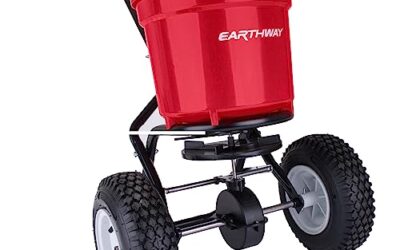
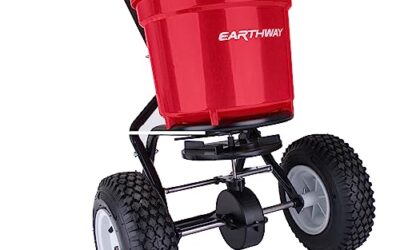
Yard Commander 60 LB Walk-Behind Push Drop Spreader

The Yard Commander 60 LB is a compact push drop spreader with a composite hopper that resists corrosion from fertilizer and harsh chemicals. Its 60 lb capacity covers up to 15,000 square feet, which is generous for its size, and the 22-inch spread pattern keeps material exactly where it belongs. An adjustable drop rate puts control at your fingertips, and the unit weighs only 13.4 lb empty, so it is easy to move, store, and lift. It is a sensible pick when the spreader will be washed down and stored between seasonal jobs.
Specs
- Hopper capacity: 60 lb
- Coverage: up to 15,000 sq ft
- Spread pattern: 22 inches
- Drop rate: adjustable
- Hopper: composite, corrosion resistant
- Item weight: 13.4 lb
- Dimensions: 27.7 x 26.8 x 32.6 inches
- Model number: YTL-140-268
Best for: Homeowners who want a light, corrosion-resistant push spreader for fertilizer and seed.
Watch out for: Confirm sand compatibility before using it for sand, since the listing focuses on fertilizer and seed.
Which One Fits Your Situation
A medium suburban lawn with beds and paths
Pick the Scotts Turf Builder Classic. Its 22-inch band and 10,000 square foot coverage match a typical suburban lawn, and it arrives assembled and pre-calibrated, so there is no setup before the first pass. The heavy-duty frame stays steady along bed edges, and the narrow band keeps granules off paths and driveways.
A tired lawn that needs overseeding and aerating
Pick the Agri-Fab 45-0543. Its eight spike discs open the soil as you tow it, so seed drops straight into ground that is ready to take it, and the 32-inch band covers a wide strip per pass. The 100 lb hopper suits a large lawn, and the direct rod control lets you switch spreading on and off from the tractor seat without stopping.
An acre or more, with a tractor already in the shed
Pick the Agri-Fab 45-0288. The 175 lb hopper and 42-inch band cover close to an acre per fill, and the tow-behind design turns a long job into a few passes behind the tractor. The rustproof hopper and galvanized agitator are built for season after season of fertilizer work, with no mid-job refill.
Frequent use on big lawns, including commercial jobs
Pick the Spyker P70-12010. The split hopper gives a 36-inch band for open ground or an 18-inch band for narrow strips, and the powder-coated steel frame and large wheels handle rough terrain. The 120 lb capacity and variable rate control suit anyone who spreads seed and fertilizer often across the season.
Common Mistakes
- Choosing a broadcast spreader when the lawn has beds and paths that need protection from drift, since a drop spreader places material exactly between the wheels.
- Buying a 42-inch tow-behind model for a small lawn with tight turns, where a 22-inch push spreader would fit and steer far better.
- Ignoring the coverage figure on the listing and picking a hopper that needs refilling halfway through the lawn, which leaves visible stripes.
- Setting the flow rate by guesswork instead of reading the seed or fertilizer bag, which lists different settings for drop spreaders and broadcast spreaders.
- Storing the spreader dirty after a fertilizer job, letting corrosive residue attack the hopper, agitator, and frame over the winter.
Frequently Asked Questions
What is the difference between a drop spreader and a broadcast spreader?
A drop spreader releases seed and fertilizer straight down through slots between the wheels, placing material in a precise band with no drift. A broadcast spreader throws granules outward in a wide arc, covering ground faster but scattering material onto beds, paths, and driveways. Drop spreaders suit lawns with edging and planting nearby, while broadcast spreaders suit large, open areas.
Can a drop spreader spread grass seed?
Yes. Drop spreaders handle grass seed, granular fertilizer, sand, and salt, as long as the granules flow freely through the slots. Set the flow rate from the seed bag instructions, which list separate settings for drop spreaders, and walk at a steady pace so the seed falls evenly. Fine seed needs a lower flow setting than coarse fertilizer granules.
How do I avoid stripes when using a drop spreader?
Overlap each pass slightly so the wheel tracks of one pass sit just inside the edge of the previous band. Walk in straight lines and keep a steady pace, because slowing down drops more material in one spot. Close the gate at the end of each row before turning, so granules do not pile up where you turn around.
Should I choose a push or tow-behind drop spreader?
Choose a push spreader for lawns up to roughly half an acre, for lawns with many beds and tight turns, and when you have no tractor or riding mower. Choose a tow-behind spreader for lawns approaching an acre or more, where walking the whole area would take too long and you already own a tractor or riding mower to pull it.