Key takeaways
- Find the best broadcast spreaders for lawns of every size, from compact walk-behind models to a heavy tow-behind unit, with guidance on capacity, spread width, and fit.
Intro
A broadcast spreader, also called a rotary spreader, throws granular material out in a wide arc from a spinning disc as you walk or drive. One pass covers a broad band of lawn, which makes it the fastest way to apply grass seed, fertilizer, weed control, and ice melt across a yard. Compared with a drop spreader, which lays material in a narrow strip directly below the hopper, a broadcast spreader covers ground quickly and works well on large, open lawns where a little overlap between passes is easy to manage.
Choosing the right broadcast spreader starts with the size of the area you treat and the material you spread most often. A compact walk-behind model suits a small suburban lawn and stores easily in a garage corner. A large-capacity walk-behind model with pneumatic tires suits a half-acre or larger property where fewer refills matter. A tow-behind model suits anyone who already owns a riding mower or lawn tractor and wants to treat several acres without walking the whole property. Salt-focused models add features such as a spiked auger and adjustable baffles that keep granular ice melt flowing in cold weather and off sidewalks and planting beds.
The four spreaders in this guide cover those situations. Two are compact and mid-size walk-behind models from a familiar lawn care brand, one is a heavy tow-behind unit built for large properties, and one is a salt-oriented walk-behind model with a rugged frame and edge-control baffles. Every model below is a true broadcast spreader with a spinning distribution disc, a flow-control lever, and a hopper sized for real lawn work. None of them is a drop spreader or a hand-held seeder, so each one matches the intent of this guide.
Before you buy, measure your lawn and note the material you spread most often. A spreader that is too small means constant refills, while one that is too large is heavy to push and hard to store. The sections below compare the four picks side by side, then explain each model in detail, followed by guidance on choosing, assembly, and common questions.
At a Glance
| Spreader | Type | Hopper capacity | Coverage per fill | Best for |
|---|---|---|---|---|
| Scotts Turf Builder EdgeGuard DLX | Walk-behind | Up to 15,000 sq ft of product | Up to 15,000 sq ft | Large lawns, all-season use |
| Scotts Turf Builder EdgeGuard Mini | Walk-behind | Up to 5,000 sq ft of product | Up to 5,000 sq ft | Small lawns, easy storage |
| Agri-Fab 45-0463 Tow-Behind | Tow-behind | 130 lb | Up to 25,000 sq ft | Large properties with a riding mower |
| Chapin 88000A SaltPro | Walk-behind | 80 lb | Up to 18,000 sq ft | Salt and ice melt, winter use |
Scotts Turf Builder EdgeGuard DLX Broadcast Spreader

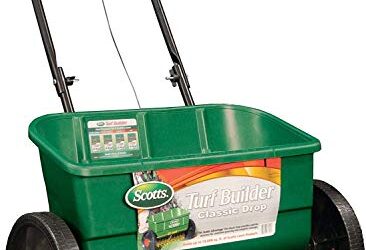
The Scotts Turf Builder EdgeGuard DLX is the full-size walk-behind spreader in this guide, built for homeowners with a large lawn who want to finish a treatment in fewer passes and fewer refills. Its hopper holds enough product to cover up to 15,000 square feet per fill, which suits properties of around a third of an acre and larger. The spreader handles grass seed, fertilizer, weed control, and ice melt, so one unit covers spring seeding, summer feeding, fall treatment, and winter de-icing.
The defining feature is EdgeGuard technology. A lever on the handle blocks the right side of the spread pattern, so material stays on the lawn and off driveways, sidewalks, flower beds, and patios when you work along an edge. Flip the lever off for open lawn and the disc throws a full arc again. This matters because granular fertilizer left on concrete can wash into drains, and ice melt on planting beds can damage shrubs.
Calibration is handled by an orange dial on the hopper with numbered settings that match the application rates printed on Scotts product bags. Set the dial to the number shown on the bag, fill the hopper, and walk at a steady pace. The DLX uses a sturdy frame and large wheels that roll smoothly over uneven turf, and the handle folds down for storage against a garage wall.
Listing features
- Holds enough product to cover up to 15,000 square feet per fill
- EdgeGuard lever blocks the spread pattern on one side for clean edges
- Numbered dial settings match the rates printed on Scotts product bags
- Spreads grass seed, fertilizer, weed control, salt, and ice melt
- Folding handle for compact storage
Considerations
- The large hopper is heavy when full, so fill it on flat ground and push with both hands on slopes
- No rain cover is included, so covered storage is the better choice
- The EdgeGuard lever only blocks one side, so plan your edge passes accordingly
Scotts Turf Builder EdgeGuard Mini Broadcast Spreader

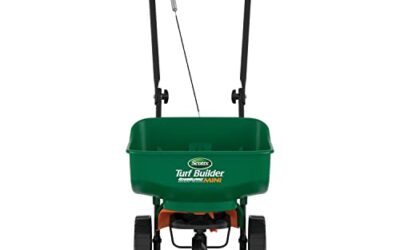
The Scotts Turf Builder EdgeGuard Mini is the compact sibling of the DLX, built for small lawns, townhouse yards, and anyone who wants a light, easy-to-store spreader. Its hopper holds enough product to cover up to 5,000 square feet per fill, which suits a typical small suburban lot. The Mini carries the same EdgeGuard technology as the DLX, so you still get clean edges along driveways and sidewalks without sweeping stray granules back onto the lawn.
The Mini uses the same numbered dial system as the DLX, with settings that match the application rates on Scotts product bags. The smaller hopper means the unit is lighter to push and easier to lift onto a shelf or hang on a wall hook. It folds down for storage and fits in a tight garage corner or a garden shed.
The Mini spreads the same range of materials as the DLX: grass seed, fertilizer, weed control, salt, and ice melt. Its smaller capacity means more refills on a large property, so it is not the right pick for a half-acre lawn. But for a compact yard, a courtyard, or a small front and back lawn, the Mini is the most practical size in this guide.
Listing features
- Holds enough product to cover up to 5,000 square feet per fill
- EdgeGuard lever blocks the spread pattern on one side for clean edges
- Numbered dial settings match the rates printed on Scotts product bags
- Spreads grass seed, fertilizer, weed control, salt, and ice melt
- Lightweight frame and folding handle for easy storage
Considerations
- The smaller hopper needs refills on lawns larger than about 5,000 square feet
- Small wheels can struggle on rough or rutted turf, so smooth lawns suit it best
- No rain cover is included, so covered storage is the better choice
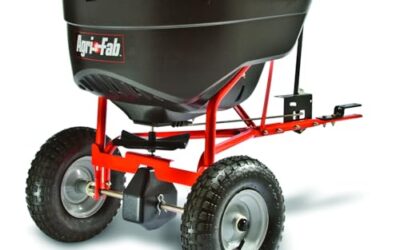
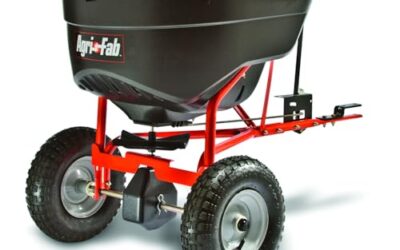
Agri-Fab 45-0463 130 lb Tow-Behind Broadcast Spreader

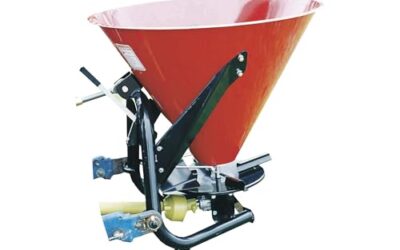
The Agri-Fab 45-0463 is the tow-behind spreader in this guide, built for large properties where walking the whole lawn with a push spreader is not practical. It hitches to a riding mower or lawn tractor with a universal hitch, and the operator controls the flow from the seat. The 130-pound hopper covers up to 25,000 square feet per fill with a spread width of up to 12 feet, so a large lawn can be treated in far fewer passes than any walk-behind model allows.
The tow-behind design changes the work entirely. Instead of pushing a heavy hopper, you drive at a steady speed while the spreader throws material in a wide arc behind the tractor. The flow control uses a simple 0 to 10 gate setting, and the spreader handles seed, fertilizer, salt, and ice melt. Pneumatic tires roll over rough ground, and the steel frame is built to carry a full 130-pound load without flexing.
This model suits properties of an acre or more, hobby farms, and anyone who maintains a large lawn with a riding mower. It is not a good match for a small yard: the unit is long, needs turning room, and needs a mower to pull it. Assembly takes longer than a walk-behind model, since the hitch, frame, and gate linkage need to be put together and adjusted.
Listing features
- 130-pound hopper capacity with coverage up to 25,000 square feet per fill
- Spread width up to 12 feet for fewer passes on large lawns
- Universal hitch fits most riding mowers and lawn tractors
- Flow control operable from the tractor seat with 0 to 10 gate settings
- Pneumatic tires and a steel frame built for heavy loads
- Spreads seed, fertilizer, salt, and ice melt
Considerations
- Requires a riding mower or lawn tractor; it cannot be pushed by hand
- Needs turning room, so tight corners and narrow gates are a poor fit
- Assembly takes longer than a walk-behind model, and the gate linkage needs adjustment before first use
- The large hopper is heavy when full, so load it after hitching on flat ground
Chapin 88000A SaltPro 80 lb Broadcast Spreader
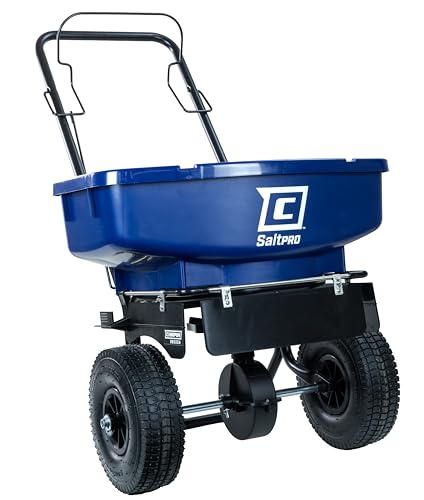
The Chapin 88000A SaltPro is the winter-focused spreader in this guide, built first for salt and ice melt and able to handle lawn materials as well. Its 80-pound hopper covers up to 18,000 square feet per fill, and the rust-resistant poly hopper and coated steel frame are made to survive repeated contact with corrosive ice melt. If winter de-icing is the main job, this is the most purpose-built model here.
The SaltPro uses a plastic spiked auger inside the hopper that breaks up clumps before they reach the gate, which matters because ice melt absorbs moisture and clumps easily in cold, damp storage. Fixed front baffles and adjustable side baffles let you narrow the spread pattern, so you can salt a sidewalk or driveway without throwing material into the street or onto planting beds. The gate is controlled by a full-bar lever on the handle, giving steady control over the flow rate.
The spreader rolls on 10-inch pneumatic tires that handle uneven pavement and frozen ground, and the enclosed gears keep grit and salt out of the drive mechanism. A rain cover is included to keep material dry during use and storage. The SaltPro is heavier than the Scotts models when full, and its salt-first design means the hopper and auger are tuned for coarse granular material rather than fine seed, though it still spreads seed and fertilizer.
Listing features
- 80-pound rust-resistant hopper with coverage up to 18,000 square feet per fill
- Spiked auger breaks up clumps before they reach the gate
- Fixed front and adjustable side baffles for edge control
- Full-bar gate lever for steady flow control
- 10-inch pneumatic tires and enclosed gears
- Rain cover included
- Coated steel frame and weather-resistant construction
Considerations
- Tuned for coarse granular material, so fine seed needs careful dial adjustment
- Heavier than the Scotts walk-behind models when the hopper is full
- The baffles need adjustment when switching between open lawn and narrow paths
How to Choose
Start with lawn size. Measure the area you treat, not the whole lot, since driveways, patios, and beds do not need product. A lawn up to 5,000 square feet suits the Scotts Mini. A lawn between 5,000 and 15,000 square feet suits the Scotts DLX or the Chapin SaltPro. A lawn above 15,000 square feet, or any property where a walk-behind model means many refills, suits the Agri-Fab tow-behind if you own a riding mower.
Next, consider the material you spread most. If the main job is lawn care through the growing season, either Scotts model is a natural match, with dial settings that line up with the bags. If the main job is winter ice melt, the Chapin SaltPro is the better match, with a spiked auger, baffles, and a rust-resistant hopper built for salt. If you spread a mix of seed, fertilizer, and ice melt across a large property, the Agri-Fab tow-behind handles all of them in large quantities.
Think about storage and handling. A compact spreader that folds down fits a small garage. A large walk-behind model needs a wall spot or a shed corner. A tow-behind unit needs floor space and a mower to pull it. Weight matters too: an 80-pound or 130-pound hopper is heavy when full, so check that you can push or tow the loaded unit comfortably.
Look at the controls. A numbered dial matched to product bags makes calibration simple. A lever that blocks one side of the pattern keeps material off hard surfaces. Adjustable baffles give finer control on narrow paths. Enclosed gears and a rain cover extend the life of the spreader when it is used in wet or salty conditions. Pneumatic tires roll better over rough ground than solid plastic wheels.
Fit and Installation Considerations
Most walk-behind spreaders arrive partly assembled. Expect to attach the handle, wheels, and flow-control linkage, then check that the gate opens and closes fully before the first fill. The Chapin SaltPro needs the baffle positions checked and the auger seated correctly in the hopper. The Agri-Fab tow-behind takes the longest to assemble, with a frame, hitch tongue, gate linkage, and control cable to fit and adjust.
Before first use, calibrate the spreader. Set the dial or gate to the number shown on the product bag for the material you are spreading, then test on a small strip of lawn or pavement where you can see the pattern. Walk or drive at a steady pace, and overlap each pass slightly so no strip is missed. If the pattern is heavy on one side, check that the disc spins freely and that the hopper is not clogged.
Check the fit with your property. Measure gate widths if the spreader must pass through a fence gate, and measure storage space before buying a large model. For the tow-behind unit, confirm that your mower has a rear hitch pin and that the hitch tongue lines up with it. Load the hopper only after the spreader is hitched and sitting on flat ground, since a full 130-pound hopper is hard to move by hand.
After each use, empty the hopper, brush out leftover granules, and wipe the disc and gate clean. Salt and fertilizer are corrosive, so a quick rinse and dry after use extends the life of the frame and gears. Store the spreader under cover with the gate closed and the hopper empty, and check tires for correct inflation before the season.
FAQ
What is the difference between a broadcast spreader and a drop spreader?
A broadcast spreader throws material in a wide arc from a spinning disc, covering a broad band with each pass. A drop spreader releases material straight down from the hopper in a narrow strip. Broadcast spreaders cover large lawns faster, while drop spreaders give more precise placement along edges and narrow strips. This guide covers broadcast spreaders only.
Can one spreader handle seed, fertilizer, and ice melt?
Yes, all four models in this guide handle seed, fertilizer, salt, and ice melt. The difference is tuning: the Chapin SaltPro is built first for salt, with a spiked auger and baffles, while the Scotts models are tuned first for lawn materials, with dial settings matched to product bags. Clean the hopper between materials so leftover granules do not mix.
How do I avoid stripes or missed patches?
Walk or drive at a steady pace, overlap each pass by a small amount, and keep the gate open only while moving. Start with the dial setting printed on the product bag, then adjust after a test strip. A spinning disc throws farther on one side if it is dirty or damaged, so keep the disc clean and check it spins freely before each use.
Do I need a tow-behind spreader, or is a walk-behind model enough?
A walk-behind model is enough for most lawns up to about 15,000 square feet. A tow-behind model earns its place on larger properties, where it cuts the number of passes and refills sharply. It only makes sense if you already own a riding mower or lawn tractor, since it cannot be pushed by hand and needs room to turn.
Conclusion
The best broadcast spreader is the one that matches your lawn size, your main material, and the equipment you already own. The Scotts EdgeGuard Mini suits small lawns and tight storage. The Scotts EdgeGuard DLX suits large lawns and all-season use, with clean edges from the EdgeGuard lever. The Agri-Fab 45-0463 tow-behind suits large properties with a riding mower, covering up to 25,000 square feet per fill. The Chapin 88000A SaltPro suits winter work, with a spiked auger, baffles, and a rust-resistant build for salt and ice melt.
Measure your lawn, note the material you spread most, and pick the model whose capacity and controls fit the job. Calibrate it before first use, clean it after each session, and store it under cover. A spreader chosen this way will cover your lawn evenly for many seasons.
As an Amazon Associate, we earn from qualifying purchases.