Key takeaways
- You pull the cover off in March, thumb the starter, and hear nothing but a faint click.
You pull the cover off in March, thumb the starter, and hear nothing but a faint click. A motorcycle that sits for weeks asks a lot of its small battery, because parasitic drains from the clock, alarm or fuel injection keep sipping power while the bike is parked. A battery maintainer, sometimes called a tender, solves that by delivering a gentle, regulated trickle that holds the charge without overcooking it.
This list covers six widely sold maintainers from Battery Tender, NOCO, CTEK and Optimate. The names tell you the brand and the product line, and this guide claims nothing beyond that, so check each maker’s page for amp output and compatible battery types. Read the buying rules first, because matching a charger to your battery chemistry is the single most important decision for a motorcycle that lives in a cold garage.
Quick Picks
| Product | Best for | Worth knowing |
|---|---|---|
| Battery Tender Junior | Small motorcycle batteries and first-time buyers | Junior name signals a small-capacity unit |
| Battery Tender Plus | Riders who want a step up from the Junior | Plus trim of the same brand family |
| NOCO Genius1 | Compact storage and simple setup | The 1 in the name refers to a 1-amp class |
| CTEK MXS 5.0 | Riders with a multi-vehicle garage | Version 5.0 of the MXS line |
| Optimate 4 Dual Program | Owners who want selectable programs | Dual Program suggests two charging profiles |
| Optimate 3 | Riders who want a basic Optimate entry | Third model in the Optimate family |
All six units listed here are plug-in maintainers meant to sit between a wall outlet and a parked motorcycle. They differ mainly in brand family, output class and how much control they give you, and the notes in the table repeat only what each name says. Use the buying rules to decide which traits matter before you compare listings.
How to Choose
Amperage that suits a motorcycle battery
Most motorcycle batteries hold between 4 and 20 amp-hours, and a good rule of thumb is a charger delivering roughly one-tenth of the battery’s amp-hour capacity or less. A 1-amp unit is plenty for small sport bike batteries, while larger touring batteries may benefit from a unit in the 4 to 5 amp range.
Look up the amp-hour figure printed on your battery case, then compare it with the charger’s stated output. If you cannot find either number, the owner’s manual or the battery maker’s page almost always lists them in a specification table.
Chemistry compatibility
Lead-acid, AGM, gel and lithium iron phosphate batteries all want different charging profiles. Check that the charger explicitly lists your chemistry, and avoid using a lead-acid-only charger on a lithium battery, since it can damage the cells or trip the battery’s built-in protection.
If your bike came with a sealed AGM battery from the factory, do not assume a basic lead-acid profile is acceptable. Chargers with a dedicated AGM or lithium mode protect the cells and usually say so in the first line of the description.
Connection type and fit
Look for a harness with a quick-disconnect plug that stays on the bike, so you can plug in without touching the battery terminals each time. Ring terminals under the bolts are the most secure option, while alligator clips work for occasional use. Check that the cord reaches from the garage outlet to the bike.
A permanent pigtail routed under the seat or near the tail section turns charging into a ten-second job, so riders actually do it. Choose a harness whose plug sits somewhere you can reach without removing fairings or side panels.
Safety features and weather resistance
Prefer chargers with spark-proof clamping, reverse-polarity protection and automatic float mode. Garage humidity and dust are normal, so a sealed or splash-resistant case is useful, but never use an indoor-rated charger in standing water or leave it exposed to rain.
Check the length of the output cable as well as the plug type. A short lead forces you to run an extension cord, which adds a trip hazard and a second connection that can corrode over a damp winter.
Our Picks Reviewed
Battery Tender Junior

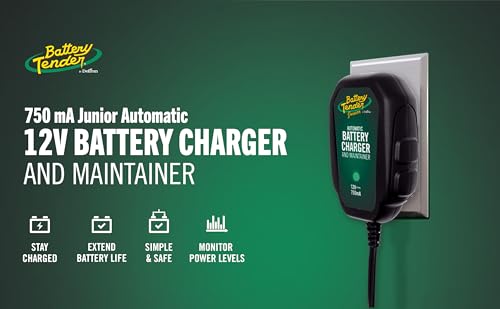
Battery Tender Junior 12V, 750mA Charger and Maintainer: Automatic 12V Powersports for Motorcycle, ATVs, and More - Smarter Than a Trickle Charger - 021-0123



As an Amazon Associate we earn from qualifying purchases. Product prices and availability are accurate as of the date/time indicated.
A common first purchase for a small bike, it is the sort of tender that people buy once and then forget about, which is exactly the point of a simple maintenance tool that quietly does its job.
The Junior is the entry-level model in the Battery Tender line, which the name places at the small, low-output end of the range.
- Pro: A small unit with a gentle output suits the compact batteries found on many sport bikes, scooters and smaller cruisers.
- Pro: A simple design with few settings makes it easy for first-time owners who just want to plug it in and walk away for the winter.
- Con: A low-output charger recovers a drained battery slowly, so it is better for maintaining than rescuing.
Skip it if your battery is large, deeply discharged or lithium-based, since a unit with selectable profiles is a better match.
Battery Tender Plus

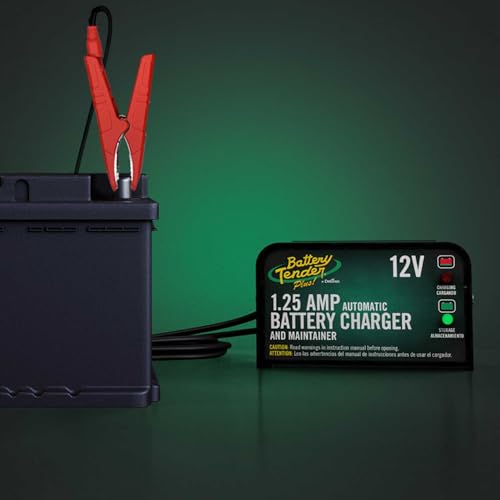
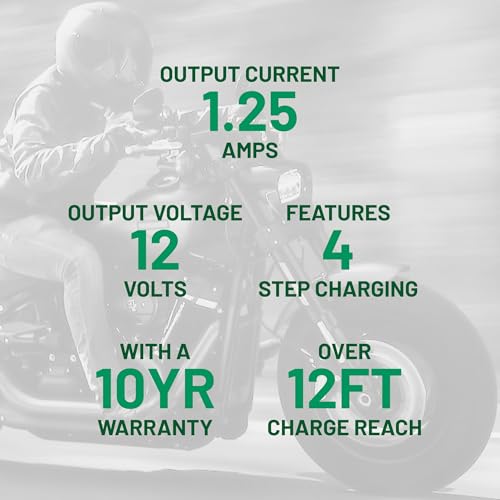
Battery Tender Plus 12V 1.25 AMP Car & Motorcycle Battery Charger and Maintainer, Float Charge for Automotive, and ATVs - Smarter Than a Trickle Charger




As an Amazon Associate we earn from qualifying purchases. Product prices and availability are accurate as of the date/time indicated.
Riders often move up to it when a bigger battery or a second bike joins the garage, and the shared family name keeps connectors and accessories familiar, so existing leads may still fit.
The Plus model is the step above the Junior in the same brand family, aimed at riders who want a little more capability.
- Pro: Staying within one widely sold brand means replacement leads, harnesses and accessories are simple to find.
- Pro: A Plus-level unit generally gives a bit more charging headroom than the base model, useful for slightly larger batteries.
- Con: Some riders will find the difference from the Junior small, so check the maker’s page to see whether it justifies the step up.
Skip it if you own only one small-capacity motorcycle and the Junior already matches your battery size.
NOCO Genius1
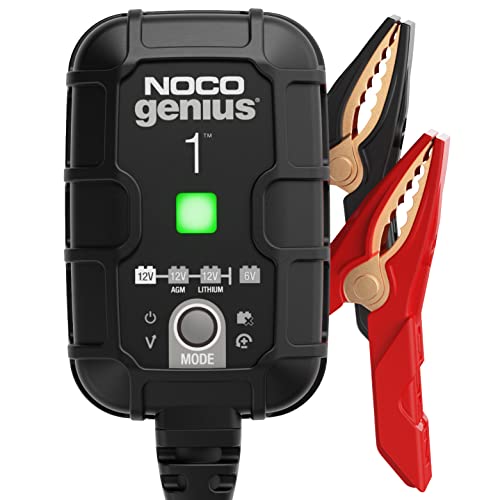
NOCO GENIUS1 1A 6/12V Smart Battery Charger, Trickle Charger & Maintainer | Overcharge Protection, Desulfator, Temperature Compensation, Force Mode, For Lead-Acid (Wet, Gel, AGM) & Lithium (LiFePO4)


As an Amazon Associate we earn from qualifying purchases. Product prices and availability are accurate as of the date/time indicated.
The unit appeals to riders with limited bench space, because a small charger can live in a saddlebag or toolbox and travel to a seasonal storage unit or a friend’s garage without any fuss.
The Genius1 is a compact smart charger in the 1-amp class from NOCO, a brand known for battery chargers and jump starters.
- Pro: A small footprint fits on a shelf or toolbox, making it easy to store and carry between a garage and a second location.
- Pro: Smart charging means the unit monitors the battery and shifts into maintenance mode instead of continuing to push current.
- Con: A 1-amp class unit takes a long time to recharge a larger battery, so match it to a smaller battery or lots of patience.
Skip it if you want one charger that can also handle a full-size car battery in a reasonable time.
CTEK MXS 5.0
It is widely recognized beyond motorcycles, so owners who also keep a car, a boat or a lawn tractor can often use it across several machines instead of buying a separate charger for each.
The MXS 5.0 is a CTEK charger known across Europe and North America for use on cars, motorcycles and other small vehicles.
- Pro: Versatility lets one charger serve a motorcycle, a car and perhaps a lawn tractor, which suits a multi-vehicle household.
- Pro: CTEK is a long-established charger brand, so manuals, accessories and compatible harnesses are easy to locate.
- Con: A charger built for several vehicle types may be more than a single small motorcycle needs, which adds size and cost.
Skip it if you only own one small bike and want the lightest, simplest maintainer possible.
Optimate 4 Dual Program

Optimate 4 Quad Program | Premium Edition, TM631-PR, Gold Series: 9-Step 12V / 12.8V 1.25A Sealed Battery Saving Charger & maintainer


As an Amazon Associate we earn from qualifying purchases. Product prices and availability are accurate as of the date/time indicated.
Riders who care about controlling the charge profile tend to look here first, and a manual that explains each program is worth reading before the first connection so you choose the right one.
The name points to a charger from Optimate with two selectable programs, giving owners more control over the charging profile.
- Pro: Selectable programs help match the charge to different battery types or a seasonal storage routine.
- Pro: Optimate is a respected name among motorcycle owners, and many riders look to it first when shopping for a maintainer.
- Con: More programs mean more to read in the manual, which can slow a beginner who just wants to plug in a tender.
Skip it if you want the simplest set-and-forget tender and do not care about charging profiles.
Optimate 3
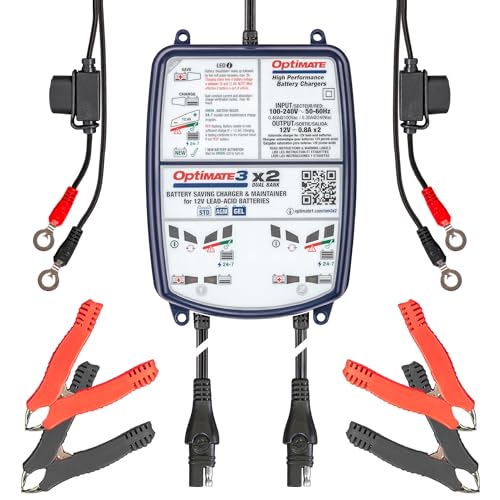
Optimate 3 Dual Bank, TM-451, 7-Step 2x12V 0.8A Sealed Battery Saving Charger & maintainer


As an Amazon Associate we earn from qualifying purchases. Product prices and availability are accurate as of the date/time indicated.
The brand name is closely tied to motorcycle batteries, which is reassuring for riders who prefer to buy from a maker whose whole business is two wheels rather than a general-purpose device.
The Optimate 3 is an entry-level model in the Optimate family, designed with motorcycle batteries in mind.
- Pro: An established motorcycle-focused brand gives you manuals and accessories geared specifically to bikes.
- Pro: A dedicated motorcycle charger usually includes a harness for permanent connection, which saves time every season.
- Con: As a basic model, it may lack features that higher-level Optimate units offer, such as extra programs.
Skip it if you want multiple charging programs or a unit that can switch between battery types, since this basic model keeps things deliberately simple.
Which One Fits
Choose by battery size, the number of vehicles you own and how much control you want.
- One small bike, minimal fuss: Battery Tender Junior or NOCO Genius1.
- Slightly larger battery: Battery Tender Plus.
- Multi-vehicle garage: CTEK MXS 5.0.
- Owners who want programs: Optimate 4 Dual Program.
- Basic motorcycle-brand option: Optimate 3.
If you are undecided, count your batteries and note their chemistry. One lead-acid battery on one bike points to the simple options, while mixed chemistries or several vehicles point toward units with selectable profiles. Then check cable length and plug type against your garage layout, because a charger you cannot reach conveniently will not get used.
Common Mistakes
- Using a car-sized charger on a small motorcycle battery without regulation.
- Ignoring chemistry and charging a lithium battery with a lead-acid profile.
- Leaving a basic charger without float mode connected for months.
- Skipping a fused harness, which forces you to handle terminals every time.
- Storing the bike outdoors with an extension cord exposed to rain.
FAQ
Is a maintainer the same as a charger?
Not quite. A maintainer holds a charge at a low level, while a charger is built to refill a depleted battery faster.
Can I leave a tender connected all winter?
A smart unit with automatic float mode is designed for that. Check the manual to confirm.
Should I protect the bike from salt and sun while it sits?
Yes. A fitted cover helps, and the guide to the best motorcycle cover for hot, salt-air conditions explains what to look for in coastal climates.
Do the same rules apply to a car battery?
Mostly, though amp needs are higher. See the list of car maintenance tools for DIY drivers for charger options sized for cars.
How do I know the battery is healthy?
A resting voltage reading above roughly 12.4 volts on a lead-acid battery is a sign of good charge.