Key takeaways
- Compare the best solar panels for camping, RVs and off-grid setups, from rigid rooftop panels to foldable portable kits that pair with power stations.
The best solar panels for most campers and RV owners are the Renogy 100W N-Type rigid panel for a permanent roof mount, the Jackery SolarSaga 100W Bifacial for portable power station charging, and the Renogy 200W Portable Solar Suitcase for the highest output in a carry-and-set-up kit. The EF ECOFLOW 110W is the strongest foldable option for rough weather, and the Renogy 100W Starter Kit is the simplest way to build a first 12-volt system, with controller and wiring in the box.
As an Amazon Associate, we earn from qualifying purchases.
Table of Contents
- How to Choose a Solar Panel
- Renogy 100W N-Type Solar Panel
- Jackery SolarSaga 100W Bifacial Portable Solar Panel
- EF ECOFLOW 110W Portable Solar Panel
- Renogy 200W Portable Solar Panel Suitcase
- Renogy 100W Solar Panel Starter Kit
- A Note on Availability
- Frequently Asked Questions
- Conclusion
How to Choose a Solar Panel
Start with how the panel will be used. A rigid panel belongs on a roof or a fixed rack, where it stays put and works every day without setup, while a foldable or suitcase panel belongs in a storage bay or a car trunk, coming out only when you stop to camp. Rigid panels give more watts per dollar; portable panels cost more per watt but can be angled toward the sun and packed away.
Wattage decides how fast a battery refills. A 100-watt panel produces around 400 to 500 watt-hours on a day with five hours of direct sun, enough for lights, phones, a small fan, and a 12-volt fridge in modest use. A 200-watt panel roughly doubles that, which matters for larger fridges, laptops, and longer stays off grid. Match the panel to the battery and the load.
Voltage and connectors decide compatibility. Most 12-volt RV and off-grid systems use panels with an open-circuit voltage near 22 to 24 volts and MC4 connectors, which plug into a charge controller. Portable power stations often use a different input, so a panel built for a station brand, or one with an adapter cable, saves a lot of fiddling. A kit with a charge controller is the easiest starting point for a battery system, since the controller protects the battery and lets the panel expand later. For durability, tempered glass and an aluminum frame handle hail and road vibration on a roof, while foldable panels rely on fabric and laminate, so a weather rating and a solid carry case matter more for them.
Renogy 100W N-Type Solar Panel

The Renogy 100W N-Type is the best budget pick for a permanent roof installation. It uses N-type monocrystalline cells with 16 busbars, a design that lifts cell efficiency to 25 percent and cuts the risk of hot spots and hidden cracks. At 100 watts it is the smallest panel here, but also the most straightforward: one rigid panel, four Z brackets in the box, and a standard 12-volt output that works with almost any charge controller. At 13 pounds it fits on camper and van roofs, boat cabins, and small sheds.
Its low temperature coefficient is a real advantage in hot weather, because output falls less as the panel heats up. The tempered glass and corrosion-resistant aluminum frame carry an IP65 weather rating, and Renogy backs the panel with a 10-year warranty on materials and workmanship plus a 25-year commitment to at least 80 percent of its original output. That combination makes it the default choice for a first fixed installation, and a second panel can be added later for a 200-watt array.
Specs
- Rated power: 100 watts
- Cell type: N-type monocrystalline, 16 busbars
- Cell efficiency: 25 percent
- Open-circuit voltage: 22.79 volts
- Short-circuit current: 5.31 amps
- Optimum operating voltage: 19.97 volts
- Optimum operating current: 5.01 amps
- Dimensions: 34.1 x 22.8 x 1.2 inches
- Weight: 13.0 pounds
- Maximum system voltage: 600 volts DC
- Weather rating: IP65
- Warranty: 10-year materials and workmanship, 25-year output commitment
Jackery SolarSaga 100W Bifacial Portable Solar Panel
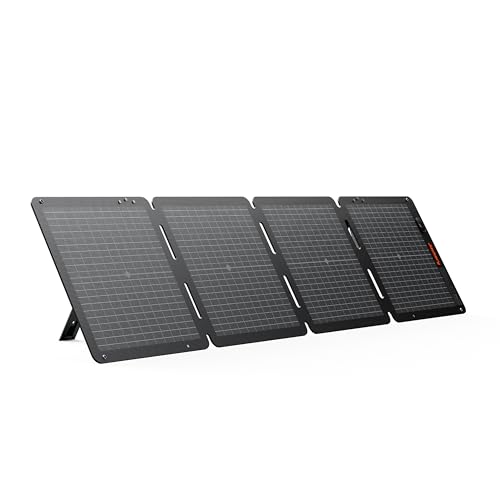
The Jackery SolarSaga 100W Bifacial is the best portable panel for owners of Jackery Explorer power stations. It folds in half, carries by its orange handles, and sets up on its built-in kickstand, so it goes from trunk to campsite in under a minute. The bifacial design collects sunlight on both faces, which lifts output when light reflects off sand, water, or a pale groundsheet. It connects directly to the Explorer 240, 300, 500, 1000, and 1500 stations, and its USB outputs can charge a phone without a station in the loop.
This is a panel built for movement rather than for a roof. It weighs far less than a rigid panel of the same wattage, packs flat, and needs no tools, brackets, or wiring, which makes it a natural fit for weekend camping, tailgating, and emergency backup. Its 100-watt rating matches the input of the smaller Explorer stations, so the panel and the station work as a matched pair. Jackery owners get the most from it; buyers on other station brands should check the connector first.
Specs
- Rated power: 100 watts
- Cell type: Bifacial monocrystalline
- Form factor: Foldable with built-in kickstand
- Outputs: USB outputs for phones and small devices
- Compatible stations: Jackery Explorer 240, 300, 500, 1000, and 1500
- Model number: JS-100F
- Use case: Camping, RVs, rooftops, and off-grid charging
EF ECOFLOW 110W Portable Solar Panel

The EF ECOFLOW 110W is the best foldable panel for rough weather. It folds into a zippered carry case that unfolds into an adjustable kickstand, so the panel can be tilted toward the sun without separate hardware. Its IP68 rating is the strongest weather sealing in this roundup, covering the laminate, the junction box, and the fabric against dust and water. Monocrystalline cells rated at 23 percent efficiency give it a small edge over most 100-watt foldables, and at 8.8 pounds it is light enough to carry anywhere.
The panel connects through an MC4 to XT60 cable, which plugs straight into EcoFlow Delta and River stations, while the MC4 end keeps third-party stations reachable with a low-cost adapter. Its 21.8-volt open-circuit voltage and 6.5-amp short-circuit current sit inside the input window of every River and Delta model, and a single panel matches the River 3 input exactly. The 110-watt rating sits between a 100-watt panel and a heavier 160 or 220-watt unit, with enough output for a weekend of lights, phones, and a small fridge when paired with a mid-size station.
Specs
- Rated power: 110 watts
- Cell type: Monocrystalline
- Conversion efficiency: 23 percent
- Open-circuit voltage: 21.8 volts
- Short-circuit current: 6.5 amps
- Folded dimensions: 16.5 x 20.2 x 0.9 inches
- Weight: 8.8 pounds
- Weather rating: IP68
- Cable: MC4 to XT60 included
- Model number: EF-Flex-110C
Renogy 200W Portable Solar Panel Suitcase
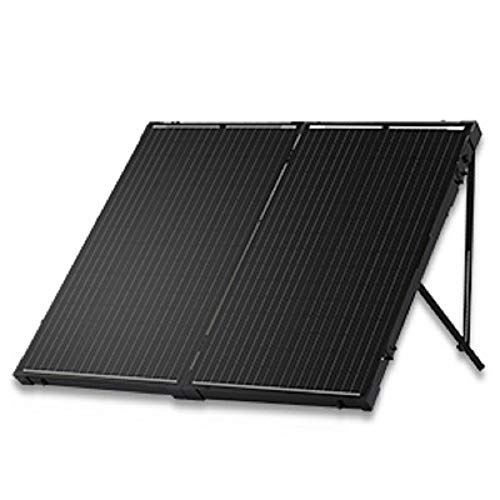
The Renogy 200W Portable Solar Panel Suitcase is the best premium pick for campers who want the most power in a single portable kit. Two 100-watt monocrystalline panels fold into a suitcase case with an adjustable aluminum kickstand, and a waterproof 20-amp Voyager charge controller comes pre-installed, so the kit charges a 12-volt battery as soon as it is unfolded. Alligator clip cables are included, and the kit can produce up to 1,000 watt-hours per day with five hours of direct sunlight, enough for a 12-volt fridge, lights, and charging on a multi-day stay.
At 34.4 pounds it is the heaviest panel in this roundup, the trade-off for tempered glass panels and a built-in controller. It suits RV owners and off-grid users who drive to a site and stay put, rather than hikers or anyone who carries gear far from the vehicle. The controller works with multiple battery types, and the MC4 output keeps the kit compatible with power stations through an adapter.
Specs
- Rated power: 200 watts
- Cell type: Monocrystalline, two 100-watt panels
- Form factor: Foldable suitcase with adjustable kickstand
- Charge controller: 20-amp Voyager PWM, waterproof, pre-installed
- Open-circuit voltage: 24.3 volts
- Short-circuit current: 10.42 amps
- Efficiency: 22.5 percent
- Folded size: 41.81 x 20.87 x 2.76 inches
- Weight: 34.4 pounds
- Connector type: MC4
- Warranty: 3-year panels, 2-year controller
Renogy 100W Solar Panel Starter Kit

The Renogy 100W Solar Panel Starter Kit is the best mid-range pick for a first 12-volt solar system. It bundles a 100-watt monocrystalline panel with a Wanderer 30-amp PWM charge controller, an adaptor kit, tray cables, and Z brackets, so everything needed to start charging a battery is in one box. The panel produces an average of 500 watt-hours per day with five hours of direct sunlight, and the controller supports expansion up to 400 watts by adding more of the same panels.
The panel uses monocrystalline cells rated at 22 percent efficiency, with an open-circuit voltage of 24.3 volts and a short-circuit current of 5.21 amps. Pre-drilled holes and included brackets make roof mounting quick, and the 30-amp controller protects the battery from overcharge. At 14.1 pounds, the kit stays manageable for a single person to install on a camper, shed, or cabin, and it is the simplest route here from an empty roof to a working off-grid system.
Specs
- Rated power: 100 watts
- Cell type: Monocrystalline
- Cell efficiency: 22 percent
- Open-circuit voltage: 24.3 volts
- Short-circuit current: 5.21 amps
- Optimum operating voltage: 20.4 volts
- Optimum operating current: 4.91 amps
- Maximum system voltage: 600 volts DC
- Charge controller: Wanderer 30-amp PWM included
- Weight: 14.1 pounds
- Expandable to: 400 watts with additional panels
A Note on Availability
Two panels in this roundup showed no featured offers on their Amazon listings at the time of research: the Renogy 100W N-Type rigid panel and the Renogy 200W Portable Solar Panel Suitcase. That can mean the panel is temporarily out of stock, sold through a third-party seller, or moving to a newer version, so check availability and the seller before ordering either one. The other three panels showed live offers during research, but stock moves quickly in camping season, so confirm availability for every pick before you buy.
Frequently Asked Questions
How many watts of solar panel do I need for camping?
A 100-watt panel covers lights, phones, and a small fan, producing around 400 to 500 watt-hours on a sunny day. A 200-watt panel roughly doubles that and supports a 12-volt fridge plus laptops on a longer stay. Size the panel to the battery and the daily load.
Can I use a portable solar panel with any power station?
Most portable panels use MC4 connectors or a brand-specific cable, so compatibility depends on the input port and voltage window of the station. Panels built for one brand, such as the Jackery SolarSaga or the EcoFlow 110W, connect directly to their own stations and need an adapter for others. Check the voltage against the station manual before buying.
Do I need a charge controller with a solar panel?
A charge controller is needed when a panel charges a 12-volt battery directly, because it regulates voltage and prevents overcharging. Portable power stations have a controller built in, so a panel can plug straight into them. Kits that include a controller cover battery systems out of the box.
Are rigid or foldable solar panels better?
Rigid panels give more watts per dollar, last longer in fixed installations, and need no setup once mounted. Foldable panels cost more per watt but can be angled toward the sun, moved into the light, and packed away for travel. Choose rigid for a roof and foldable for a campsite or a trunk.
Conclusion
The right solar panel depends on where it will live. The Renogy 100W N-Type is the best budget pick for a permanent roof mount, with strong efficiency and a long warranty. The Jackery SolarSaga 100W Bifacial and the EF ECOFLOW 110W are the best portable picks, one matched to Jackery stations and the other sealed against the worst weather. The Renogy 200W Suitcase is the best premium pick for the highest portable output with a controller already installed, and the Renogy 100W Starter Kit is the simplest way to build a first 12-volt system. Pick the form factor first, match the watts to the battery, and check availability before ordering.
Product and ASIN Reference
| Renogy 100W N-Type Solar Panel | B0BWR7HT34 |
| Jackery SolarSaga 100W Bifacial Portable Solar Panel | B0D5CCY5Y2 |
| EF ECOFLOW 110W Portable Solar Panel | B0B7KY3D15 |
| Renogy 200W Portable Solar Panel Suitcase | B07RFQVB9M |
| Renogy 100W Solar Panel Starter Kit | B00BFCNFRM |