Key takeaways
- Compare the best ski poles for kids by your child's height, with adjustable and fixed lengths, junior grips and aluminium or carbon shafts explained.
As an Amazon Associate we earn from qualifying purchases.
A child’s first poles are a technique tool, not a badge of progress. The right pair helps a young skier plant, push and keep rhythm on flat cat tracks, and the wrong pair — too long, with an adult grip a small gloved hand cannot close around — teaches them to wave their arms and lean back instead. Kids’ poles are simple: a junior grip, a strap a child can manage, and a length matched to the child’s height rather than their age or shoe size.
This roundup covers five real junior poles sold on Amazon: one telescopic model that grows with the child, three fixed-length aluminium poles, and one carbon step-up pole for an older child who skis hard. Every length, material and grip detail below comes from the maker’s own listing for the exact product linked, and where a listing contradicts itself or leaves a figure out, the article says so instead of smoothing it over.
This article contains affiliate links, and if you buy through one of them the site may earn a commission at no extra cost to you.
Quick Answer
For most families, the Atomic AMT Jr Telescopic is the practical buy: it adjusts from 75 to 105 cm, so one pair covers several seasons of growth and can be shared between siblings. If you prefer a fixed pole sized exactly to your child today, the LEKI Kids’ Rider is a light aluminium pole with a junior Turbo Sport grip, sold in 5 cm steps. The Swix Tech Junior is the budget fixed-length option, the Rossignol Tactic Jr suits a taller child at 100 cm, and the Zipline Lollipop 14.0 is the carbon step-up for an older young skier.
How to Choose
Size by height and the forearm check, never by age
Pole length is set by the child’s body, and each maker publishes its own sizing guidance for its own poles — use the chart on the exact listing you are buying, because ranges differ between brands. The fitting check instructors use is physical, not a conversion table: have the child stand in ski boots, turn the pole upside down and grip it under the basket, then rest the grip on the floor. The forearm should sit roughly parallel to the floor, with the elbow near a right angle. A pole that lifts the forearm well above level is too long; one that drops it below level is too short. Re-check each season — a pole that fit in November can be short by March.
Adjustable versus fixed length
An adjustable telescopic pole, like the Atomic below, trades a little simplicity for range: one pair covers 75 to 105 cm, survives growth spurts, and can pass between siblings. The trade-offs are a locking mechanism a child must learn to close firmly and a slightly heavier build. A fixed-length pole has nothing to slip and usually costs less, but it fits for a season or two at most, and it only works if you size it honestly — buy for the height your child is now, not the height you hope for by February. An over-long pole pushes a child’s hands up and back and works against everything their instructor is teaching.
Shaft material: aluminium first, carbon later
Aluminium is the default for children and the material of four of the five picks here. It bends rather than snaps when it meets a ski edge or a lift chair, survives being dropped and dragged, and is cheap to replace when it does bend. Carbon shafts, like the Zipline pick, are lighter and absorb more vibration at each plant, which matters to an older child skiing full days at speed — and very little to a six-year-old on a magic carpet. Match the material to the skier, not to the marketing.
Grips, straps and baskets
The grip is the main thing that makes a junior pole a junior pole. A child’s hand inside a ski glove cannot close around an adult grip, so look for a grip the maker describes as junior-sized, with a strap the child can manage with gloves on. Straps should be taught properly — hand up through the loop, then grip over the top — and some instructors remove straps for the youngest beginners; follow your ski school’s practice. Baskets on junior alpine poles are small standard baskets that stop the tip sinking into groomed snow; none of these poles is a powder tool, and a pole is a technique aid, not safety equipment.
The Picks
1. Atomic AMT Jr Telescopic Adjustable — the grow-with-them pick
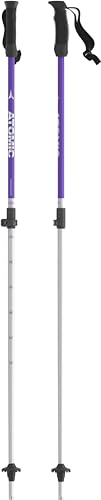
Atomic’s AMT Jr Telescopic is the only adjustable pole in this roundup: the listing gives its size as 75 cm to 105 cm adjustable (part number AJ5005824001), spanning the junior range from a small beginner to a near-teen in one pair. The two-section telescopic shaft locks at the length your child’s forearm check calls for, so the same pair can be re-set after a growth spurt and handed between siblings. Atomic builds the AMT line around an aluminium shaft with a junior grip sized for smaller hands and an adjustable strap. The honest costs are the lock itself — teach your child to close it fully and check it at the top of the lift — and a little more complexity than a fixed stick.
See the Atomic AMT Jr Telescopic on Amazon
2. LEKI Kids’ Rider — the fixed-length staple

The LEKI Kids’ Rider is the straightforward choice: a lightweight aluminium junior pole with LEKI’s Turbo Sport grip, sold in fixed lengths in 5 cm steps so you can match the forearm check precisely. The linked listing is the 85 cm size in Darkblue-Light Turquoise-White (part number 65344143-BLUE-WHITE-85cm), and its specification block gives an item weight of 10.37 ounces — light enough that a young skier is not dragging dead weight up the lift. LEKI sells the Rider across a wide span of junior lengths, so the same model covers a child from their first seasons into the early teens; pick the size from LEKI’s own guidance and the physical check, not from the child’s age. There is no adjustment to go wrong and nothing to maintain.
See the LEKI Kids’ Rider on Amazon
3. Swix Tech Junior — the budget fixed-length pole

Swix sells the Tech Junior as a simple, sturdy children’s pole: an aluminium alloy shaft, a Swix Junior handle in soft, contoured material shaped for small hands in youth gloves, an adjustable strap, and a standard alpine basket. Swix offers it in eight lengths from 70 to 105 cm in 5 cm steps, aimed at children from about 4 through 12 — use that age span only as a starting point and confirm with the forearm check. Two honest flags: the listing publishes no weight, and it contradicts itself on length — one field shows 90 cm while the size field shows 80 cm — so choose the length in the size selector and confirm it before paying.
See the Swix Tech Junior on Amazon
4. Rossignol Tactic Jr — for the taller child who skis every weekend

The Rossignol Tactic Jr listing is a 100 cm pole, at the tall end of the junior range — the pick for an older child whose forearm check already calls for a metre of pole. Rossignol builds it on an aluminium DURAL shaft and puts the design effort into the grip: a junior-specific grip with a smaller circumference and vibration-damping material, because a child whose hand cannot close around the grip cannot plant the pole cleanly. That smaller grip is the real reason to choose it over a cheap adult pole in the same length. Be aware of what the listing does not say: it publishes only a couple of lines of description, with no strap, basket or tip details, and its title and colour field disagree on the colour.
See the Rossignol Tactic Jr on Amazon
5. Zipline Lollipop 14.0 — the carbon step-up for older kids

The Zipline Lollipop is the junior line from a maker known for graphite poles, and the 14.0 pairs a graphite carbon composite shaft of 14.0 mm with Zipline’s ZipGrip, a trigger-finger style grip, and hook-and-loop straps. The linked listing is the 112 cm (44 inch) pole, the top of the junior length range, so this is a pole for an older child or young teen whose size check lands at 112 cm and who skis hard enough — all-mountain, park and pipe are the uses Zipline names — to feel a lighter, damper shaft at every plant. Carbon’s trade-offs are real for children: it costs more than the aluminium poles above and does not forgive being slammed in a car door. The listing does not publish a weight, a pity because low weight is the main reason to buy carbon; what is verifiable is the shaft material, the grip design and the length.
See the Zipline Lollipop 14.0 on Amazon
Who Should Skip
Skip poles entirely for many first lessons. A large share of ski instructors start young beginners without poles at all, because new skiers use them as crutches — leaning on them, sitting back and steering with their arms instead of their feet — and most ski schools introduce poles only once a child can turn and stop comfortably. If your child’s instructor says not yet, this roundup can wait a season, and that is the correct outcome. Skip the adjustable Atomic if your child is rough on locking mechanisms; skip fixed-length poles mid-growth-spurt; and skip the carbon Zipline for any child in their first two seasons. Finally, skip any pole as a substitute for properly fitted boots and bindings set by a certified technician: poles are technique aids, not safety equipment.
FAQ
How do I know what length of ski pole my child needs?
Use the maker’s own size guidance for the exact pole, then confirm it physically: in ski boots, your child grips the upside-down pole under the basket with the grip resting on the floor, and the forearm should sit roughly parallel to the floor. Never size from an age or shoe-size conversion, and re-check each season.
Are adjustable ski poles worth it for kids?
For most families, yes. A telescopic pole like the Atomic AMT Jr covers 75 to 105 cm, so it absorbs growth spurts and can be shared between siblings. A fixed pole is simpler, lighter and cheaper, but fits for a season or two. The adjustable lock must be closed firmly and checked — that small routine is the whole cost of the flexibility.
Should a beginner child ski with poles at all?
Often not at first. Many instructors start young beginners pole-free so they learn balance and turning with their feet, and add poles once turns and stops are reliable. Follow your ski school’s guidance; buying poles before the instructor wants them usually slows learning.
Aluminium or carbon for a child’s ski poles?
Aluminium for almost every child: it bends instead of snapping, survives drops and costs little to replace. Carbon, like the Zipline Lollipop here, is lighter and calmer at speed, which an older, committed young skier can genuinely feel. For a child in their first seasons, the difference is not one they can use.
Final Verdict
Buy the Atomic AMT Jr Telescopic if you want one pair of ski poles for kids that survives several seasons of growth; buy the LEKI Kids’ Rider for a light fixed pole sized exactly to your child today; take the Swix Tech Junior as the budget stick, the Rossignol Tactic Jr for a taller child who needs the smaller junior grip at 100 cm, and the Zipline Lollipop 14.0 when an older young skier has earned the carbon step-up. Size whichever you choose by your child’s height and the forearm check, using each maker’s own chart — and if the instructor says no poles yet, listen to the instructor.
Product and ASIN Reference
| Product | ASIN |
|---|---|
| Atomic AMT Jr Telescopic Adjustable Youth Ski Poles | B0DC6N3JMZ |
| LEKI Kids’ Rider Lightweight Aluminum Ski Poles | B0CG2JZKYJ |
| Swix Tech Junior Ski Poles | B01LZVDEE2 |
| Rossignol Tactic Jr Ski Poles | B0DDTJSJD4 |
| Zipline Lollipop 14.0 Graphite Carbon Composite Ski Poles | B0BYY715CK |