
Key takeaways
- Compare five proven compasses for hiking, camping and survival, from a mirror sighting compass to rugged lensatic models, and pick the right one.
A compass never needs charging, never loses signal, and never asks for a software update. When a phone battery dies in the cold, when fog swallows a trail, or when a mapped route simply is not where the map says it should be, a needle, a map, and a bearing are what get you back to camp. The best compasses pair a stable, well-damped needle with a clear baseplate or a precise sighting system, readable scales, and a declination adjustment you can set once and trust.
As an Amazon Associate, we earn from qualifying purchases.
Table of Contents
- Quick Answer
- How to Choose a Compass
- 1. Silva Ranger 2.0 Compass, Black
- 2. Suunto M-3 NH Compass
- 3. Eyeskey EK-01 Lensatic Compass, Camouflage
- 4. Sportneer Military Lensatic Compass, Army Green
- 5. AOFAR AF-4074 Lensatic Compass, Camouflage
- FAQ
- Conclusion
- Product and ASIN Reference
Quick Answer
If you want one compass for hiking and map work, get the Suunto M-3 NH: a proven baseplate design with adjustable declination, a magnifying lens, and luminous markings, balanced for the Northern Hemisphere. If you want the most capable tool for long-distance bearings and slope measurement, the Silva Ranger 2.0 adds a sighting mirror, a clinometer, and a distance lanyard. For a tough metal compass that shrugs off drops and bad weather, the Eyeskey EK-01 is the best-value lensatic, while the Sportneer and AOFAR cover the same ground at the budget end, with the AOFAR adding a built-in inclinometer.
How to Choose a Compass
Start with how you will navigate. A baseplate compass sits flat on a paper map, so you can take a bearing from the map, transfer it to the ground, and follow it. That is the core skill for hiking, backpacking, and orienteering. A lensatic compass is sighted like a rifle: you look through a rear sight at a distant landmark and read the bearing off a floating dial. It is faster for field bearings and far tougher, but clumsier for plotting routes on a map.
Declination adjustment matters more than most beginners expect. Magnetic north and true north differ by several degrees in most places, and that difference changes with location. A compass with a declination system lets you set the local correction once and then read true bearings directly. Without it, you must add or subtract the correction on every bearing, which invites mistakes when you are tired or cold.
Weight and size are real trade-offs. A baseplate compass weighs about an ounce and slips into a hip-belt pocket. A metal lensatic compass weighs several times more, but it survives drops onto rock that would crack a plastic housing. If you carry a compass as a backup to a phone, light and simple wins. If the compass is your primary navigation tool on a multi-day trip, durability and sighting precision deserve more weight in the decision.
Check the needle system and the scales. A liquid-filled capsule damps the needle so it settles quickly instead of swinging, and a global needle stays balanced across magnetic zones and both hemispheres. The most useful map scales for North American hikers are 1:24,000 USGS quads, 1:25,000, and 1:50,000, plus inch and millimeter rulers. A magnifying lens helps with fine contour lines, and a sighting mirror adds accuracy for long-distance bearings.
1. Silva Ranger 2.0 Compass, Black

The Silva Ranger 2.0 is the premium pick in this roundup, a mirror sighting compass built for experienced navigators who need accuracy over long distances. The folding mirror lets you sight a landmark and read the bearing at the same time, which is the most accurate way to take a field bearing with a handheld compass. A slope card and a distance lanyard come in the box.
The baseplate carries map scales of 1:25,000, 1:50,000, and 1:24,000 USGS, plus millimeter, inch, and GPS scales, so it matches the most common topographic maps. The built-in declination adjuster, clinometer, and magnifying lens cover the rest of serious map work, and rubber friction feet keep the compass from sliding on the map. The DryFlex grip makes the housing easy to hold with cold or wet hands.
At 86 grams, the Ranger 2.0 is heavier than a simple baseplate compass, and its feature set is more than a casual day hiker needs. But for mountain navigation, navigation courses, and off-trail travel, it is one of the most complete tools available, and Outdoor Life names it the best compass for hiking.
Specs
- Type: Mirror sighting compass with clear baseplate
- Weight: 86 g
- Accuracy: 2 degrees
- Declination: Built-in adjuster
- Scales: 1:25k, 1:50k, 1:24k USGS, mm, inch, GPS
- Features: Clinometer, magnifying lens, slope card, distance lanyard, luminous markings
- Grip: DryFlex rubber grip with friction feet
- Temperature range: Minus 20 to plus 60 degrees C
- Part number: 37038-PE
- Best for: Serious hikers, mountain navigation, navigation courses
2. Suunto M-3 NH Compass
The Suunto M-3 NH is the classic baseplate compass, and it is the pick we recommend first for most hikers. Its long, transparent baseplate is easy to lay on a map, the rotating housing is marked in two-degree increments, and the adjustable declination correction is smooth to set and firm enough to hold while you move. A magnifying lens and luminescent markings help with fine map detail and low-light use.
The M-3 NH is balanced for the Northern Hemisphere and carries metric and imperial scales, so it suits the USGS topo maps most North American hikers use. The liquid-filled capsule steadies the needle, and the detachable locking lanyard keeps the compass on your person. Three small rubber feet on the baseplate help you draw a clean bearing line on the map.
What the M-3 NH does not have is a mirror or a clinometer, so long-distance sighting bearings are less precise than with the Silva Ranger 2.0, and slope measurement needs a separate tool. That is a fair trade for a compass that is simpler, lighter, and easier to learn, and scout navigation guides consistently recommend the M-3 as the step up from a starter compass.
Specs
- Type: Baseplate compass
- Weight: 1.6 oz
- Dimensions: 4.72 x 2.4 x 0.55 inches
- Increments: 2 degrees
- Declination: Adjustable
- Scales: Metric and imperial
- Features: Magnifying lens, luminescent markings, detachable locking lanyard, rubber feet
- Capsule: Liquid-filled
- Balance: Northern Hemisphere
- Best for: Hiking, backpacking, scouting, general map navigation
3. Eyeskey EK-01 Lensatic Compass, Camouflage
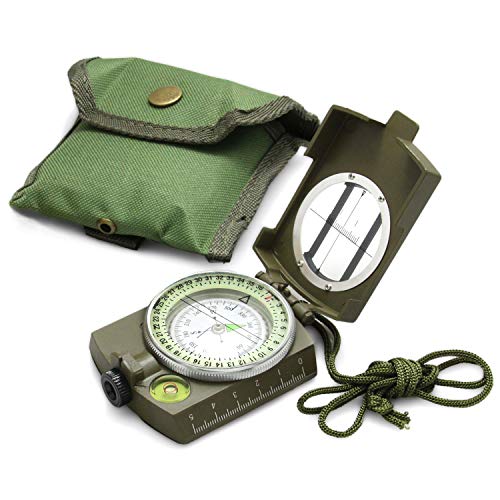
The Eyeskey EK-01 is the best-value lensatic compass in this roundup. Its zinc alloy housing is waterproof and shockproof, and the liquid-filled capsule with a sapphire jewel bearing lets the floating dial settle quickly and steadily. The dial reads in 360 degrees, and the sighting lens magnifies the card for precise readings.
This is a proper military-style lensatic compass: a folding metal cover, a thumb hold, a sighting hairline, and a pouch and lanyard in the box. It is heavier than any baseplate compass here, at just under 193 grams, but that weight buys a tool that survives drops, rain, and rough packing. The operating range runs from minus 30 to plus 60 degrees C, so it keeps working in winter cold that can make cheap compasses sluggish.
Specs
- Type: Lensatic sighting compass
- Weight: 192.6 g
- Dimensions: 85 x 63 x 30 mm
- Dial: Floating card, 360-degree scale
- Accuracy: Plus or minus 1 degree
- Housing: Zinc alloy, waterproof and shockproof
- Bearing: Sapphire jewel bearing, liquid-filled capsule
- Features: Fluorescent dial, sighting lens, pouch and lanyard included
- Temperature range: Minus 30 to plus 60 degrees C
- Part number: EK1001-M
- Best for: Survival kits, field bearings, rough outdoor use
4. Sportneer Military Lensatic Compass, Army Green
The Sportneer is the budget lensatic in this roundup, a metal military-style compass with a rear sight lens, a glow-in-the-dark dial, and a carrying pouch. Its metal base and cover are waterproof and shockproof, and the lensatic sighting system magnifies the dial for precise readings.
At 0.39 pounds, the Sportneer is lighter than the Eyeskey and the AOFAR, which makes it an easy addition to a day pack or a scout kit. Multiple guide roundups rank it as a top budget military-style compass, and it is a popular choice for beginners who want a real lensatic compass without paying for tritium illumination or a military-issue brand name.
The trade-offs are modest. The dial is fluorescent rather than tritium, so it needs light exposure to glow, and the listing has no independent tracker page, so the verification here rests on the Amazon listing itself plus guide coverage. For a first lensatic compass, a backup navigator, or a gift for a young hiker, it covers the essentials well.
Specs
- Type: Lensatic sighting compass
- Weight: 0.39 lb
- Dimensions: 3.3 x 2.5 x 1 inches
- Housing: Metal base and cover, waterproof and shockproof
- Features: Rear sight lens, glow-in-the-dark dial, strap and pouch included
- Part number: 4333560717
- Color: Army Green
- Best for: Beginners, scouts, budget lensatic navigation, backup use
5. AOFAR AF-4074 Lensatic Compass, Camouflage
The AOFAR AF-4074 rounds out the lensatic trio with one feature the others lack: a built-in inclinometer. That lets you measure slope angles and elevation changes in the field, which is useful for avalanche awareness, surveying, and route planning in steep terrain. The zinc alloy body is waterproof and shakeproof, and the thermoelastic liquid-filled capsule keeps the dial stable.
One caution: the listing carries several UPCs across its variants, so confirm you are looking at the Camouflage AF-4074 before ordering. For slope measurement in a tough metal package, it is the most capable budget lensatic here.
Specs
- Type: Lensatic sighting compass with inclinometer
- Housing: Zinc alloy, waterproof and shakeproof
- Capsule: Thermoelastic liquid-filled
- Features: Inclinometer, adjustable prism lens, sighting hairline, thumb hold, magnifying viewer
- Dial: 360-degree scale, fluorescent
- Included: Carrying bag, lanyard, manual
- Part number: AF-4074
- Color: Camouflage
- Best for: Slope measurement, hunting, camping, field navigation
FAQ
Do I still need a compass if my phone has GPS?
Yes. A phone is a fine primary navigator, but batteries die, screens crack, and signals vanish in canyons and dense forest. A compass weighs almost nothing, needs no power, and works in any weather. Carry one as a backup on every hike, and learn the basic skills to use it with a paper map before you need them.
What is the difference between a baseplate compass and a lensatic compass?
A baseplate compass is a flat, clear plate with a rotating housing that sits on a map for taking and plotting bearings. A lensatic compass is a folding metal instrument with a sighting lens and a floating dial, built for precise bearings on distant landmarks. Baseplate compasses suit map work; lensatic compasses are tougher and better for field sighting.
How do I set declination on a compass?
Find the magnetic declination for your area from your map or a declination chart, then turn the declination adjustment on the compass until the index mark matches that value. On tool-free models like the Brunton designs, you rotate the capsule; on the Suunto M-3 and Silva Ranger 2.0, you use the built-in adjuster or a small screw. Set it once for your area and check it when you travel to a new region.
Which compass is best for a beginner?
A baseplate compass with adjustable declination, such as the Suunto M-3 NH, is the best first compass. It is light, simple to learn, and works directly on a map. A budget lensatic like the Sportneer is a good second compass or a first choice if you prefer military-style field navigation and want a tougher metal tool.
Conclusion
The right compass depends on how you navigate. For map-based hiking and backpacking, the Suunto M-3 NH is the best all-around choice, and the Silva Ranger 2.0 is the upgrade for serious mountain navigation and long-distance bearings. For tough field work, the Eyeskey EK-01 is the best-value lensatic, the Sportneer is the lightest budget option, and the AOFAR AF-4074 adds slope measurement that the others lack. Whichever you choose, learn to use it with a paper map before your next trip, because a compass only helps if you know how to read it.
Product and ASIN Reference
| Compass | ASIN |
|---|---|
| Silva Ranger 2.0 Compass, Black | B079Y5CFPR |
| Suunto M-3 NH Compass | B00XANJRHG |
| Eyeskey EK-01 Lensatic Compass, Camouflage | B00QR3LPXK |
| Sportneer Military Lensatic Compass, Army Green | B01MY6VVWU |
| AOFAR AF-4074 Lensatic Compass, Camouflage | B07W53MJRM |

