Key takeaways
- Compare volume-limiting headphones for kids for travel and school, with maker-stated dB limits, Bluetooth and wired options, mics and sharing ports.
- Top Pick: Puro Sound Labs PuroQuiet Plus (Teal)
- Runner-up: JBL Junior 320BT (Purple)
- Also consider: Puro Sound Labs BT2200 Plus (Purple)
Volume-limiting headphones for kids cap how loud the audio can get, and each maker publishes its own maximum output figure in decibels. Those figures are manufacturer specifications measured under the maker’s own test conditions, not guarantees of what reaches your child’s ears. Fit matters: an ear cup that seals poorly lets outside noise in, which tempts kids to push the volume up, and the source device’s own volume setting also affects the actual level. Read every dB number below as a stated specification to compare between models, and pair it with sensible listening habits and regular breaks.
As an Amazon Associate, we earn from qualifying purchases.
The five picks below cover the main formats families ask about. Four are Bluetooth models for wireless listening on planes, in cars and at home, and one is a wired model with a built-in sharing port for siblings. Some include a microphone for calls and classes, some fold flat for a backpack, and one adds active noise cancellation.
This article contains affiliate links, and we may earn a commission if you buy through them, at no extra cost to you.
Quick Answer
For most families, the Puro Sound Labs PuroQuiet Plus is the strongest pick: its maker states an 85 dB maximum output, active noise cancellation for cabins and classrooms, up to 35 hours of battery life, and a wired backup cable. Every pick below publishes its own volume limit, so compare the figures before choosing.
Puro Sound Labs PuroQuiet Plus (Teal)
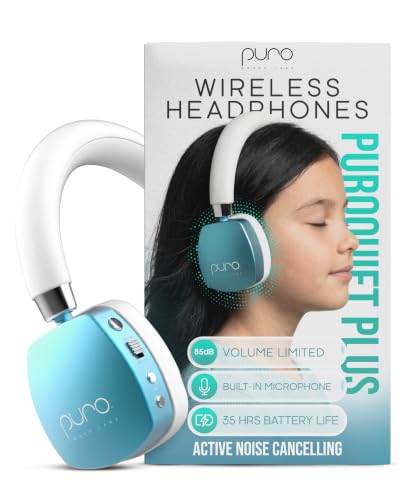
The PuroQuiet Plus is Puro Sound Labs’ flagship kids headphone, an on-ear Bluetooth model with active noise cancellation. Puro states that its volume-limiting technology caps output at 85 dB, and the same limit applies over the included volume-limiting 3.5mm auxiliary cable, a useful fallback for seat-back screens or a flat battery.
The maker rates battery life at up to 35 hours with noise cancellation off and up to 23 hours with it on, with a stated Bluetooth range of 30 feet. A built-in microphone covers calls and online classes. Puro does not state a recommended age for this model in its listing data, so treat fit as the deciding factor for younger kids.
Specs:
– Maker-stated volume limit: 85 dB maximum output
– Connection: Bluetooth 5.1, plus wired mode via included volume-limiting 3.5mm cable
– Noise control: active noise cancellation, maker-stated reduction of up to 22 dB
– Battery life: up to 35 hours with ANC off, up to 23 hours with ANC on (maker-stated)
– Driver: 40mm dynamic driver
– Microphone: built-in, for calls and classes
– Form factor: on-ear, sized for kids
See it on Amazon: https://www.amazon.com/dp/B0CP4NDBPT?tag=trustedtoppicks-20
JBL Junior 320BT (Purple)

The JBL Junior 320BT is a wireless on-ear headphone built around JBL Safe Sound, which the maker describes as a maximum volume of under 85 dB. What separates it from most rivals is the parental control layer: through the JBL Headphones app, a parent can keep the automatic 85 dB ceiling or set a lower custom maximum, and can also set playtime limits and check listening activity.
JBL states a battery life of up to 50 hours, the longest figure in this roundup, along with Bluetooth 5.3 and a built-in microphone for calls. The ear cups are sized for kids and the controls are simple. JBL does not publish an age range for the 320BT in its listing data, so check the fit on smaller toddlers before a long flight.
Specs:
– Maker-stated volume limit: under 85 dB (JBL Safe Sound)
– Parental controls: JBL Headphones app with customizable volume limit, playtime limits and activity monitoring
– Connection: Bluetooth 5.3 wireless
– Battery life: up to 50 hours (maker-stated)
– Microphone: built-in, for calls
– Form factor: on-ear, sized for kids
See it on Amazon: https://www.amazon.com/dp/B0DVTF5VK1?tag=trustedtoppicks-20
Puro Sound Labs BT2200 Plus (Purple)
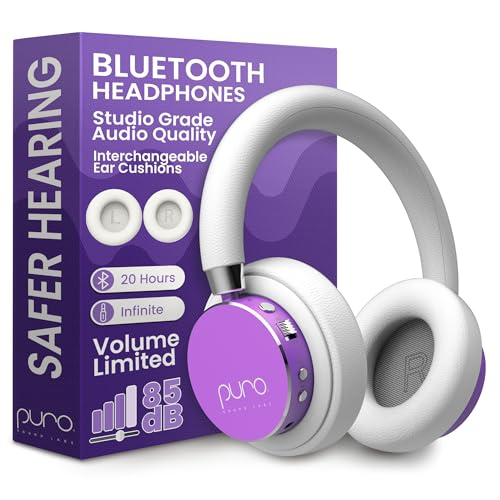
The BT2200 Plus is Puro’s lighter, simpler Bluetooth option, with the same published approach to volume: the maker states a maximum output of 85 dB. It drops the active noise cancellation of the PuroQuiet Plus, which keeps it lighter on the head, and instead competes on fit flexibility. The ear cushions are switchable between on-ear and over-ear styles, so the same headphone can be adjusted as a child grows.
Puro rates the battery at 20 hours of music playback with 200 hours of standby, and a built-in microphone handles calls and remote learning. A hard case is included for travel. The listing does not pin down a specific age band, so use the adjustable headband range and cushion choice as your fit guide.
Specs:
– Maker-stated volume limit: 85 dB maximum output
– Connection: Bluetooth wireless
– Battery life: 20 hours of music playback, 200 hours standby (maker-stated)
– Ear cushions: switchable on-ear and over-ear cushions included
– Microphone: built-in, for calls and classes
– Included accessory: hard travel case
– Form factor: on-ear, with over-ear cushion option
See it on Amazon: https://www.amazon.com/dp/B0C3T8YSZZ?tag=trustedtoppicks-20
iClever BTH02 (Green)

The iClever BTH02 is the value-focused Bluetooth pick, and its listing leads with battery endurance: the maker states up to 93 hours of playtime with USB-C fast charging, so one charge can cover weeks of school runs and several long trips. Its stated volume limit is 85 dBA, and it works in both wireless and wired modes, so a dead battery on a plane does not have to mean silence if you pack the cable.
Dual 40mm drivers, an adjustable headband and a foldable design cover the practical basics, and the built-in microphone is there for calls and online lessons. The fold-flat shape slips into a seat-back pocket or a small daypack more easily than bulkier designs. iClever does not state a recommended age for the BTH02 in its listing data, so judge it by head size and fit.
Specs:
– Maker-stated volume limit: 85 dBA
– Connection: Bluetooth 5.4 wireless, plus wired mode
– Battery life: up to 93 hours (maker-stated), USB-C fast charging
– Drivers: dual 40mm drivers
– Microphone: built-in, for calls and classes
– Design: foldable with adjustable headband
– Form factor: on-ear
See it on Amazon: https://www.amazon.com/dp/B07Y83TWKN?tag=trustedtoppicks-20
LilGadgets Connect+ Pro (Pink)

The Connect+ Pro is the wired pick, built for two jobs the Bluetooth models do not do as well: school-issued devices with a headphone jack, and siblings sharing one screen. Its SharePort is a second socket built into the headphone, so a second LilGadgets headphone plugs straight into the first and both children hear the same device, with no splitter to buy or lose. The cable is detachable, so the most commonly damaged part can be replaced on its own.
LilGadgets publishes a higher stated ceiling than the Bluetooth picks: its manual specifies a maximum volume of 93 dB, plus or minus 2 dB at 1 kHz. That is noticeably above the 85 dB figures elsewhere in this list, so parents who want the lower ceiling should weigh that difference and use the source device’s own volume limiter as a second control. The brand rates the Connect+ Pro for ages 6 and up, and fits it with SoftTouch padding, an in-line microphone and a travel pouch.
Specs:
– Maker-stated volume limit: 93 dB maximum (plus or minus 2 dB at 1 kHz, per the maker’s manual)
– Connection: wired 3.5mm, detachable 4-foot braided nylon cable
– Sharing: built-in SharePort for daisy-chaining a second headphone without a splitter
– Drivers: 40mm; frequency response 20Hz to 20kHz; impedance 32 ohms
– Microphone: in-line microphone for calls and classes
– Form factor: over-ear with SoftTouch padding
– Included accessory: travel pouch
– Recommended age: 6 years and up (maker guidance)
See it on Amazon: https://www.amazon.com/dp/B06XT71RZ4?tag=trustedtoppicks-20
How to Choose
Start with the stated volume limit, and treat it as a specification rather than a promise. Makers measure maximum output under their own conditions, and the level a child actually hears also depends on ear-cup fit, the source device and the content itself. A model stating 85 dB and a model stating 93 dB are not equivalent on paper, so decide which ceiling you are comfortable with first, then use the device’s own volume limiter as a second control either way.
Next, choose wired or wireless honestly. Bluetooth models remove the cable that gets yanked and tangled, but they need charging and can go flat mid-flight unless they also offer a wired mode, as the PuroQuiet Plus and iClever BTH02 do. A wired model like the Connect+ Pro never needs charging and works with seat-back screens and school Chromebooks, at the cost of a cable. For travel, foldability and a case matter, and a built-in microphone is worth insisting on if the headphones will double for online classes. Finally, check fit on the child who will wear them: a loose fit leaks sound, and kids compensate by turning things up.
Who Should Skip
Skip this whole category if your child will only listen at home on a device you already control tightly; a standard headphone paired with a strict device-level volume cap may be enough. Skip the wired Connect+ Pro if your child’s tablet or phone has no headphone jack and you do not want an adapter. Skip the Bluetooth picks if charging will not happen, because a flat headphone on a long flight is worse than a simple wired pair. Skip the 93 dB LilGadgets model if a lower stated ceiling is your top priority, and skip premium noise-cancelling models for toddlers who will outgrow or lose them quickly.
FAQ
Is an 85 dB limit a guarantee that listening is safe?
No. The 85 dB figures here are maximum-output specifications published by each maker, measured under the maker’s own conditions. Actual levels vary with fit, device and content, and listening time matters as well. Use the headphone limit together with the source device’s volume controls and regular breaks rather than treating any single number as a guarantee.
Wired or Bluetooth: which is better for flights?
Both work, for different reasons. Bluetooth models avoid cable tangles and pair with tablets easily, but they need charge; models with a wired fallback, like the PuroQuiet Plus and the iClever BTH02, keep playing when the battery dies and plug into seat-back screens. A purely wired model like the Connect+ Pro never needs charging at all.
What is a SharePort or daisy-chain feature?
It is a second audio socket built into the headphone itself. On the LilGadgets Connect+ Pro, a second headphone plugs into the first one, so two children can listen to one device at the same time without a separate splitter.
Do these headphones have microphones for online classes?
Most of them do. The PuroQuiet Plus, JBL Junior 320BT, BT2200 Plus and iClever BTH02 have built-in microphones, and the wired Connect+ Pro has an in-line microphone on its cable.
Final Verdict
For most families buying one pair for travel and everyday use, the Puro Sound Labs PuroQuiet Plus is the pick: a maker-stated 85 dB ceiling, active noise cancellation for noisy cabins, long battery life and a wired backup cable cover the widest range of situations. If you want parental control through an app, the JBL Junior 320BT adds customizable volume and playtime limits with the longest stated battery life here. The BT2200 Plus is Puro’s approach in a lighter frame with switchable cushions, the iClever BTH02 is the endurance and value option, and the LilGadgets Connect+ Pro is the wired specialist for school devices and shared listening, with the caveat that its stated ceiling is 93 dB rather than 85 dB. Whichever you choose, set the device-level volume limit too, and break up long listening sessions.