Key takeaways
- The best binoculars for kids compared: real 8x21 glass optics for ages 4-8, a youth 6.5x32 for older children, and a focus-free 2x pair for toddlers.
- Top Pick: Noptix Real Kids Binoculars 8×21
- Runner-up: Vortex Bantam HD 6.5×32 Youth Binoculars
- Also consider: OBUBY Real Binoculars for Kids 8×21
Binoculars sold for children fall into two very different groups. The first group is genuine compact binoculars: glass lenses, real prisms, and a working focus wheel, built smaller for young hands. The second group is toy viewers with plastic lenses, fixed focus, and low magnification, designed for pretend play and very young children. This guide labels each pick plainly so you know which kind you are buying.
As an Amazon Associate, we earn from qualifying purchases.
The numbers in a name such as 8×21 are simple: the first is magnification (8x makes a subject appear eight times closer), and the second is the front lens diameter in millimetres, so 21 means small, light lenses and 32 means larger, brighter ones. Higher magnification is not automatically better for a child, because every wobble is magnified too. One safety rule applies to every pair here, toy or real: a child must never look at the sun through binoculars.
This article contains affiliate links, and we may earn a commission if you buy through them, at no extra cost to you.
Quick Answer
For most children aged four to eight, the Noptix Real Kids 8×21 is the top pick: a genuine roof-prism binocular with coated glass lenses, a centre focus wheel, a breakaway neck strap, and a shockproof rubber body, plus a bird sticker book. Older children should step up to the Vortex Bantam HD 6.5×32; toddlers are better served by the focus-free GeoSafari Jr. Kidnoculars.
Noptix Real Kids Binoculars 8×21

The Noptix Real Kids is a real binocular sized and coloured for children. It pairs 8x magnification with 21mm front lenses, using roof prisms and coated glass rather than a toy viewer’s plastic optics. A centre focus wheel and a diopter ring let a child set the view for their own eyes.
The body is wrapped in a soft rubber coating the maker describes as shockproof, with flexible eye cups for small faces, and the neck strap is a breakaway design listed as releasing under a tug. The box also includes a carrying case, a lens cloth, and a bird identification sticker book with more than 40 labelled bird stickers.
Noptix lists this model for ages 4-8, and that range should be respected: both controls ask for more finger control than a three-year-old usually has. Within its stated age band, it is the most complete real-optics package here.
Specs:
– Magnification: 8x
– Objective lens: 21 mm
– Prism: roof prism; coated lenses, as maker states
– Focus: manual centre wheel; diopter plus or minus 5, as maker states
– Weight: not stated
– Maker age range: 4-8 years
– Included: case, lens cloth, bird identification sticker book
See the Noptix Real Kids 8×21 on Amazon
Vortex Bantam HD 6.5×32 Youth Binoculars

The Vortex Bantam HD is the step up for an older child who has outgrown the 8×21 starter pairs and wants an adult-style binocular in a smaller size. It is a genuine optical instrument: an HD optical system with XR lens coatings, glass elements, and a rubber-armoured body Vortex rates as waterproof, fogproof, and shockproof.
The 6.5x magnification looks modest, but it suits young users. The field of view is wide, at 400 feet at 1,000 yards, making it easier to find a bird and keep following it. Its 51 to 69 mm interpupillary range includes narrower, younger faces, and the 18.7 mm eye relief leaves room for glasses wearers.
At 14.4 ounces it is the heaviest pair here, roughly double the small 8×21 models, so it suits a child old enough to hold that weight steady. Vortex states no numeric age range, describing it as a youth model; the included case, covers, and rainguard make it the most completely equipped pick here.
Specs:
– Magnification: 6.5x
– Objective lens: 32 mm
– Optics: HD optical system, XR lens coatings
– Field of view: 400 ft at 1,000 yards
– Eye relief: 18.7 mm
– Interpupillary distance: 51-69 mm
– Weight: 14.4 oz
– Body: rubber armour; waterproof, fogproof, shockproof, as maker states
– Maker age range: not stated (youth model)
– Included: case, strap, tethered lens covers, rainguard, lens cloth
See the Vortex Bantam HD 6.5×32 on Amazon
OBUBY Real Binoculars for Kids 8×21
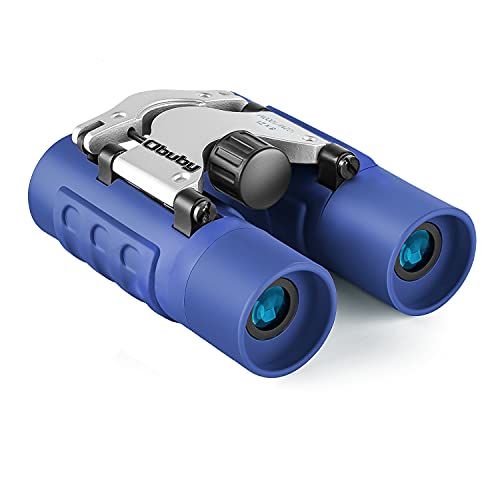
The OBUBY 8×21 is the lightest real-optics option here at 6 ounces, a real advantage for younger children. It uses BAK4 prism glass and coated lenses in a folding compact body, so despite the toy wording in its own listing title, the optical parts are genuine: a centre focus wheel, adjustable eye spacing, and a stated field of view of 122 metres at 1,000 metres.
The body carries a non-slip rubber coating OBUBY describes as shockproof, and the eyepieces are surrounded with soft rubber, so there are no hard edges against a child’s face.
OBUBY markets this pair for ages 3-12 and states a manufacturer recommended age of 3 years and up. In practice, the younger end of that range needs an adult’s help with focusing at first. OBUBY does not describe its neck strap as a breakaway design, so check it yourself before a small child wears it.
Specs:
– Magnification: 8x
– Objective lens: 21 mm
– Prism: BAK4
– Field of view: 122 m at 1,000 m
– Weight: 6 oz
– Size: 3.5 x 2.3 x 1.5 inches
– Body: shockproof non-slip rubber coating, as maker states
– Maker recommended age: 3 years and up (marketed for ages 3-12)
– Included: case, velvet bag, cleaning cloth, neck strap, instructions
Think Peak Binoculars for Kids 8×21

Think Peak’s 8×21 is built around rough handling. The maker describes a shockproof rubber coating, BAK4 optics behind it, and a waterproof rating, making this the pair for backpacks, dropped-on-path handling, and rain. The textured centre focus knob is large for a binocular this size, and small fingers can turn it without much grip strength.
The stated eye relief is 10.5 mm, which is short, so glasses wearers will likely find the view easier with glasses off; worth knowing before you buy. The barrels swivel to set the eye spacing, and the maker lists a breakaway neck strap in the box.
Think Peak states a manufacturer recommended age of 3 years and up and titles the product for ages 3-12. The realistic starting age is whenever a child can focus a wheel, with the younger years needing supervision.
Specs:
– Magnification: 8x
– Objective lens: 21 mm
– Prism: BAK4, as maker states
– Eye relief: 10.5 mm
– Weight: 8.8 oz
– Body: shockproof rubber coating; waterproof, as maker states
– Maker recommended age: 3 years and up (titled for ages 3-12)
– Included: neck strap, case, cleaning cloth, manual
See the Think Peak 8×21 on Amazon
Educational Insights GeoSafari Jr. Kidnoculars

The Kidnoculars are the toy end of this guide, included because for a three-year-old they are the right tool. Educational Insights is plain about what they are: a focus-free viewer with 2x magnification, enlarged eyepieces, and a goggle-style face piece that guides them into place. With no focus wheel and nothing to adjust, a preschooler can simply lift them and look.
That simplicity is also the limit. With 2x magnification and no stated objective lens size, these will not pick out a bird across a pond; they make nearby things look a little bigger, which is all a toddler needs. The construction is plastic throughout, the strap is a breakaway design as the maker states, and the recommended age is 36 months to 7 years, aimed mainly at ages 3-5.
Buy these as a first pair at three or four, expecting to replace them with a real 8×21 once the child starts asking to see birds properly.
Specs:
– Magnification: 2x
– Objective lens: not stated
– Focus: focus-free (no focus wheel)
– Eyepieces: enlarged, with placement goggles, as maker states
– Weight: not stated
– Maker recommended age: 36 months to 7 years
– Model: EI-5260
See the GeoSafari Jr. Kidnoculars on Amazon
How to Choose
Start with age and honesty about the child’s hands. Under about five, choose focus-free or expect to focus for them; from five or six, most children can manage a centre focus wheel. Follow the manufacturer’s stated age range rather than the marketing in a product title, since the two sometimes differ on the same listing.
Read the two numbers next. For children, 6.5x to 8x magnification is the workable band: enough reach to make a bird fill the view, not so much that hand shake ruins it. A 21 mm objective keeps a pair light; 32 mm gathers more light for dawn, dusk, and woodland shade but adds weight, as the Vortex and OBUBY weights here show.
Then check the physical details. Glass lenses and a named prism type, such as BAK4 or a roof prism, mark a real binocular; a listing that never mentions lens material is usually describing plastic. A rubber-coated, shockproof body suits children’s handling, a breakaway strap is the safer design for young wearers, and weight decides whether the pair gets carried or left at home.
Who Should Skip
Skip the real 8×21 and 6.5×32 models for children under three; the makers do not rate them for that age, and small focus wheels and straps need supervision even at three. Skip the Kidnoculars for any child over about six who wants to identify birds at a distance, because 2x fixed focus cannot do that job. Skip 10x or 12x compacts for young children: the view shakes too much in small hands, whatever the listing promises. And skip binoculars for now if the child will only use them on one short trip; a borrowed adult pair covers that case.
FAQ
What does 8×21 mean on kids’ binoculars?
The first number is magnification: 8x makes a subject appear eight times closer. The second is the front lens diameter in millimetres. An 8×21 is small and light, suiting children; a larger second number gathers more light but adds weight.
Are toy binoculars worth buying for a toddler?
For a three- or four-year-old, yes, as a first step. A focus-free 2x viewer such as the Kidnoculars works the moment it is lifted, with no wheel to learn. Buy it knowing it is a toy that will be replaced once the child is ready for a real pair.
Can a child just use adult binoculars instead?
Sometimes, but two things fight against it. Adult binoculars often cannot narrow their eye spacing enough for a child’s face, so the eyepieces never line up with both eyes, and they are usually heavy enough that a child tires quickly. A youth model with a stated interpupillary range, like the Vortex at 51-69 mm, solves the first problem.
What is the most important safety rule for kids’ binoculars?
Never look at the sun through binoculars, even for a moment, and supervise young children so the rule sticks. After that, choose a breakaway neck strap for younger wearers, as fitted to the Noptix, Think Peak, and Kidnoculars here, so the strap releases if it snags.
Final Verdict
Match the pair to the child, not to the biggest number on the box. The Noptix Real Kids 8×21 is the best all-round buy for ages 4-8: real glass optics, a breakaway strap, and a sticker book included. The OBUBY is the lightest real option and the Think Peak the toughest, both 8×21. Older, keener children should take the Vortex Bantam HD 6.5×32, and the youngest watchers start with the focus-free Kidnoculars.