Key takeaways
- The best kids headphones for school, travel and tablets compared: volume limits near 85 dB, wired and Bluetooth options, built-in mics and foldable builds.
- Top Pick: Puro Sound Labs PuroQuiet Plus
- Runner-up: JBL Jr310BT
- Also consider: Belkin SoundForm Mini
Children listen differently from adults. They hold tablets close, sit through long car rides and video lessons, and they rarely notice when the volume creeps up. That is why kids headphones are built around three things adult models often ignore: a hard ceiling on loudness, a smaller and lighter fit, and controls simple enough for small hands. Schools increasingly ask for a personal headset on the supply list, and a good pair keeps young passengers far happier on a flight or train journey.
As an Amazon Associate, we earn from qualifying purchases.
The five models below cover the main ways families actually use them. There is an active noise cancelling option for flights, Bluetooth pairs for tablets and travel, a switchable-volume model with very long battery life, and a wired pair that never needs charging before class. Each one limits volume, but they differ in how the cap works, whether a microphone is included, and how well the design survives daily life inside a school bag.
This article contains affiliate links, so purchases made through them may earn us a commission at no additional cost to you.
Quick Answer
For most families, a volume-limited pair capped at 85 dB is the right starting point. Choose Bluetooth for travel and tablet time, wired for school Chromebooks and zero charging, and check for a built-in microphone if your child joins video classes. The five kids headphones below cover noise cancelling, long battery life, audio sharing and simple wired reliability.
The Picks
Puro Sound Labs PuroQuiet Plus
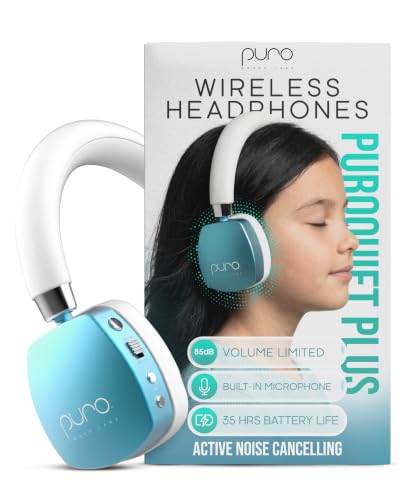
The PuroQuiet Plus is the premium pick for families who fly or spend long stretches in noisy cars and trains. It pairs an 85 dB volume limit with active noise cancellation, so engine drone and cabin rumble are reduced before your child ever reaches for the volume button. That combination matters, because kids tend to turn headphones up to drown out background noise. Battery life stretches to 35 hours, a wired listening option is included for seatback screens and flat batteries, and the hard-shell case keeps the aluminium frame protected in a carry-on. A built-in microphone handles calls and online lessons.
Specs:
– Volume limit: 85 dB maximum
– Noise cancelling: Active, rated to reduce ambient noise by up to 22 dB
– Battery life: Up to 35 hours
– Driver: 40 mm
– Microphone: Built-in
– Wired mode: Yes, volume-limiting cable included
– Case: Hard-shell travel case included
– Form factor: On-ear
JBL Jr310BT

JBL’s Jr310BT is a light, simple Bluetooth pair sized for younger children. At 115 grams it will not weigh down a small head, the ear cups fold for packing, and the controls are chunky enough for kids to manage themselves. JBL Safe Sound keeps output under 85 dB, the battery runs for up to 30 hours, and a quick USB-C top-up covers a forgotten overnight charge. A built-in microphone is there for calls and classes. The trade-off is that this model is Bluetooth only: there is no cable fallback, so a flat battery means silence, and it will not suit schools that require a wired connection.
Specs:
– Volume limit: JBL Safe Sound, under 85 dB
– Driver: 32 mm dynamic
– Battery life: Up to 30 hours
– Bluetooth: 5.0, up to 15 m range
– Microphone: Built-in
– Weight: 115 g
– Folding: Yes
– Wired mode: No, Bluetooth only
– Charging: USB-C
Belkin SoundForm Mini
Belkin designed the SoundForm Mini with classrooms in mind, and it shows in the details. The 85 dB cap, built-in microphone and 30-hour battery cover the school day and the trip home, while the included 3.5 mm aux cable means the same pair works wirelessly with a tablet at home and wired with a school Chromebook or an airplane jack. Bluetooth range reaches about 30 feet, enough for a child to move around a room without carrying the device. The on-ear fit is sized for younger heads, and the simple controls avoid the confusing button combinations found on adult models.
Specs:
– Volume limit: 85 dB maximum
– Battery life: Up to 30 hours
– Bluetooth range: Up to 30 ft
– Microphone: Built-in
– Wired mode: Yes, 3.5 mm aux cable included
– Charging: Micro-USB cable included
– Model: AUD001btBL (Blue)
– Weight: not stated
iClever BTH12
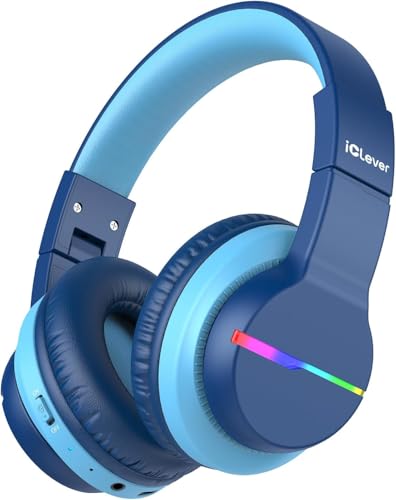
The BTH12 stands out for two things: a switchable volume limiter and a very long battery. Parents can set the cap to 74 dBA for younger children and quiet rooms, or 85 dBA for noisier environments such as cars and planes, and the setting stays put until an adult changes it. Playtime is rated at up to 85 hours, so charging becomes a rare event rather than a weekly chore. The over-ear cushions suit longer listening sessions, colourful LED lights on the ear cups add fun for the child, and a built-in microphone covers video calls and lessons. Fast charging support helps when the battery finally does run low.
Specs:
– Volume limit: Switchable 74 dBA or 85 dBA
– Playtime: Up to 85 hours
– Bluetooth: 5.2
– Microphone: Built-in
– Extra feature: LED ear-cup lights
– Form factor: Over-ear
– Charging port: not stated
JLab JBuddies Studio
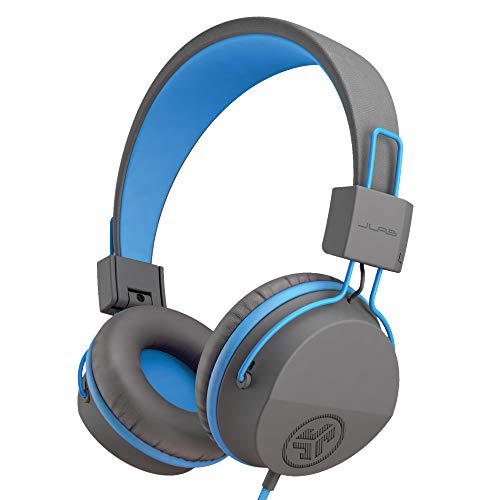
The JBuddies Studio is the wired workhorse of this group and the easiest recommendation for classroom use. There is no battery to charge, no Bluetooth pairing to troubleshoot, and nothing for a teacher to configure: the 3.5 mm plug goes into a Chromebook, tablet or library computer and simply works. A built-in volume limiter caps output at 85 dB, the in-line microphone and controls let students answer and speak during lessons, and the ear cups fold flat so the pair stores neatly in a desk or backpack. The adjustable, padded headband grows with your child, and the cushioned on-ear design provides a degree of passive noise isolation.
Specs:
– Connection: Wired, 3.5 mm plug
– Volume limit: Built-in limiter, 85 dB maximum
– Microphone: In-line, with track and call controls
– Folding: Yes
– Form factor: On-ear
– Battery: None required
– Model: HJKSTUDIORGRYBLU6 (Graphite/Blue)
– Driver size: not stated
How to Choose
Start with the volume cap. The figure you will see most often is 85 dB, the ceiling most hearing-health guidance points to for children’s listening, provided sessions are not endless. Lower caps around 74 or 75 dB suit toddlers and younger children, who tend to listen at close range and for whom quieter is simply safer. Switchable limiters, like the one on the iClever BTH12, are useful when the same pair moves between a quiet bedroom and a loud car. Whatever the cap, set a volume limit on the tablet or phone as well, because two layers of protection beat one.
Decide on wired versus Bluetooth. Wired pairs never need charging, work with every school device that has a headphone jack, and are often what schools ask for. Bluetooth pairs remove the cable that gets yanked, tangled and chewed, and they pair happily with modern tablets, but they add charging and pairing to your routine. Dual-mode models such as the Belkin SoundForm Mini remove the dilemma. Note that a growing number of tablets have dropped the headphone jack, so check the port situation before choosing a wired-only pair.
Check fit and comfort. On-ear designs are lighter and suit smaller heads; over-ear cushions seal better and feel softer on long journeys. Look for a headband sized for children rather than a shrunken adult band, padding that does not clamp, and the lightest weight your child will tolerate for a full lesson or flight.
Think about microphones. If your child joins video classes, language apps or family calls, a built-in or in-line microphone matters. For pure movie and music listening, it is optional.
Consider folding and durability. Hinges that fold flat, flexible headbands and replaceable cables all extend working life. A case is worth having if the headphones travel daily in a school bag.
Who Should Skip
Parents of children under two should skip headphones altogether for now and use a nearby speaker at moderate volume instead; very young ears and heads are not ready for ear cups. Teenagers who have outgrown child sizing will also be better served by a regular adult model with the features they want, since kids headphones deliberately trade maximum volume and advanced features for safety. If your real problem is loud environments rather than listening — concerts, fireworks, machinery — buy dedicated children’s ear defenders instead, because most audio headphones are not rated hearing protection. Finally, if your child’s school bans wireless devices or requires a wired headset for exams, skip Bluetooth-only models entirely and go straight to a wired or dual-mode pair.
FAQ
What is a safe volume limit for kids headphones?
A cap of 85 dB is the most common recommendation for children’s headphones, and lower caps around 74 to 75 dB are better for younger children and longer sessions. Listening time matters as well as level, so regular breaks help. Setting a maximum volume in the device settings adds a second layer of protection on top of the headphone’s own limiter.
Are wired or Bluetooth kids headphones better for school?
It depends on the school’s rules and devices. Wired pairs need no charging, work instantly with Chromebooks and test software, and are frequently the required option. Bluetooth pairs are tidier at home and on tablets but can be banned in classrooms and always need charging. A dual-mode pair covers both situations with one purchase.
Can kids use these headphones on an airplane?
Yes. Noise cancelling models such as the PuroQuiet Plus make engine noise far less tiring, and wired or dual-mode pairs can plug into seatback entertainment systems, sometimes with a simple adapter. Bluetooth use may be restricted during take-off and landing, so a cable backup is worth packing. Download films and music before the flight so everything works offline.
What if our tablet has no headphone jack?
Choose a Bluetooth model, or keep a wired pair and add a USB-C to 3.5 mm adapter matched to your tablet. Adapters are small and easy to lose, so many families keep one attached to the cable. Before buying, confirm which ports your child’s school device has, since that decides whether wired listening is possible at all.
Final Verdict
Match the pair to the job. The Puro Sound Labs PuroQuiet Plus is the travel flagship, with noise cancelling that protects hearing twice over. The JBL Jr310BT is the light, easy wireless option for younger children, while the Belkin SoundForm Mini is the school-friendly all-rounder that also works wired. The iClever BTH12 wins on battery life and its lower 74 dBA setting for younger listeners, and the JLab JBuddies Studio is the dependable wired choice for classrooms. Any of the five keeps volume in check; the right one is simply the one whose connection, fit and microphone match your child’s day.