
Key takeaways
- For electronics, Snap Circuits Jr. and Snap Circuits Classic (both listed for ages eight and up) are the most consistent picks; for chemistry and…
For electronics, Snap Circuits Jr. and Snap Circuits Classic (both listed for ages eight and up) are the most consistent picks; for chemistry and kitchen-style experiments, Thames & Kosmos kits such as Kids First Chemistry suit beginners; and National Geographic kits suit children who want showy experiments like crystals, geodes and microscopes. All of these sit comfortably within the $150 cap, with room for a second kit. Match the kit to the child’s age and interest rather than buying the biggest box.
Our top picks



As an Amazon Associate we earn from qualifying purchases at no extra cost to you.
At a glance: the main kit families compared
| Kit family | Typical age | Best for | Key stated or reported points | Limits |
|---|---|---|---|---|
| Snap Circuits Jr. SC-100 | 8 and up | First electronics | Pieces snap together with no soldering or tools; the maker lists over 100 projects (101 in the manual) | Basic circuits only; needs batteries |
| Snap Circuits Classic SC-300 | 8 and up | Wider electronics learning | The maker lists 305 projects | More parts to organise |
| Snap Circuits Pro SC-500 | 8 and up | Advanced beginners | The maker lists 500 or more projects | Upper end of the budget |
| Thames & Kosmos Kids First Chemistry | Check the box label; retailer listings show 8 and up | Gentle first chemistry | Retailer listings describe household substances plus the kit’s lab tools | Limited depth; adult supervision still advised |
| Thames & Kosmos Chem C1000 | 10 and up | Real introductory chemistry | Retailer listings give ages 10 and up with adult supervision | Needs space, supervision and careful reading of safety notes |
| Thames & Kosmos engineering and physics kits | 8 and up | Simple machines, bridges, structures | Reviewers note curriculum-aligned content | Assembly and reading required |
| National Geographic kits (Science Magic, Earth Science, crystals, geodes, microscope, Circuit Maker) | 6 to 12 | Showy experiments and variety | The Science Magic Kit is listed at 100 or more experiments for ages 8 and up | Some colour reactions depend on temperature and humidity |
Choosing a kit by interest and age
Science kits are not interchangeable. A child fascinated by gadgets will love electronics, while one who enjoys mixing, pouring and watching fizzes will prefer chemistry. A budding naturalist might prefer a microscope or a geode-cracking kit. Matching the topic to existing curiosity matters more than the number of experiments in the box. Age labels printed by makers reflect both difficulty and safety, so follow them, particularly for chemistry kits containing powders or small parts.
A good rule is to look at the kit’s content rather than the headline project count. Hundreds of projects are impressive, but a small kit with clear instructions and reusable parts is often more engaging than a huge kit with confusing guides.
Budget tiers within the $150 cap
Budget tier
At the budget level are single-topic kits such as National Geographic crystal growing or geode sets, Snap Circuits Jr., and Kids First Chemistry. These deliver a satisfying session or two and often work as gifts. Roundups warn that generic “STEM kits” at the very bottom of the market often cut corners on content and instructions, so favour established makers.
Mid-range tier
Mid-range choices include Snap Circuits Classic with its larger project count, Thames & Kosmos engineering and physics kits, and larger National Geographic sets such as a microscope kit. They offer more depth and reuse. Children can work through multiple projects, and parts survive for siblings.
Upper tier
Near the cap you can reach Snap Circuits Pro, Thames & Kosmos Chem C1000 and combination kits. These suit older children who are serious about the subject. Because the cap leaves room, many families split the budget between two complementary kits, for example one electronics and one chemistry.
Safety, space and supervision
- Follow age labels and instructions: Chemistry kits include substances that should be handled according to the maker’s safety notes. Read all instructions and warnings before starting.
- Adult supervision: Even kits marketed for ages four to six benefit from an adult close by. Supervise all experiments involving heat, chemicals or small parts.
- Protect surfaces and eyes: Use a tray or covered table, wear eye protection if the kit suggests it, and wash hands after experiments.
- Small parts: Many kits include parts unsuitable for young children. Keep them away from toddlers.
- Batteries: Electronics kits need batteries. Follow the maker’s guidance on type and handling, and never short-circuit batteries.
- Disposal: Dispose of used materials according to the instructions and local rules. If a child swallows a substance or gets a reaction on skin or in eyes, seek medical advice and follow the pack’s first-aid guidance.
Detailed notes on the main picks
Snap Circuits
Snap Circuits uses coloured, labelled components that snap onto a base grid, so there is no soldering and no tools. Reviewers consistently name Jr. SC-100 as the best entry point; the maker lists over 100 projects, and retailers list it for ages eight and up. The Classic SC-300 expands to 305 projects, and the Pro SC-500 adds more complexity with 500 or more. The modular design also makes it a good group activity.
Thames & Kosmos
Thames & Kosmos is a German-founded maker of science kits. Kids First Chemistry pairs household substances with the kit’s lab tools and a printed manual, and retailer listings show ages eight and up, so follow the box label and keep an adult close. The Chem C1000 teaches introductory chemistry to ages ten and up. The brand also makes engineering and physics kits covering simple machines, physics and bridges. Reviewers value the clear manuals and real science content.
National Geographic
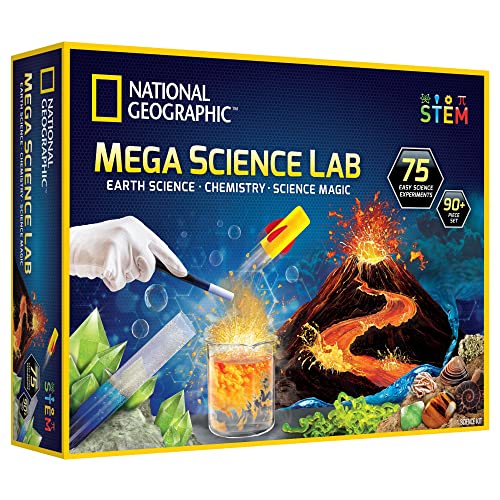
National Geographic kits tend to focus on spectacle. The Science Magic Kit is listed for ages eight and up with 100 or more experiments, counting about 20 in the box plus a booklet of household-item ones. Other popular kits include earth science, geodes, crystal growing, microscopes, a marble run and a Circuit Maker kit. One reviewer cautions that colour reactions can depend on water temperature and humidity, leaving some results pale.
Pick X if you need Y
| If you need… | Pick | Why |
|---|---|---|
| A first electronics kit | Snap Circuits Jr. | No tools, simple snap parts |
| More electronics projects | Snap Circuits Classic | More projects and parts |
| Gentle first chemistry | Kids First Chemistry | Household-style materials; follow the age label |
| Real introductory chemistry for ages 10 and up | Chem C1000 | Deeper content |
| Showy experiments and variety | National Geographic kits | Crystals, geodes, magic-style tricks |
| Engineering and machines | Thames & Kosmos engineering kits | Build and test structures |
Alternatives
- Beginner microscope: Opens up a world of slides and observation for ages six and up.
- Nature and outdoor science sets: Bug catchers, magnifiers and weather stations encourage curiosity outdoors.
- Coding and robotics kits: Combine science with programming for older children.
Getting the most from a kit
Science kits succeed when an adult shows interest. Read the manual together, predict what will happen, discuss the result and ask what could be changed. Keep a notebook to record observations. Store parts in the original box or sealed containers, and write down which experiments you have done so that you can plan the next. If a result does not match the manual, treat it as a chance to ask why; temperature, measuring and mixing order all matter.
Online roundups on science kits are largely affiliate-based and rankings vary, so rely on the maker’s age labelling and instructions above any list.
Common mistakes when buying a science kit
The first mistake is buying for the age on the box rather than the child. A confident eight-year-old may enjoy a kit labelled for ten, while a sensitive five-year-old may prefer something labelled for four. Read the project list and instructions where possible, and consider reading ability, since many kits rely on written manuals.
The second is overlooking consumables. Crystal-growing, chemistry and some magic-style kits use up their materials, so a child who loves the activity may run out after a few sessions. Ask whether refills are sold by the maker, or choose reusable kits such as electronics sets if repeat use matters.
The third is skipping the setup. Many experiments need household items such as cups, spoons, warm water or batteries that are not in the box. Gather them before starting so enthusiasm does not stall. Finally, choose a tidy work area, lay down a tray or old towel, and allow time for cleanup so that experiments feel like a pleasant routine rather than a chore.
Frequently Asked Questions
What is the best science kit for a 6-year-old?
Many science kits, including Snap Circuits Jr., carry an age label of eight and up, so for a six-year-old look for kits whose box states a younger age and work through them together with an adult. Always follow the maker’s age label and supervise.
Are chemistry kits safe for children?
Kits made for children follow safety labelling and are designed for specified ages, but they still need supervision. Read the safety notes, use protective equipment where advised and seek medical advice if a substance is swallowed or irritates skin or eyes.
Do Snap Circuits need batteries?
Yes, they run on batteries as listed in the manual. Use the type recommended and never short-circuit them. Remove batteries when the kit is stored for long periods.
Are bigger kits with hundreds of experiments better?
Not necessarily. Clear instructions, quality parts and a topic the child cares about matter more than the headline number. A smaller kit that gets used is better than a large one that sits on a shelf.
Can siblings share a science kit?
Modular kits like Snap Circuits work well for groups. Chemistry kits with consumable materials may run out sooner, so check refill availability from the maker.
Why did my experiment not look like the picture?
Reviewers note that results can depend on water temperature, humidity and exact measurements. Re-read the instructions, measure carefully and try again.


