Key takeaways
- Compare five seed spreaders for small patches, suburban lawns, and large yards, with hopper size, spread control, and handling explained before you buy.
A seed spreader decides whether a lawn comes up in a smooth sheet of green or in stripes, bare patches, and clumps where seed landed twice. Hand scattering looks simple until wind carries light seed sideways, a heavy handful drops in one spot, and the far corner of the yard gets nothing at all. A spreader meters the flow, throws seed in a repeatable pattern, and lets the operator walk at a steady pace instead of guessing with every toss.
This guide suits homeowners reseeding a thin front lawn, renters patching worn spots beside a path, and owners of larger plots who want one tool for seed, fertilizer, and winter grit. The five spreaders below were chosen from their names and specifications on the Amazon product page, covering handheld units for tight corners, walk-behind models for suburban lawns, and a heavier steel-frame spreader for bigger ground.
Quick Picks
As an Amazon Associate we earn from qualifying purchases.
| Product | Best for | Key spec from title |
|---|---|---|
| Scotts Turf Builder EdgeGuard Mini Broadcast Spreader | Small to medium suburban lawns | Holds up to 5,000 sq. ft. of product |
| Scotts Turf Builder EdgeGuard DLX Broadcast Spreader | Larger lawns needing fewer refills | Holds up to 15,000 sq. ft. of product |
| Scotts Whirl Hand-Powered Spreader | Small patches and tight corners | Holds up to 1,500 sq. ft. of product |
| Scotts Wizz Hand-Held Spreader | Battery-powered handheld spreading | Holds up to 2,500 sq. ft. of product |
| EarthWay 2600A-PLUS Fertilizer Spreader | Heavier work on rough ground | 40 lb hopper capacity |
How to Choose
Match the hopper to the lawn
Hopper capacity is the first number to check, because it sets how often the operator stops to refill. A handheld unit that covers up to 1,500 square feet suits a patch beside a driveway or a narrow strip along a fence, while a walk-behind model rated for 5,000 square feet suits a typical suburban front and back lawn in one or two fills. Larger plots call for a 15,000-square-foot hopper or a 40-pound steel-frame spreader, since every refill is a chance to overlap a pass and lay a dark stripe. Measure the lawn roughly before shopping, and pick a hopper that covers it with a small margin rather than one that runs dry halfway across.
Choose broadcast or handheld handling
Broadcast spreaders throw seed in a wide arc from a spinning plate, so they cover open ground quickly and suit rectangular lawns with long straight passes. Handheld spreaders throw a narrower pattern and suit curved beds, slopes, narrow side yards, and spots where a wheeled unit cannot turn. A walk-behind broadcast spreader needs storage space and a reasonably flat lawn, while a handheld unit fits on a shelf and works where wheels would sink or tip. Buyers with both open turf and awkward corners often keep a handheld unit beside a larger walk-behind model rather than forcing one tool to do both jobs.
Check edge control and rate settings
Edge control matters wherever lawn meets driveway, path, planting bed, or pavement, because seed thrown onto hard surfaces is wasted and fertilizer left on concrete can stain. Some spreaders block one side of the pattern with a shield or a side-spread control, so the operator can run along an edge without scattering material where it does not belong. Rate settings matter just as much, since grass seed, fertilizer, and ice melt each need a different flow. A numbered dial linked to the setting printed on the product bag removes guesswork, while a model with too few settings forces the operator to improvise with walking speed alone.
Look at build, tires, and cleaning
Seed spreaders live in garages, sheds, and damp weather, so materials decide how long one lasts. Rust-proof polypropylene hoppers resist corrosion from fertilizer and salt, epoxy-coated steel frames add rigidity for heavier loads, and solid linkage outlasts cables that stretch or snap. Large pneumatic tires roll over rough turf, roots, and frozen ground without bouncing the hopper, while small plastic wheels suit smooth, flat lawns and struggle on uneven soil. After each use, the hopper, plate, and shut-off gate need brushing out and drying, because damp seed clumps, fertilizer cakes, and salt corrodes moving parts left dirty.
The 5 Best Options
Scotts Turf Builder EdgeGuard Mini Broadcast Spreader

This walk-behind spreader fits the homeowner with a small to medium lawn who wants a straightforward tool for spring seeding, summer feeding, and winter ice melt without learning a complicated machine. It arrives pre-calibrated and ready to use, so the operator sets the dial from the number on the product bag, pours seed or fertilizer into the hopper, and walks. The fold-down handle helps it fit a crowded garage shelf, and the EdgeGuard shield keeps material off driveways and beds along the edges of the lawn.
Specs
- Holds up to 5,000 sq. ft. of Scotts product
- Pre-calibrated and ready to use
- EdgeGuard technology blocks the right side of the spread pattern
- Redesigned hopper and agitator for smoother flow and consistent coverage
- Fold-down handle for storage
- Product dimensions: 21.5 x 16 x 18 inches
- Item model number: 76121
- Spreads grass seed, fertilizer, salt, and ice melt
Best for: Homeowners with a small to medium suburban lawn who want one walk-behind spreader for seed and fertilizer.
Watch out for: Check the rate setting printed on the seed bag before the first pass, because the dial setting changes with the material being spread.
Scotts Turf Builder EdgeGuard DLX Broadcast Spreader

This larger walk-behind spreader fits owners of bigger lawns who are tired of refilling a small hopper in the middle of a seeding job. It holds enough product for up to 15,000 square feet, so a front and back lawn can often be covered in a single fill, and fewer stops mean fewer overlapping passes and a more even result. The same EdgeGuard shield and pre-calibrated design as the smaller model carry over, so the operator works the same way, only with a longer run between refills and a wider area covered per outing.
Specs
- Holds up to 15,000 sq. ft. of Scotts product
- Pre-calibrated and ready to use
- EdgeGuard technology helps keep product off landscaping, driveways, and sidewalks
- Item model number: 76232
- Spreads grass seed, fertilizer, salt, and ice melt
- Walk-behind broadcast spreader
Best for: Homeowners with larger lawns who want fewer refills and longer uninterrupted passes.
Watch out for: Measure storage space before buying, because the larger hopper and frame need more garage or shed room than a mini spreader.
Scotts Whirl Hand-Powered Spreader

This handheld spreader fits the buyer who only needs to seed a bare patch, feed a narrow strip, or scatter ice melt on a path without dragging a wheeled spreader out of the garage. It is hand-powered, so there are no batteries to charge and no cord to manage, and the operator controls the flow by cranking while walking slowly along the target area. Its small size suits renters, owners of townhouse gardens, and anyone whose lawn is mostly patio, beds, and a modest patch of turf rather than open ground.
Specs
- Holds up to 1,500 sq. ft. of product
- Hand-powered handheld spreader
- Spreads grass seed, fertilizer, salt, and ice melt
- Handheld design for small areas and tight spaces
Best for: Small patches, narrow strips, and quick touch-ups where a walk-behind spreader is too large.
Watch out for: Check that the seed or granules are dry and free-flowing before loading, because damp material clumps in a small handheld hopper.
Scotts Wizz Hand-Held Spreader
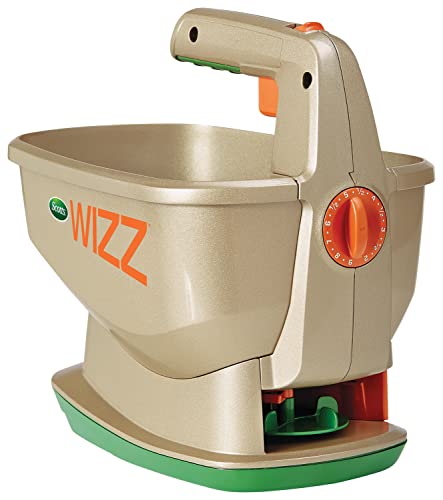
This battery-powered handheld spreader fits the buyer who wants handheld control without the steady cranking of a manual unit. It runs on four AA batteries and throws material in a five-foot broadcast, so small and medium areas get covered faster than with a hand-crank model while the operator still steers precisely around beds and paths. The EdgeGuard control keeps seed off hard surfaces, and the wide range of settings lets the same unit handle grass seed, fertilizer, weed control products, and ice melt through the year.
Specs
- Holds up to 2,500 sq. ft. of Scotts lawn products
- Battery powered, runs on 4 AA batteries
- 5 ft. broadcast with EdgeGuard technology
- 23 spreader settings
- Handy-Lock feature
- Spreads grass seed, fertilizer, salt, and ice melt
- Item model number: 71131
Best for: Homeowners who want battery-powered handheld spreading for small lawns, edges, and spot work.
Watch out for: Check the batteries before a seeding session and keep spares on hand, because a flat battery stops the spreader mid-pass.
EarthWay 2600A-PLUS Fertilizer Spreader

This steel-frame walk-behind spreader fits the buyer with a larger or rougher property who wants a sturdier tool than a light plastic residential model. Its 40-pound rust-proof polypropylene hopper holds a full bag of seed or fertilizer, and the epoxy-coated steel frame, solid linkage, and steel T-handle are built for repeated use across uneven ground. The patented three-hole drop system and side spread control aim for an even pattern without the stripes that a single-drop spreader can leave, and the large pneumatic tires roll over rough turf and icy ground.
Specs
- 40 lb hopper capacity
- Rust-proof polypropylene hopper
- Epoxy-coated steel frame
- 9-inch pneumatic high-flotation tires
- EVEN-SPREAD 3-hole drop shut-off system
- Side Spread Control
- Steel T-handle and solid linkage
- Product dimensions: 40 x 20.5 x 30 inches
- Item model number: 2600A-Plus
- Spreads fertilizer, grass seed, salt, and ice melt
Best for: Larger or uneven lawns where a heavier steel-frame spreader and large tires make the work steadier.
Watch out for: Check the assembly instructions and the rate setting for the specific seed being used before the first full pass, because calibration varies by material.
Which One Fits Your Situation
A small lawn with bare patches
The Scotts Whirl Hand-Powered Spreader suits this situation, because a 1,500-square-foot handheld unit reaches the worn spot beside a path or the thin strip along a fence without a wheeled spreader. It is light, needs no batteries, and lets the operator aim seed exactly where turf is missing. A walk-behind model would be awkward to turn in such tight ground, and its wide pattern would waste seed on beds and paving.
A typical suburban front and back lawn
The Scotts Turf Builder EdgeGuard Mini Broadcast Spreader suits this situation, because its 5,000-square-foot hopper covers a standard suburban lawn in one or two fills. The pre-calibrated dial and EdgeGuard shield keep the work simple along driveways and beds, and the fold-down handle helps with storage. It is the middle ground between a handheld unit that would need many refills and a large spreader that would be hard to store.
A large lawn that needs fewer refills
The Scotts Turf Builder EdgeGuard DLX Broadcast Spreader suits this situation, because its 15,000-square-foot hopper covers a large lawn with far fewer stops than the mini model. Fewer refills mean fewer restarts, and fewer restarts mean fewer stripes where passes overlap. The same EdgeGuard shield protects edges, so the larger hopper does not come at the cost of scattering seed onto paths and planting beds.
Rough ground or a heavy seeding job
The EarthWay 2600A-PLUS Fertilizer Spreader suits this situation, because its steel frame, solid linkage, and 9-inch pneumatic tires handle uneven turf that would bounce a light plastic spreader. Its 40-pound hopper carries a full bag, and the three-hole drop system with side spread control is designed for an even pattern across larger areas. Buyers seeding a new lawn or working a rural plot will value the sturdier build over a lighter residential unit.
Common Mistakes
- Spreading seed on a windy day, so light seed drifts sideways and lands in clumps instead of an even layer.
- Walking at an uneven pace, which lays heavy bands where the operator slows and thin bands where the operator speeds up.
- Skipping calibration and using the same dial setting for seed, fertilizer, and ice melt, even though each material flows differently.
- Overfilling the hopper, which jams the agitator and dumps material in a heap at the start of a pass.
- Leaving seed, fertilizer, or salt in the hopper after use, so damp material clumps, cakes, and corrodes the shut-off gate.
Frequently Asked Questions
How much seed should a spreader hold for a suburban lawn?
A hopper rated for 5,000 square feet suits many suburban lawns in one or two fills, while a 15,000-square-foot model suits larger plots with fewer refills. Measure the lawn area first, then compare it with the coverage figure on the product page. A hopper that is too small means repeated refills and overlapping passes, while one that is far too large wastes storage space and money.
Can one spreader handle seed, fertilizer, and ice melt?
Many broadcast spreaders are sold for grass seed, fertilizer, salt, and ice melt, and the models in this guide list those uses on their Amazon pages. The dial setting still changes with each material, so the operator should check the setting printed on the bag before every job. Clean the hopper after each use, because fertilizer and salt left inside can corrode parts and clog the gate.
Why does seed come up in stripes after spreading?
Stripes usually come from overlapping passes, an uneven walking pace, or a single-drop pattern that lays more material in the centre of each pass. Walking at a steady speed, overlapping each pass by a small margin, and using a spreader with an even-drop system all help. A test pass on a driveway or sheeting can show the pattern before seed goes onto the lawn.
Is a handheld spreader enough for a whole lawn?
A handheld spreader suits patches, narrow strips, and lawns up to about 2,500 square feet, depending on the model. Larger lawns take many refills with a handheld unit, and the narrow pattern makes even coverage harder over a wide area. For a full suburban lawn, a walk-behind broadcast spreader covers ground faster and with fewer stops.