Key takeaways
- Compare the best tire pressure gauges for cars, trucks, and bikes: digital, dial, and pencil models with the range and accuracy to match your tires.
A tire pressure gauge looks like the simplest tool in the garage, yet the real decision is not the brand on the handle. It is the range on the scale, the accuracy behind the number, and whether the chuck can seal on the valve without leaking air. A gauge that tops out at 100 PSI cannot read a motorhome tire, a pencil gauge that steps in whole pounds cannot fine-tune a low-pressure setup, and a digital gauge with a dead battery reads nothing at all.
This guide is for daily drivers who check tires once a month, truck and trailer owners who run high pressures, cyclists who need a Presta adapter, and anyone who wants a backup gauge that never needs a battery. Every gauge below was chosen from the name and specifications on its Amazon product page, with the range and accuracy stated by the maker.
Quick Picks
As an Amazon Associate we earn from qualifying purchases
| Product | Best for | Key spec from title |
|---|---|---|
| JACO ElitePro Digital 100 PSI | Shop-grade accuracy with a hose and bleeder valve | 100 PSI digital, 2.5-inch backlit LCD |
| AstroAI Digital 230 PSI | High-pressure truck, RV, and trailer tires | 0-230 PSI digital, backlit LCD and flashlight |
| JACO ElitePro Analog 100 PSI | Battery-free accuracy with a glow dial | 100 PSI analog, 2-inch glow-in-the-dark dial |
| AstroAI Digital 150 PSI | Everyday checks on a budget | 0-150 PSI digital, backlit LCD and Presta adapter |
| Milton S-921 Pencil | Glovebox backup that never needs a battery | 5-50 PSI pencil, built-in deflator valve |
How to Choose
Match the Range to Your Tires
Start with the highest pressure you will ever measure, not the average. Most car tires sit near 32 to 35 PSI, a full-size spare can call for 60, trailer tires commonly run 65 to 80, and motorhome tires can exceed 100. A gauge that tops out below your tire pressure will pin at its maximum and tell you nothing useful. At the other end, a very wide range costs resolution: on a 230 PSI gauge, a single pound is a small slice of the scale, so a car tire reading is coarser than on a 100 PSI gauge. Buy the narrowest range that still covers your highest tire, with a little headroom.
Digital, Dial, or Pencil
Digital gauges give the easiest reading: a backlit number in tenths of a pound, often with a hold function and a bleeder valve for fine-tuning. They need batteries, and a coin cell can die unnoticed in a cold glovebox. Dial gauges need no power, and a glow dial reads well at night, but the needle can drift if the gauge is dropped, and dust in the valve can stop the reading from holding. Pencil gauges are nearly indestructible, cost little, and fit anywhere, yet they read in whole pounds and are hard to read in dim light. Choose digital for precision, dial for a battery-free middle ground, and pencil for a backup that always works.
Read the Accuracy Claim Carefully
Look for the standard and the tolerance together: ASME Grade 2A or ANSI B40.7 Grade 2A with a tolerance of 0.5 percent of full scale is a shop-grade claim, and on a 100 PSI gauge that means about half a pound either way. A claim of plus or minus 1 PSI is honest for an everyday digital gauge, while plus or minus 2 percent on a 230 PSI gauge can mean more than four pounds of error at the top of the scale. Resolution is not accuracy: a display that shows tenths of a pound is only useful if the sensor behind it is calibrated to match. Trust the grade, not the number of decimals.
Chuck, Hose, and Reading in the Dark
The chuck decides whether the reading is real. A straight chuck works on exposed stems, but recessed or angled stems need a swivel chuck or a hose, and a hose of around ten inches reaches dual rear wheels and low-profile cars without twisting your wrist. A lock-on chuck or a hold function lets you pull the gauge away and read it at eye level instead of crouching by the wheel. A bleeder valve lets air out in small steps while the reading stays on screen, which is how you land exactly on your target pressure. For night checks, a backlit display, a glowing dial, or a small flashlight matters more than any extra feature.
The 5 Best Options
JACO ElitePro Digital 100 PSI

The ElitePro Digital is the gauge to buy when accuracy is the whole point. JACO calibrates it to ASME Grade 2A, with dual sensors rated at plus or minus 0.50 percent of full scale, which works out to half a pound on this 100 PSI gauge. The ten-inch HybridFlex hose and 360-degree swivel chuck reach stems that a stubby gauge cannot, the lock-on display holds the reading until you reset it, and the built-in bleeder valve lets you trim pressure without starting over. It is a premium-priced tool, but the lifetime warranty and the brass-and-steel build explain why mechanics keep recommending it.
Specs
- Working range: 5-100 PSI
- Accuracy: plus or minus 0.50 percent of full scale, ASME Grade 2A
- Resolution: 0.10 PSI
- Display: 2.5-inch digital LCD with backlight
- Hose: 10-inch HybridFlex hose with 360-degree swivel chuck
- Bleeder valve: built-in, releases pressure without resetting the display
- Batteries: 2 AAA batteries included
- Auto shut-off: 150 seconds
- Warranty: lifetime warranty from JACO
- Dimensions: 1.57 x 3.7 x 7.56 inches
- Model: ElitePro Digital 100
Best for: Drivers who want shop-grade accuracy and a hose that reaches awkward valve stems.
Watch out for: The gauge reads from 5 PSI, so it is not made for very low-pressure tires, and it needs two AAA batteries to work at all.
AstroAI Digital 230 PSI

If your driveway holds a truck, a trailer, or a motorhome, the standard 100 PSI gauge is the wrong tool, and this AstroAI is the fix. Its range runs to 230 PSI, which covers trailer tires at 65 to 80 PSI and motorhome tires that climb past 100. The stainless-steel body and non-slip grip survive toolbox life, the backlit LCD and built-in flashlight make night checks possible, and the dual-head chuck fits stems from either side. The trade-off is resolution: at the top of a 230 PSI scale, a single pound is a small step, so car-tire readings are coarser than on a 100 PSI gauge.
Specs
- Measurement range: 0-230 PSI / 0-16 Bar / 0-16 Kg/cm2 / 0-1600 kPa
- Minimum increment: 0.1 PSI
- Range of error: plus or minus 2 percent
- Display: backlit LCD with flashlight
- Body: stainless steel with non-slip grip
- Chuck: dual-head, bi-directional
- Batteries: 2 AAA batteries included
- Dimensions: 6.5 x 1.89 x 1.1 inches
- Weight: 0.28 pounds
- UPC: 796358885955
Best for: Truck, RV, and trailer owners who need readings above 100 PSI.
Watch out for: The listing states an error range of plus or minus 2 percent, while some guides describe this heavy-duty line as Grade 2A, so confirm the accuracy claim on the listing before buying.
JACO ElitePro Analog 100 PSI
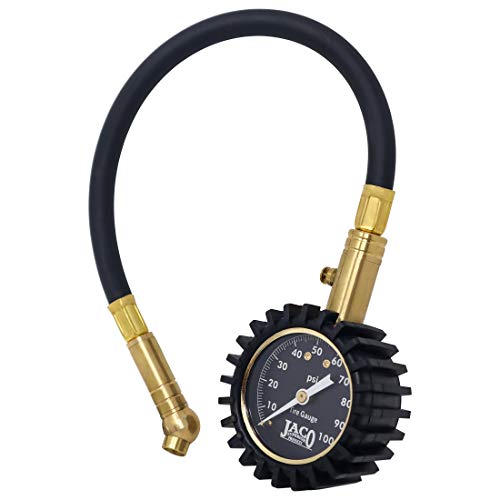
The analog ElitePro is the answer for drivers who want accuracy without batteries. Its two-inch glow-in-the-dark dial reads 0 to 100 PSI in single-pound steps, calibrated to ANSI B40.1 at plus or minus 1.5 percent at mid-scale, and the solid brass body sits inside a shock-resistant guard that survives drops. The HybridFlex hose and 360-degree swivel chuck reach the same awkward stems as the digital version, and the built-in bleeder valve trims overinflated tires without removing the gauge. JACO backs it with a lifetime warranty, which is rare for an analog tool at this level.
Specs
- Range: 0-100 PSI
- Dial: analogue, 2 inch, glow-in-the-dark
- Calibration: plus or minus 1.5 percent mid-scale, ANSI B40.1
- Body: solid brass with shock-resistant protective guard
- Hose: HybridFlex leak-proof air hose with 360-degree swivel chuck
- Bleeder valve: built-in
- Batteries: none required
- Warranty: lifetime warranty from JACO
- Weight: 0.35 pounds
- Model: JSP-014
Best for: Drivers who want a battery-free gauge with a readable dial for night checks.
Watch out for: Dust from the valve stem can stop the dial from holding a reading, so the maker tells buyers to clean the seal parts if the needle drops.
AstroAI Digital 150 PSI
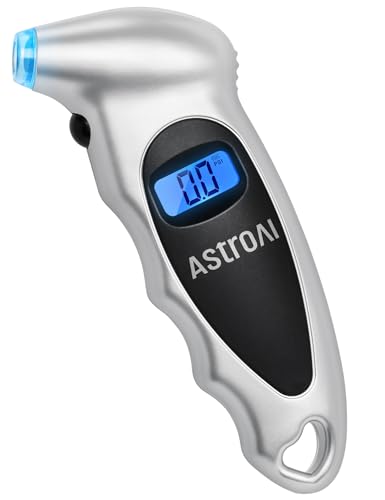
This is the gauge for the driver who checks tires once a month and wants a clear number for very little money. It reads 0 to 150 PSI in 0.1 increments across four units, with a backlit LCD and an illuminated nozzle that helps in a dim garage, plus a Presta valve adapter for road bikes. The pocket-size body fits a glovebox or a jacket pocket, and the auto shut-off stretches battery life. It is not a shop-grade tool, and the coin-cell batteries are harder to find than AAA cells, but for everyday cars it covers everything that matters.
Specs
- Measurement range: 0-150 PSI / 0-10 Bar / 0-10 Kgf/cm2 / 0-1000 kPa
- Accuracy: plus or minus 1 PSI
- Resolution: 0.1 PSI increments
- Display: backlit LCD with illuminated nozzle
- Units: PSI, Bar, Kgf/cm2, kPa
- Presta valve adapter: included
- Batteries: 3 LR44 batteries included
- Auto shut-off: 30 seconds
Best for: Everyday drivers who want a cheap digital gauge that also works on road bikes.
Watch out for: The coin-cell batteries are smaller and harder to find than AAA cells, so keep spares if this is your only gauge.
Milton S-921 Pencil

The S-921 is the glovebox gauge that still works the first time you grab it, years later. There is no battery to die, no screen to crack, and no dial to knock out of calibration: a plated brass body, a nylon indicator bar, and a single-chuck head that seals on the valve. It reads 5 to 50 PSI in one-pound steps and also measures in kPa, with a built-in deflator valve and a tread depth gauge. The scale is harder to read in dim light than a backlit screen, and it will not cover truck tires above 50 PSI, but as a backup it is hard to beat.
Specs
- Range: 5-50 PSI / 40-350 kPa
- Increments: 1 PSI and 10 kPa
- Body: durable plated brass
- Indicator: 4-side nylon indicator bar
- Deflator valve: built-in
- Tread depth gauge: built-in
- Chuck: single chuck head
- Batteries: none required
- Made in: USA
- Dimensions: 8.1 x 1.2 x 1.1 inches
- Weight: 22.68 grams
- Part number: S-921
Best for: A glovebox backup that always works, with no battery to worry about.
Watch out for: The scale reads in whole pounds and is hard to read in dim light, and the 50 PSI ceiling rules out truck and trailer tires.
Which One Fits Your Situation
You drive one car and check tires monthly
Pick the AstroAI Digital 150 PSI. It covers every pressure a passenger car will ever need, reads in tenths of a pound, and costs little enough to keep one in each car. The backlit display and illuminated nozzle help in a dark garage, and the Presta adapter means the same gauge works on a road bike. Keep a spare set of coin-cell batteries in the glovebox so a dead cell never leaves you guessing.
You want the most accurate reading you can get
Buy the JACO ElitePro Digital. Its ASME Grade 2A calibration and dual sensors hold accuracy to half a pound on a 100 PSI scale, and the ten-inch hose with a swivel chuck reaches stems without leaking air. The lock-on display and bleeder valve let you set pressure exactly instead of guessing from a bouncing needle. It is the premium pick here, and the lifetime warranty backs that up.
You tow a trailer or drive a truck or RV
Take the AstroAI Digital 230 PSI. Trailer tires at 65 to 80 PSI and motorhome tires above 100 PSI are past what a standard gauge can read, and this one covers them with room to spare. The stainless-steel body stands up to toolbox life, the dual-head chuck fits stems from either side, and the flashlight helps at a dark campsite. Just remember the accuracy trade-off at the top of such a wide scale.
You want a backup that never lets you down
Keep the Milton S-921 in the glovebox. It needs no battery, so it works in January cold and after years of sitting untouched, and the plated brass body survives being knocked around with the rest of the emergency kit. The built-in deflator and tread depth gauge mean one small tool does two jobs. It only reads to 50 PSI, so pair it with a higher-range gauge if you also run a truck.
Common Mistakes
- Checking pressure on hot tires: driving even a short distance raises the reading, so check tires cold, before driving or at least three hours after parking.
- Trusting the number on the tire sidewall: that is the maximum pressure the tire can take, not the pressure your car needs; the right number is on the door jamb sticker.
- Buying a gauge that cannot reach your highest tire: one tool has to cover the spare as well as the road tires, so match the range first.
- Pressing the chuck on at an angle: a poor seal hisses air out and reads low, so press straight on until the hiss stops and the reading holds.
- Forgetting the spare: a flat spare is useless on the roadside, so check it on the same monthly round as the other four tires.
Frequently Asked Questions
How often should I check my tire pressure?
Check once a month and before any long trip. Tires lose a little air over time, and cold weather drops pressure further, so a monthly cold check catches slow leaks before they wear the tread unevenly or hurt fuel economy. A quick check takes less time than filling up, and it is the cheapest maintenance a car gets.
What pressure should my tires be?
Use the pressure on the sticker inside the driver-side door jamb, not the number molded into the tire sidewall. The sidewall number is the tire’s maximum safe pressure, while the door sticker lists the pressure the car maker set for your car’s weight and handling. Front and rear tires often call for different pressures, so check both numbers.
Are digital gauges more accurate than analog gauges?
Not by themselves. Accuracy comes from the calibration grade, not the display: a digital gauge calibrated to ASME Grade 2A can beat a cheap dial gauge, but a well-made analog gauge with an ANSI B40.1 rating can beat a bargain digital one. Compare the stated tolerance and standard, and remember that a display showing tenths of a pound is only as good as the sensor feeding it.
Do I need a different gauge for a bicycle?
Most car gauges work on Schrader valves, which many bikes use, but road bikes often use slimmer Presta valves that need an adapter. The AstroAI 150 PSI in this guide includes one, so it covers both. High-pressure road tires can also call for more than 100 PSI, so check the range before assuming a car gauge will read a bike tire.